
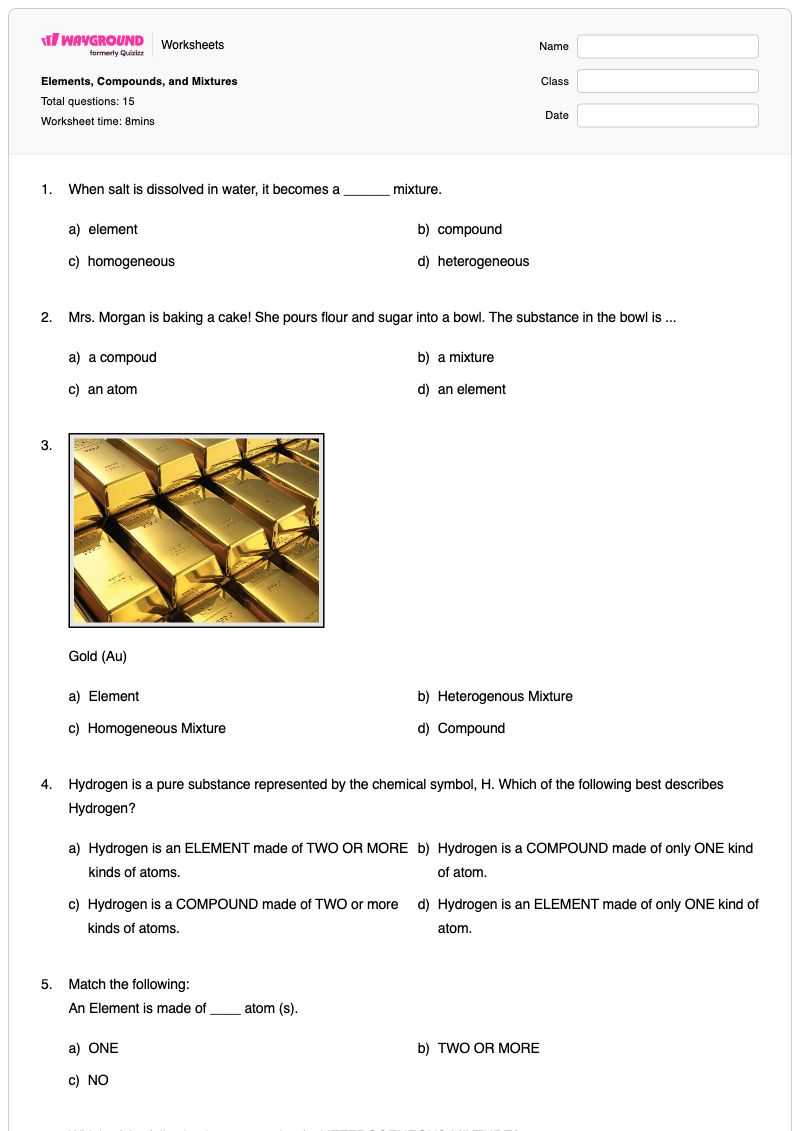

Elements, Compounds, and Mixtures is a Grade 8 science worksheet with 15 multiple-choice questions that builds classification skills around matter and pure substances. Students identify elements from chemical symbols and definitions, recognize compounds such as H₂S and NaCl, and distinguish homogeneous mixtures from heterogeneous mixtures using examples including salt water, vegetable soup, jelly beans, and soft drinks. The worksheet also checks understanding of atoms, matter, and chemical versus physical combination.
This free printable worksheet helps students apply particle and composition rules to familiar substances rather than relying only on memorized definitions. The repeated classification items provide practice comparing elements, compounds, and mixtures, while the matter questions reinforce which examples have mass and occupy space. It is designed for Grade 8 science instruction, review, or independent assessment and includes a complete answer key for efficient checking.
Worksheet settings
Font size
S
M
L
XL
Worksheets
Elements, Compounds, and Mixtures
Total questions: 15
Name
Class
Date
1.
When salt is dissolved in water, it becomes a ______ mixture.
a)
element
b)
compound
c)
homogeneous
d)
heterogeneous
2.
Mrs. Morgan is baking a cake! She pours flour and sugar into a bowl. The substance in the bowl is ...
a)
a compoud
b)
a mixture
c)
an atom
d)
an element
3.
Gold (Au)
a)
Element
b)
Heterogenous Mixture
c)
Homogeneous Mixture
d)
Compound
4.
Hydrogen is a pure substance represented by the chemical symbol, H. Which of the following best describes Hydrogen?
a)
Hydrogen is an ELEMENT made of TWO OR MORE kinds of atoms.
b)
Hydrogen is a COMPOUND made of only ONE kind of atom.
c)
Hydrogen is a COMPOUND made of TWO or more kinds of atoms.
d)
Hydrogen is an ELEMENT made of only ONE kind of atom.
5.
Match the following:
An Element is made of ____ atom (s).
a)
ONE
b)
TWO OR MORE
c)
NO
6.
Which of the following is an example of a HETEROGENEOUS MIXTURE?
a)
H2O (Water)
b)
Dr. Pepper
c)
vegetable soup
d)
Iron (Fe)
7.
Which of the following is a COMPOUND?
a)
Hydrogen Sulfide Gas (H2S)
b)
Solid Iron Metal (Fe)
c)
Salad
d)
Air
8.
When Carbon (C) and Hydrogen (H) combined to form the compound methane (CH4), what has occurred?
a)
Carbon (C) and Hydrogen combine CHEMICALLY.
b)
It is impossible for Carbon (C) and Hydrogen (H) to combine.
c)
Carbon (C) and Hydrogen (H) combine PHYSICALLY and can be separated by physical means.
9.
Air and Balloons are considered to be matter.
a)
True
b)
False
10.
Matter is anything that takes up space and has a mass. Locate the items that ARE NOT MATTER.
a)
Air
Rocks
Baby Powder
b)
Salt
Rotten Apples
Cells
c)
Bacteria
Dust
Milk
d)
Light
Love
Heat Energy
11.
Jelly Beans
a)
Element
b)
Compound
c)
Heterogenous Mixture
d)
Homogeneous Mixture
12.
Dr. Pepper
a)
Element
b)
Compound
c)
Homogeneous Mixture
d)
Heterogeneous Mixture
13.
NaCl (Sodium Chloride)
a)
Element
b)
Compound
c)
Homogeneous Mixture
d)
Heterogeneous Mixture
14.
A Compound is made of _________ atom(s).
a)
ONE
b)
TWO OR MORE
c)
NO
15.
A mixture is . . .
a)
CHEMICALLY COMBINED
b)
NOT CHEMICALLY COMBINED
Answer Key
Elements, Compounds, and Mixtures
Total questions: 15
1.
c)
homogeneous
2.
b)
a mixture
3.
a)
Element
4.
d)
Hydrogen is an ELEMENT made of only ONE kind of atom.
5.
a) ONE
6.
c)
vegetable soup
7.
a)
Hydrogen Sulfide Gas (H2S)
8.
a)
Carbon (C) and Hydrogen combine CHEMICALLY.
9.
a)
True
10.
d)
Light
Love
Heat Energy
11.
c)
Heterogenous Mixture
12.
c)
Homogeneous Mixture
13.
b)
Compound
14.
b)
TWO OR MORE
15.
a)
CHEMICALLY COMBINED
140 %
Browse by subjects
Browse by grades
Browse by format
FAQs
What does the Elements, Compounds, and Mixtures worksheet cover?
This Grade 8 science worksheet uses 15 multiple-choice questions to assess how students classify substances as elements, compounds, homogeneous mixtures, or heterogeneous mixtures. Students apply definitions involving one kind of atom or two or more kinds of atoms to examples such as gold, hydrogen, NaCl, H₂S, salt water, vegetable soup, jelly beans, and Dr. Pepper.
How can I use this worksheet to teach elements, compounds, and mixtures?
Introduce the classification rules first: an element contains one kind of atom, a compound contains two or more kinds of atoms chemically combined, and a mixture contains substances that are not chemically combined. Then have students explain the evidence behind selected multiple-choice answers, such as why gold and hydrogen are elements, why NaCl is a compound, and why salt water is homogeneous while vegetable soup is heterogeneous.
What mistakes should I watch for when students complete this worksheet?
Students may confuse a compound with a mixture because both can contain more than one substance or element; prompt them to focus on chemical combination and formulas such as H₂S and NaCl. They may also classify every visibly uniform example as a pure substance, so review why salt water and Dr. Pepper are homogeneous mixtures, while vegetable soup and jelly beans are heterogeneous mixtures. Check that they distinguish matter from nonmatter examples such as light, heat, and energy.
How do I assign and grade this Elements, Compounds, and Mixtures worksheet?
Wayground provides this worksheet as a printable PDF and as a digital quiz, and it includes a complete answer key for all 15 multiple-choice questions. Printable submissions can be graded by scanning student work with the Wayground for Teachers app, while the digital version supports online completion and grading.
How can I differentiate this worksheet for my students?
In the worksheet’s Advanced Settings, adjust font spacing and font size to make the 15 classification questions easier to scan. You can also apply a dyslexia-friendly font or translate the worksheet into another language, which can support students as they interpret terms such as element, compound, homogeneous mixture, and heterogeneous mixture.
Where can I find more worksheets like this on Wayground?
Wayground offers a broad collection of free printable worksheets and practice problems across subjects, with downloadable PDFs and answer keys to support essential skills and concepts. Browse more resources at https://wayground.com/en-us/worksheets.