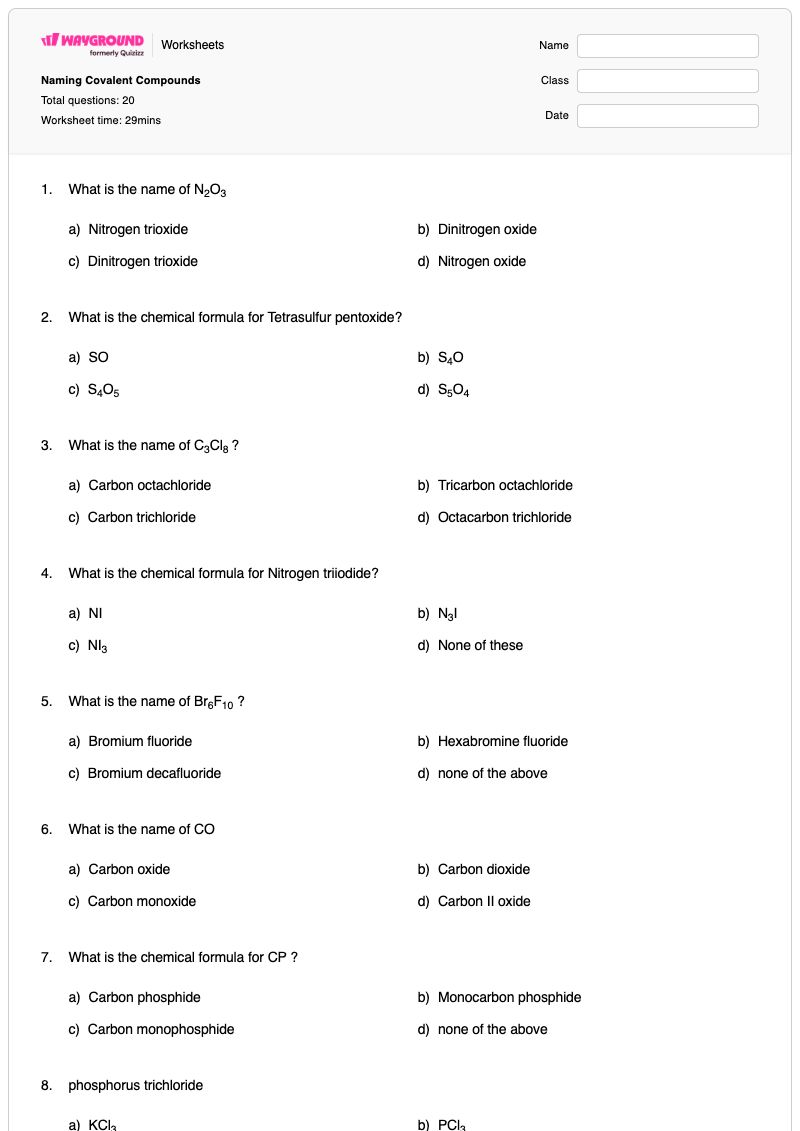
Naming Covalent Compounds is a free printable Grade 11 chemistry worksheet for practicing how to name covalent compounds from their chemical formulas and write formulas from compound names. The worksheet contains 20 multiple-choice questions featuring compounds such as dinitrogen trioxide, carbon monoxide, nitrogen triiodide, phosphorus trichloride, and chlorine dioxide. Students use prefixes—including mono-, di-, tri-, tetra-, hexa-, and hepta—to connect the number of atoms with the correct compound name or formula.
Because the questions alternate between naming formulas and selecting formulas from names, students practice both directions of this essential chemistry skill. The multiple-choice format also gives learners opportunities to distinguish correct element symbols, subscript placement, word order, and prefix selection from plausible distractors. This worksheet is useful for Grade 11 chemistry practice, independent review, or a quick formative check, and it includes a complete answer key for efficient feedback and grading.
Worksheet settings
Font size
S
M
L
XL
Worksheets
Naming Covalent Compounds
Total questions: 20
Name
Class
Date
1.
What is the name of N2O3
a)
Nitrogen trioxide
b)
Dinitrogen oxide
c)
Dinitrogen trioxide
d)
Nitrogen oxide
2.
What is the chemical formula for Tetrasulfur pentoxide?
a)
SO
b)
S4O
c)
S4O5
d)
S5O4
3.
What is the name of C3Cl8 ?
a)
Carbon octachloride
b)
Tricarbon octachloride
c)
Carbon trichloride
d)
Octacarbon trichloride
4.
What is the chemical formula for Nitrogen triiodide?
a)
NI
b)
N3I
c)
NI3
d)
None of these
5.
What is the name of Br6F10 ?
a)
Bromium fluoride
b)
Hexabromine fluoride
c)
Bromium decafluoride
d)
none of the above
6.
What is the name of CO
a)
Carbon oxide
b)
Carbon dioxide
c)
Carbon monoxide
d)
Carbon II oxide
7.
What is the chemical formula for CP ?
a)
Carbon phosphide
b)
Monocarbon phosphide
c)
Carbon monophosphide
d)
none of the above
8.
phosphorus trichloride
a)
KCl3
b)
PCl3
c)
K3Cl
d)
P3Cl
9.
The chemical formula of sulfur hexabromide is
a)
SBr₆
b)
S₆Br
c)
S(VI)Br
d)
S6Br
10.
The chemical formula of dinitrogen textroxide is
a)
Ni₂O₄
b)
NiO
c)
N₂O₄
d)
NiO₂
11.
The chemical formula of tetraphosphorus heptaoxide is
a)
F₄O₁₀
b)
P₄O7
c)
PO
d)
P₁₀O₄
12.
What's the formula for chlorine dioxide
a)
ClO2
b)
CLO
c)
ClO3
d)
HClO2
13.
What is the formula for Hexaboron Monosilicide
a)
B6Si
b)
BSi
c)
BSi6
d)
B6Si6
14.
What is the OFFICIAL name for H2O
a)
Hydrogen Oxide
b)
Oxygen Dinitride
c)
Agua
d)
Dihydrogen Monoxide
15.
BrO3
a)
bromine oxide
b)
monobromine trioxide
c)
bromine trioxide
d)
bromine (III) oxide
16.
What is the formula for Tricarbon Octahydride?
a)
Ca3O
b)
C2H8
c)
C3H8
d)
Ca3H8
17.
A binary covalent bond exists between
a)
2 metals
b)
1 metal and 1 nonmetal
c)
2 nonmetals
d)
Any 2 elements
18.
Which of the following is NOT an ionic compound:
a)
CaO
b)
NaOH
c)
BaCl2
d)
Br2
19.
Which following is a covalent compound?
a)
SO2
b)
K2O
c)
CaO
d)
BeO
20.
Which of the following is NOT an ionic compound:
a)
CaO
b)
NaOH
c)
BaCl2
d)
CH4
Answer Key
Naming Covalent Compounds
Total questions: 20
1.
c) Dinitrogen trioxide
2.
c) S4O5
3.
b) Tricarbon octachloride
4.
c) NI3
5.
d) none of the above
6.
c) Carbon monoxide
7.
c) Carbon monophosphide
8.
b) PCl3
9.
a) SBr₆
10.
c) N₂O₄
11.
b) P₄O7
12.
a) ClO2
13.
a) B6Si
14.
d) Dihydrogen Monoxide
15.
c) bromine trioxide
16.
c) C3H8
17.
c) 2 nonmetals
18.
d) Br2
19.
a) SO2
20.
d) CH4
140 %
Browse by subjects
Browse by grades
Browse by format
FAQs
What does the Naming Covalent Compounds worksheet cover?
This Grade 11 chemistry worksheet uses 20 multiple-choice questions to assess naming covalent compounds from formulas and writing formulas from names. Students apply prefixes such as di-, tri-, tetra-, hexa-, and hepta- to determine atom counts, as in identifying N₂O₃ as dinitrogen trioxide or selecting NI₃ for nitrogen triiodide.
How can I use this worksheet to teach naming covalent compounds?
Introduce the worksheet by modeling one naming item and one formula-writing item, emphasizing that students must translate between subscripts and covalent prefixes. Then have students explain why an option such as carbon monoxide matches CO before completing the remaining multiple-choice questions independently. Use the answer choices to discuss element order, subscript placement, and the meaning of prefixes.
What mistakes should I watch for when students complete this worksheet?
Watch for students who reverse the element order, omit a prefix, or choose the wrong subscript—for example, confusing N₂O₄ with a formula beginning with Ni. Students may also select carbon dioxide for CO or overlook the difference between a name and a formula when working through the two-direction multiple-choice items. Review how each prefix maps to the number of atoms and how the chemical symbols are written.
How do I assign and grade this worksheet?
You can assign Naming Covalent Compounds as a printable PDF or as a digital quiz on Wayground. It includes a complete answer key, and printable submissions can be graded by scanning student work with the Wayground for Teachers app. The printable option can also support schools that want to reduce screen time.
How can I differentiate this covalent-compounds worksheet for my students?
Use the worksheet’s Advanced Settings to adjust font spacing and font size for the 20 multiple-choice items, or enable a dyslexia-friendly font to make the chemical names and answer choices easier to read. You can also translate the worksheet into another language while keeping the naming-and-formula practice format.
Where can I find more worksheets like this on Wayground?
Wayground offers a comprehensive collection of free printable worksheets and practice problems across subjects, with downloadable PDFs and answer keys to help students master essential skills and concepts. Browse more resources at https://wayground.com/en-us/worksheets.


 Worksheets