

Wayground
Circle of Control Quiz - Printable Social studies Worksheets - Wayground

Circle of Control Quiz

Erick Heaney

Created by Erick Heaney

9 questions

Social studies

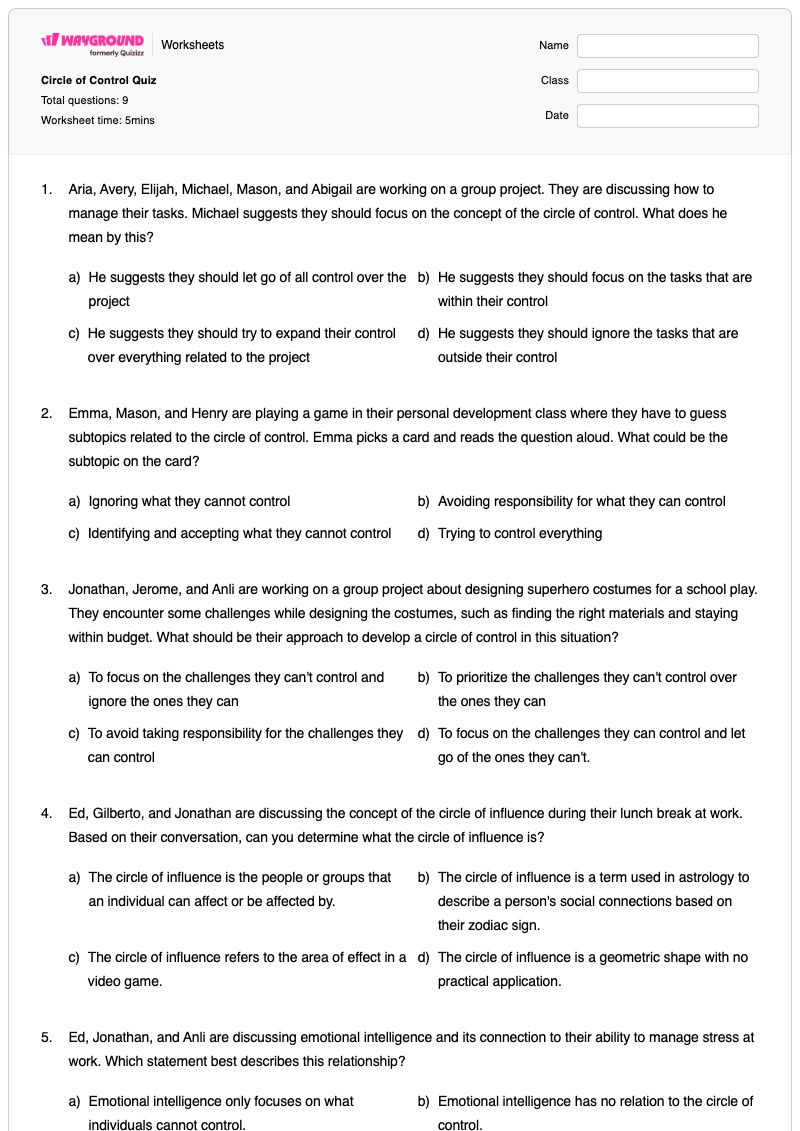
Circle of Control Quiz helps university learners apply the distinction between what they can control, what they can influence, and what falls within their broader concerns. The nine-question assessment connects these ideas to group projects, workplace situations, stress management, emotional intelligence, and professional relationships. Students identify the meaning of the circle of control, recognize how the circle of influence works, and select emotional-intelligence skills that support effective teamwork. The worksheet includes seven multiple-choice questions, one multiple-select question, and one drag-and-drop image item that asks students to label the circles Control, Influence, and Concern. These varied formats check both conceptual understanding and the ability to apply the framework to realistic academic and professional scenarios. It is a free printable worksheet with an answer key, suitable for personal development, emotional intelligence, advisory, or workplace-readiness instruction.

Worksheet settings

Font size

S
M
L
XL
WaygroundWorksheets

Circle of Control Quiz

Total questions: 9

Name
Class
Date
1.

Aria, Avery, Elijah, Michael, Mason, and Abigail are working on a group project. They are discussing how to manage their tasks. Michael suggests they should focus on the concept of the circle of control. What does he mean by this?

a)

He suggests they should let go of all control over the project

b)

He suggests they should focus on the tasks that are within their control

c)

He suggests they should try to expand their control over everything related to the project

d)

He suggests they should ignore the tasks that are outside their control

2.

Emma, Mason, and Henry are playing a game in their personal development class where they have to guess subtopics related to the circle of control. Emma picks a card and reads the question aloud. What could be the subtopic on the card?

a)

Ignoring what they cannot control

b)

Avoiding responsibility for what they can control

c)

Identifying and accepting what they cannot control

d)

Trying to control everything

3.

Jonathan, Jerome, and Anli are working on a group project about designing superhero costumes for a school play. They encounter some challenges while designing the costumes, such as finding the right materials and staying within budget. What should be their approach to develop a circle of control in this situation?

a)

To focus on the challenges they can't control and ignore the ones they can

b)

To prioritize the challenges they can't control over the ones they can

c)

To avoid taking responsibility for the challenges they can control

d)

To focus on the challenges they can control and let go of the ones they can't.

4.

Ed, Gilberto, and Jonathan are discussing the concept of the circle of influence during their lunch break at work. Based on their conversation, can you determine what the circle of influence is?

a)

The circle of influence is the people or groups that an individual can affect or be affected by.

b)

The circle of influence is a term used in astrology to describe a person's social connections based on their zodiac sign.

c)

The circle of influence refers to the area of effect in a video game.

d)

The circle of influence is a geometric shape with no practical application.

5.

Ed, Jonathan, and Anli are discussing emotional intelligence and its connection to their ability to manage stress at work. Which statement best describes this relationship?

a)

Emotional intelligence only focuses on what individuals cannot control.

b)

Emotional intelligence has no relation to the circle of control.

c)

Emotional intelligence helps individuals focus on what they can control and let go of what they cannot control.

d)

Emotional intelligence helps individuals control everything in their lives.

6.

Ed, Jonathan, Jerome, and Preston are working on a group project, and Ed is feeling overwhelmed with his workload. He wants to manage his stress better. How can developing a circle of control help him in managing stress in a real-world scenario like preparing for a presentation at work?

a)

By focusing on things that are within his control and letting go of things that are beyond his control.

b)

By trying to control everything and everyone around him, including Jonathan, Jerome, and Preston.

c)

By avoiding any situation that causes stress, even if it means not contributing to the group project.

d)

By obsessing over things that are beyond his control, like how Jonathan, Jerome, and Preston are handling their tasks.

7.

Anli, Ed, and Jonathan are discussing the benefits of having a circle of influence in their professional lives as they work on a group project. Can you help them identify the advantages they might experience from having a circle of influence in this real-world scenario?

a)

Support, guidance, networking opportunities, access to resources, and the ability to make a positive impact on others.

b)

Negative impact on others, limited networking, lack of resources

c)

Isolation, lack of guidance, missed opportunities

d)

Increased stress, limited resources, lack of support

8.

Jonathan, Jerome, and Gilberto are working together on a team project at their workplace. To succeed, they need to understand each other's strengths and weaknesses. According to the concept of emotional intelligence, what skills should they be aware of?

a)

Self-Awareness

b)

Self-Management

c)

Social Awareness

d)

Relationship Management

9.

Label each circle

WaygroundAnswer Key

Circle of Control Quiz

Total questions: 9

1.
b)

He suggests they should focus on the tasks that are within their control

2.
c)

Identifying and accepting what they cannot control

3.
d)

To focus on the challenges they can control and let go of the ones they can't.

4.
a)

The circle of influence is the people or groups that an individual can affect or be affected by.

5.
c)

Emotional intelligence helps individuals focus on what they can control and let go of what they cannot control.

6.
a)

By focusing on things that are within his control and letting go of things that are beyond his control.

7.
a)

Support, guidance, networking opportunities, access to resources, and the ability to make a positive impact on others.

8.
a)

Self-Awareness

, b)

Self-Management

, c)

Social Awareness

, d)

Relationship Management

9.

FAQs

What does the Circle of Control Quiz help students learn?

This nine-question worksheet teaches students to distinguish between the circle of control, the circle of influence, and the circle of concern. Its multiple-choice and multiple-select scenarios ask learners to apply the framework to group projects, workplace stress, emotional intelligence, and professional relationships, while the drag-and-drop item reinforces the three circle labels.

How can I use this worksheet to teach the circle of control?

Introduce the framework by asking students to sort a familiar group-project challenge into what they can control, influence, or only be concerned about. Then have them complete the worksheet’s workplace and project-based multiple-choice scenarios, using their responses to discuss why focusing on controllable actions can support stress management without ignoring responsibility.

What mistakes should I watch for when students complete this quiz?

Students may confuse the circle of control with the circle of influence, especially when deciding whether they can directly manage a person or outcome. Watch for learners who select only some emotional-intelligence skills on the multiple-select item instead of recognizing self-awareness, self-management, social awareness, and relationship management, or who mislabel the three circles in the drag-and-drop question.

How do I assign and grade the Circle of Control Quiz?

The worksheet is available as a printable PDF and as a digital quiz on Wayground, and it includes a complete answer key for the multiple-choice, multiple-select, and circle-labeling items. You can grade printable submissions by scanning student work with the Wayground for Teachers app.

How can I differentiate this worksheet for my students?

In the worksheet’s Advanced Settings, adjust font spacing and font size to make the scenario-based questions and circle-labeling item easier to read. You can also enable a dyslexia-friendly font or translate the worksheet into another language when those options support access to the Circle of Control content.

Where can I find more worksheets like this on Wayground?

Wayground offers a comprehensive collection of free printable worksheets and practice problems across subjects, with downloadable PDFs and answer keys to help students master essential skills and concepts. Browse more resources at https://wayground.com/en-us/worksheets.