

WorksheetsCFE Review: Law of Conservation of Mass and Energy
Total questions: 20
Answer Key
Created by Veronica Renuart
20 questions
8th Grade
Science
Updated Sept 2026
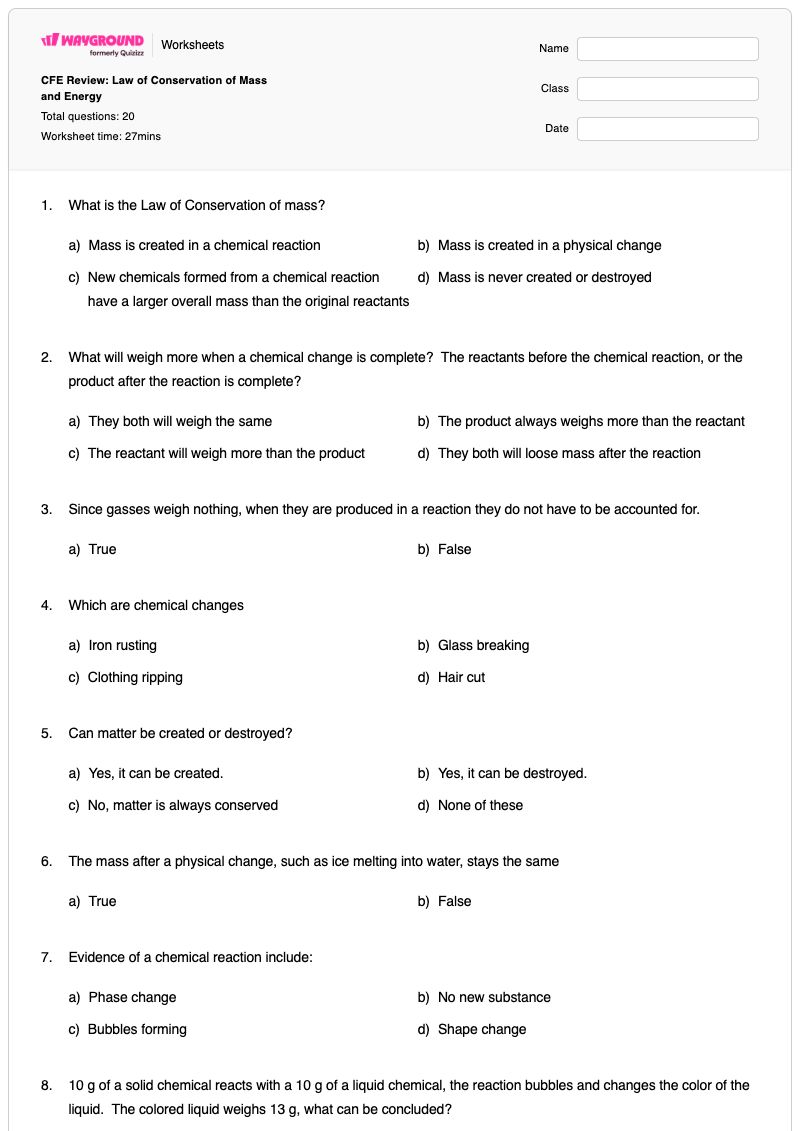
CFE Review: Law of Conservation of Mass and Energy is a free printable Grade 8 physics worksheet with 20 multiple-choice questions and a complete answer key. It reviews the law that mass and matter are not created or destroyed, including conservation during chemical reactions and physical changes, the need to account for gases, and evidence that a chemical reaction has occurred. Students also use given masses to reason about gas produced during a reaction. The worksheet then connects conservation to energy. Students identify that energy cannot be created or destroyed, recognize chemical-to-kinetic and chemical-to-heat-to-electrical transformations, classify running as kinetic energy, and identify mechanical and electrical energy in a wind turbine. Questions about where potential and kinetic energy are highest reinforce how energy changes with motion and position. This review format is suited to Grade 8 science instruction, independent practice, or assessment after teaching work and energy.
Worksheet settings
Font size
Worksheets
Answer KeyThis Grade 8 worksheet uses 20 multiple-choice questions to assess conservation of mass in physical and chemical changes, including accounting for gases and interpreting mass data from a reaction. It also asks students to apply conservation of energy by identifying energy transformations, distinguishing potential from kinetic energy, and recognizing the energy forms associated with a wind turbine.
Use the mass questions to have students compare reactants and products, then discuss why gas produced in a bubbling reaction must be included in the total mass. Follow with the energy questions by asking students to trace transformations such as chemical energy to kinetic energy in animals and chemical energy to heat to electrical energy in a power plant. Students can explain their choice for each multiple-choice item before completing the review independently.
Students may incorrectly treat gases as weightless, assume a chemical reaction destroys mass, or confuse a physical change such as melting with a chemical change such as rusting. They may also reverse energy transformations, select potential energy for running instead of kinetic energy, or overlook that the gas in the reaction-mass problem accounts for the difference between the starting and final masses.
The worksheet is available as a printable PDF and as a digital quiz on Wayground, so you can assign the 20 multiple-choice questions in the format that fits your class. It includes a complete answer key, and printable submissions can be graded by scanning student work with the Wayground for Teachers app. The printable option can also support schools that are reducing screen time.
Several multiple-choice items require students to match real examples with the correct energy pathway, including animals eating food and burning coal at a power plant. Other items ask students to classify running as kinetic energy and identify the mechanical and electrical energy associated with a wind turbine, helping them apply conservation of energy to familiar systems.
Wayground offers a comprehensive collection of free printable worksheets and practice problems across all subjects, with downloadable PDFs and answer keys to help students master essential skills and concepts. Browse more resources at https://wayground.com/en-us/worksheets.