
WorksheetsConservation of Energy- Physics
Total questions: 25
Answer KeyConservation of Energy- Physics
Total questions: 25
14 J
6 J
500,000 J
0 J
250,000 J

Created by Tynisha Wilson
25 questions
10th - 12th Grade
Science
Updated Apr 2026
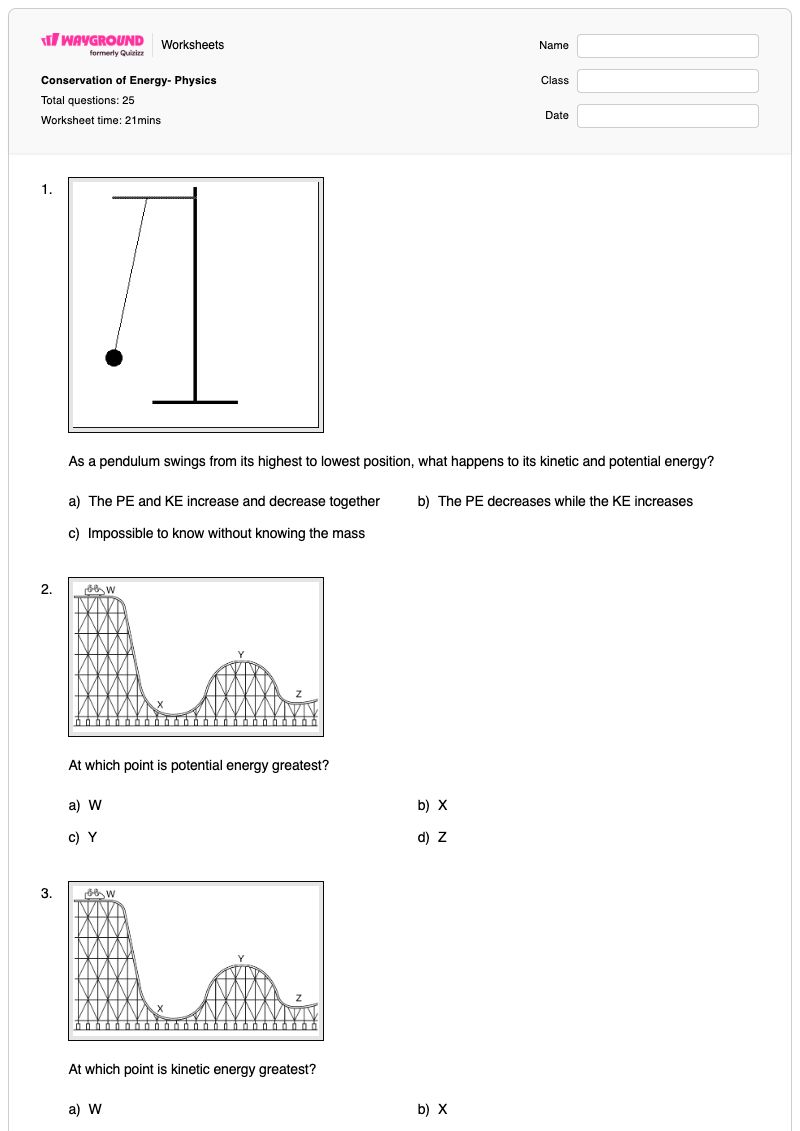
Conservation of Energy- Physics is a Grade 10–12 physics worksheet with 25 multiple-choice questions on how potential energy, kinetic energy, and total mechanical energy change within a system. Students interpret energy changes in pendulums and roller coasters, identify where potential or kinetic energy is greatest, recognize energy transformations, and determine which quantities remain constant. The worksheet also reinforces essential calculation and notation skills. Students find kinetic energy from total mechanical and potential energy, calculate velocity in a falling-crate problem, identify the correct units for joules, velocity, and gravitational acceleration, and connect variables to their physical meanings. This free printable worksheet is suitable for physics review, guided practice, or an assessment for Grades 10–12, and it includes a complete answer key for efficient checking.
Worksheet settings
Font size
Worksheets
Answer Key14 J
6 J
500,000 J
0 J
250,000 J
This Grade 10–12 Physics worksheet uses 25 multiple-choice questions to practice conservation of mechanical energy. Students compare potential and kinetic energy in pendulum and roller-coaster situations, identify energy transformations, use total mechanical energy to find a missing value, and apply correct units and variables in energy and velocity calculations.
Introduce potential energy, kinetic energy, and total mechanical energy with a pendulum or roller-coaster diagram, asking students to predict where each form is greatest. Then have students complete the multiple-choice items and explain why energy shifts as an object moves while total energy remains constant. Finish by modeling the falling-crate velocity problem and the calculation that finds kinetic energy from total mechanical and potential energy.
Watch for students reversing the relationship between potential and kinetic energy as a pendulum moves downward or as a roller coaster reaches its low point. They may also confuse joules with meters per second, select m/s² for velocity instead of gravitational acceleration, or subtract the wrong quantity when finding kinetic energy from total mechanical energy and potential energy. Some students may choose a numerical distractor with energy units for the falling-crate velocity answer.
The worksheet is available as a printable PDF and as a digital quiz on Wayground, with a complete answer key for all 25 multiple-choice questions. You can grade printable submissions by scanning student work with the Wayground for Teachers app. The printable version also supports schools that want to reduce screen time while students practice energy calculations and interpretations.
Use the worksheet’s Advanced Settings to adjust font spacing or font size so the 25 multiple-choice items, energy diagrams, and calculation prompts are easier to read. You can also apply a dyslexia-friendly font or translate the worksheet into another language when appropriate. These options preserve the worksheet’s focus on potential energy, kinetic energy, units, and conservation relationships.
Wayground offers a comprehensive collection of free printable worksheets and practice problems across all subjects, with downloadable PDFs and answer keys to help students master essential skills and concepts. Browse more resources at https://wayground.com/en-us/worksheets.