
Wayground
Curved Mirror Ray Diagrams - Printable Science Worksheets 10th - 11th Grade - Wayground

Curved Mirror Ray Diagrams

Palak Coleman

Created by Palak Coleman

20 questions

10th - 11th Grade

Science

Updated Oct 2026

Curved Mirror Ray Diagrams is a Grade 10–11 physics worksheet that develops students’ ability to interpret concave and convex mirror ray diagrams and connect ray behavior to image properties. Across 20 questions—17 multiple choice and 3 multiple select—students identify focal points, centers of curvature, real and virtual images, upright and inverted images, and the effect of object position, including an object beyond C (2F). The worksheet also asks students to apply these ideas to familiar uses, such as convex side-view and supermarket mirrors and concave dental mirrors. Students analyze how rays behave when they pass through or appear to originate from the focal point, including recognizing that a ray passing through F reflects parallel to the principal axis. This free printable worksheet includes a complete answer key for checking understanding and reinforcing curved-mirror vocabulary and image formation.

Worksheet settings

Font size

S
M
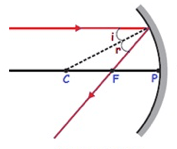
L
XL
WaygroundWorksheets

Curved Mirror Ray Diagrams

Total questions: 20

Name
Class
Date
1.

An image behind the mirror is...

a)

virtual

b)

real

c)

inverted

d)

upright

2.

An image that points below the principal axis is (choose 2)...

a)

virtual

b)

real

c)

upright

d)

inverted

3.

If the object is beyond C (2F)...

a)

image is real, smaller and inverted

b)

image is real, smaller and upright

c)

image is virtual, smaller and inverted

d)

image is real, bigger and upright

4.
This ray diagram is for which mirror?

This ray diagram is for which mirror?

a)

concave

b)

convex

c)

plane

d)

window

5.
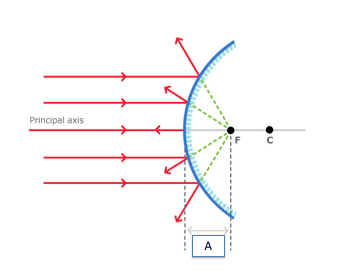
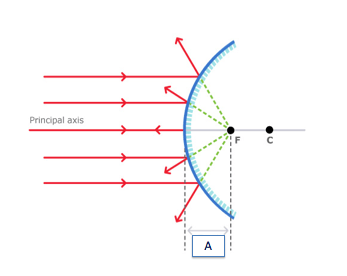
In the image, all the rays meet at F, What is F

In the image, all the rays meet at F, What is F

a)

focal length

b)

focal point

c)

center of curvature

d)

reflection

6.
This image is showing a convex mirror because the image is (choose 2 answers)

This image is showing a convex mirror because the image is (choose 2 answers)

a)

real light rays meet behind the mirror

b)

real light rays don't meet

c)

the focal point is in front of the mirror

d)

the focal point is behind the mirror

7.

This type of mirror is used in supermarkets to see around bends

a)

concave

b)

convex

c)

plane

d)

window

8.
Convex Mirrors produce...
a)
only virtual images
b)
virtual or real images
c)
only real images
d)
inverted images
9.

Real images are :

a)

Always inverted

b)

can be larger or smaller than the object

c)

can be obtained on screen

d)

all the above

10.

A dentist uses a small dental mirror to help magnify teeth in your mouth. What type of mirror is this?

a)

a convex mirror

b)

a concave mirror

c)

a convex lens

d)

a concave lens

11.

The side view mirrors on your car help shrink the image on both sides of the car, allowing you to see a larger field of view. What type of mirror is this?

a)

a convex mirror

b)

a concave mirror

c)

a convex lens

d)

a concave lens

12.

An image that forms when light rays actually meet

a)

virtual image

b)

real image

c)

diffuse reflection

d)

regular reflection

13.
The point in the middle way between a curved mirror and the center of curvature is the
a)
principle point
b)
focal point
c)
center of curvature
d)
principle axis
14.
In a concave mirror, if an incident ray passes through F and hits the mirror then it will reflect
a)
Towards C
b)
Towards F
c)
Parallel
d)
Away from the mirror
15.

Virtual images are

a)

always upright

b)

can be obtained on screen

c)

always smaller

16.
Concave mirrors can create virtual and real images.
a)
True
b)
False
17.
Convex mirrors can create real images.
a)
True
b)
False
18.
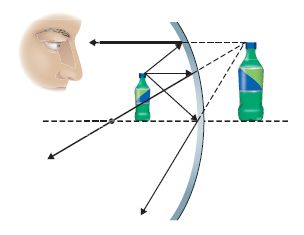
Which terms describe the reflection seen in this image?
a)
virtual, upright
b)
virtual, inverted
c)
real, upright
d)
real, inverted
19.

If the object is between C and f, the image is ...

a)

image is real, smaller, and inverted

b)

image is real, smaller, and upright

c)

image is virtual, smaller, and inverted

d)

image is real, bigger, and inverted

20.

If the object is between f and the mirror, the image is ...

a)

image is real, smaller, and inverted

b)

image is virtual, larger, and upright

c)

image is virtual, smaller, and inverted

d)

image is real, bigger, and inverted

WaygroundAnswer Key

Curved Mirror Ray Diagrams

Total questions: 20

1.
a)

virtual

, d)

upright

2.
b)

real

, d)

inverted

3.
a)

image is real, smaller and inverted

4.
a)

concave

5.
b)

focal point

6.
d)

the focal point is behind the mirror

, b)

real light rays don't meet

7.
b)

convex

8.
a) only virtual images
9.
d)

all the above

10.
b)

a concave mirror

11.
a)

a convex mirror

12.
b)

real image

13.
b) focal point
14.
c) Parallel
15.
a)

always upright

16.
a) True
17.
b) False
18.
a) virtual, upright
19.
d)

image is real, bigger, and inverted

20.
b)

image is virtual, larger, and upright

FAQs

What does the Curved Mirror Ray Diagrams worksheet cover?

This worksheet builds skill in interpreting concave and convex mirror ray diagrams and determining whether images are real or virtual, upright or inverted, and larger or smaller. Its 17 multiple-choice and 3 multiple-select questions also ask students to identify the focal point, center of curvature, and principal-axis ray behavior, including the image formed when an object is beyond C (2F).

How can I use this worksheet to teach curved-mirror ray diagrams?

Introduce the principal axis, focal point F, and center of curvature C before students complete the questions, then model one ray diagram for each mirror type. Have students explain why rays that actually meet form a real image, why convex-mirror rays do not meet in front of the mirror, and how those ideas connect to the worksheet’s dental-mirror, side-view-mirror, and supermarket examples.

What mistakes should I watch for when students complete this curved-mirror worksheet?

Watch for students confusing the focal point with the center of curvature, or choosing image orientation without checking whether the image is above or below the principal axis. Students may also select both real and virtual for the same image, overlook that convex mirrors produce only virtual images, or miss that a concave-mirror ray passing through F reflects parallel to the principal axis.

How do I assign and grade the Curved Mirror Ray Diagrams worksheet?

Wayground provides this worksheet as a printable PDF and as a digital quiz, and it includes a complete answer key for all 20 multiple-choice and multiple-select questions. For printable submissions, you can scan student work with the Wayground for Teachers app to grade responses efficiently.

How can I differentiate this curved-mirror ray-diagram worksheet for my students?

In Advanced Settings, adjust font spacing and font size to make the ray-diagram questions and answer choices easier to read, or select a dyslexia-friendly font. You can also translate the worksheet into another language while keeping its concave- and convex-mirror question format.

Where can I find more worksheets like this on Wayground?

Wayground offers a comprehensive collection of free printable worksheets and practice problems across subjects, with downloadable PDFs and answer keys to help students master essential skills and concepts. Browse more resources at https://wayground.com/en-us/worksheets.