Reflection and Mirrors is a free printable Grade 6 science worksheet with 15 multiple-choice questions on how light behaves with different surfaces and mirrors. Students distinguish diffuse reflection from regular reflection, identify plane, concave, and convex mirrors, and recognize the focal point, real images, and virtual images. Several questions ask students to interpret mirror diagrams and determine whether a focal point is in front of or behind the mirror.
This worksheet helps students connect mirror shape and light-ray behavior to observable image properties. They apply vocabulary to situations involving car side mirrors, department-store mirrors, magnified images, and mirrors that can produce real or virtual images. Use it for independent practice, review, or a quick formative assessment after instruction on reflection and mirrors. The worksheet is available as a free printable PDF and includes a complete answer key for efficient checking.
Worksheet settings
Font size
S
M
L
XL
Worksheets
Reflection and Mirrors
Total questions: 15
Name
Class
Date
1.
___________________________ occurs when light hits an irregular surface.
a)
diffuse reflection
b)
regular reflection
c)
no reflection
2.
___________________________ occurs when light hits a smooth surface.
a)
diffuse reflection
b)
regular reflection
c)
no reflection
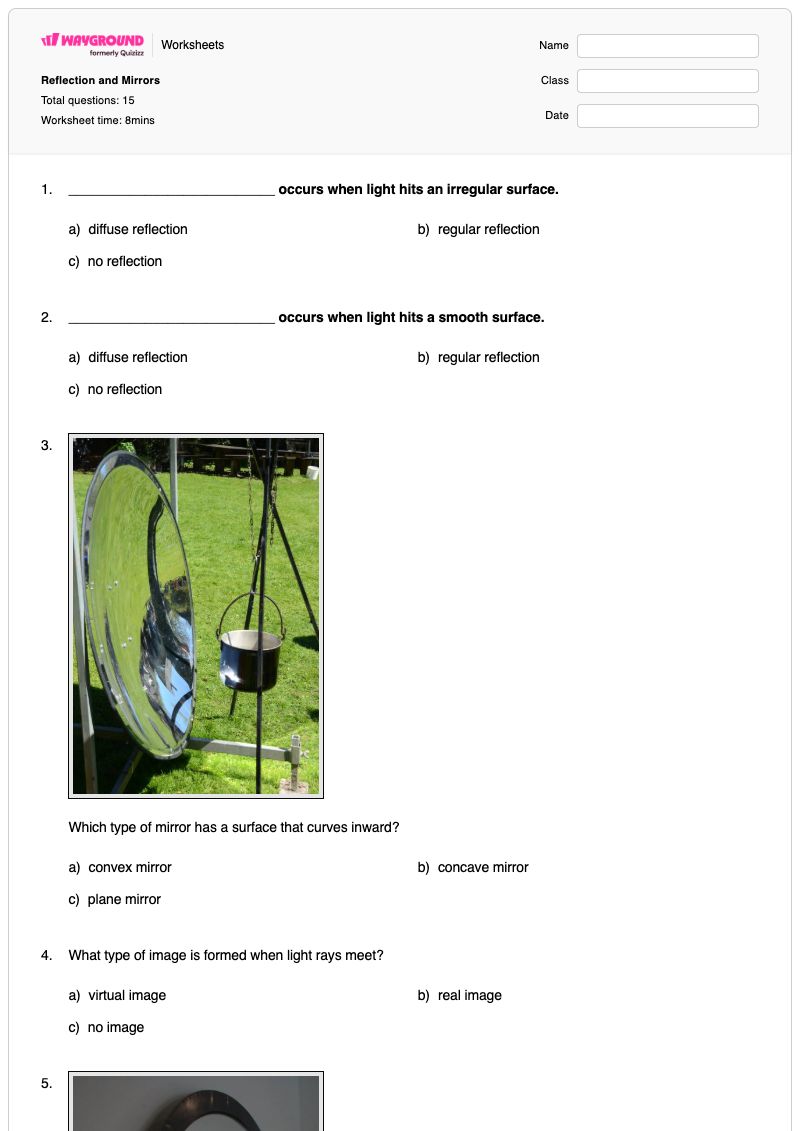
3.
Which type of mirror has a surface that curves inward?
a)
convex mirror
b)
concave mirror
c)
plane mirror
4.
What type of image is formed when light rays meet?
a)
virtual image
b)
real image
c)
no image
5.
Which type of mirror has a surface that curves outward?
a)
convex mirror
b)
concave mirror
c)
plane mirror
6.
The point at which rays parallel to the optical axis meet is called the ____________________________.
a)
focal point
b)
virtual point
c)
real point
d)
optic point
7.
T or F? An image produced that is right side up is known as a virtual image.
a)
True
b)
False
8.
What do you call a flat mirror?
a)
plane mirror
b)
convex mirror
c)
concave mirror
9.
Which type of mirror is shown by picture A?
a)
concave mirror
b)
convex mirror
c)
plane mirror
10.
Which type of mirror is shown in picture B?
a)
concave mirror
b)
convex mirror
c)
plane mirror
11.
Where is the focal point of mirror A?
a)
in front of the mirror
b)
on the side of the mirror
c)
behind the mirror
d)
there isn't a focal point
12.
Where is the focal point of Mirror B?
a)
behind the mirror
b)
in front of the mirror
c)
on the side of the mirror
d)
there isn't a focal point
13.
A _____ mirror can produce both a virtual and a real image.
a)
plane
b)
concave
c)
convex
d)
regular
14.
This type of mirror is often found on the side mirrors of cars and in department stores inorder to see a large area.
a)
concave mirror
b)
convex mirror
c)
plane mirror
15.
This type of mirror can produce a magnified image.
a)
Concave Mirror
b)
Convex Mirror
c)
Plane Mirror
Answer Key
Reflection and Mirrors
Total questions: 15
1.
a)
diffuse reflection
2.
b)
regular reflection
3.
b)
concave mirror
4.
b)
real image
5.
a)
convex mirror
6.
a)
focal point
7.
a)
True
8.
a)
plane mirror
9.
a)
concave mirror
10.
b)
convex mirror
11.
a)
in front of the mirror
12.
a)
behind the mirror
13.
b)
concave
14.
b)
convex mirror
15.
a)
Concave Mirror
140 %
Browse by subjects
Browse by grades
Browse by format
FAQs
What does the Reflection and Mirrors worksheet cover?
This Grade 6 science worksheet uses 15 multiple-choice questions to assess reflection and mirror concepts. Students distinguish diffuse and regular reflection, identify plane, concave, and convex mirrors, locate focal points in front of or behind mirrors, and connect mirror types with real, virtual, and magnified images.
How can I use this worksheet to teach reflection and mirrors?
Introduce the worksheet after modeling how light behaves on irregular and smooth surfaces and how concave, convex, and plane mirrors differ. Have students explain their choices for the diagram items identifying mirrors A and B, then use the focal-point and image questions to discuss how mirror shape affects the light rays and images produced.
What mistakes should I watch for when students complete this mirror worksheet?
Watch for students reversing diffuse and regular reflection, or confusing a mirror’s curved direction: concave curves inward, while convex curves outward. Students may also place the focal point on the wrong side of the mirror diagrams, confuse real and virtual images, or select convex instead of concave for magnified images and mirrors that can produce both real and virtual images.
How do I assign and grade the Reflection and Mirrors worksheet?
You can assign this worksheet as a printable PDF or as a digital quiz on Wayground. It includes a complete answer key, and printable submissions can be graded by scanning student work with the Wayground for Teachers app. The printable format can also support schools that are reducing screen time.
How can I differentiate this Reflection and Mirrors worksheet for my students?
Use the worksheet’s Advanced Settings to adjust font spacing and font size so the 15 multiple-choice items and mirror-diagram questions are easier to read. You can also enable a dyslexia-friendly font or translate the worksheet into another language while keeping the reflection and mirror practice intact.
Where can I find more worksheets like this on Wayground?
Wayground offers a comprehensive collection of free printable worksheets and practice problems across all subjects, including downloadable PDFs and answer keys to help students master essential skills and concepts. Browse more resources at https://wayground.com/en-us/worksheets.


 Worksheets


