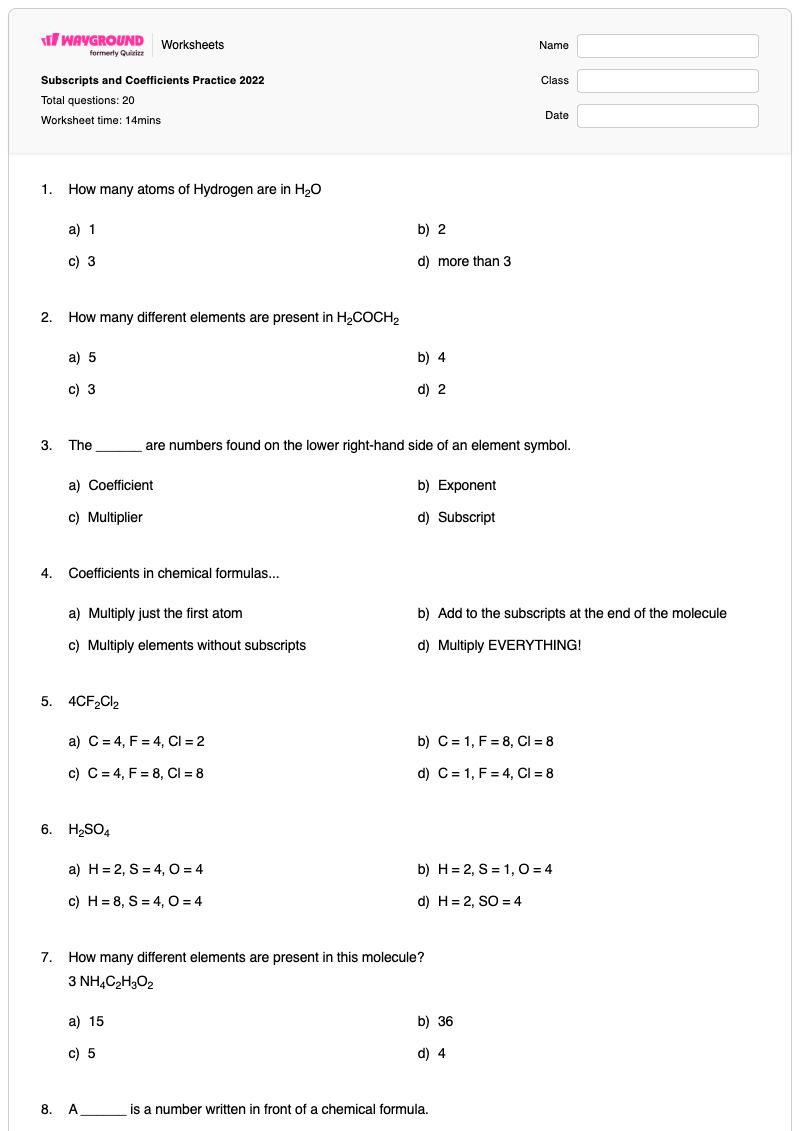

Subscripts and Coefficients Practice 2022 is a Grade 7 science worksheet focused on reading chemical formulas. Students identify subscripts and coefficients, determine how many atoms of each element a formula represents, count different elements and total atoms, and distinguish compounds from elements. Examples include H₂O, H₂SO₄, 4H₂O, 6NaCl, and other formulas with coefficients and subscripts.
The worksheet contains 20 questions: 18 multiple-choice items, one fill-in-the-blank question, and one multiple-select question. It helps students apply the rule that an omitted subscript represents one atom and that a coefficient multiplies every atom in the formula, while also recognizing molecules and identifying products in a simple chemical equation. This free printable worksheet includes a complete answer key for efficient review, independent practice, or assessment.
Worksheet settings
Font size
S
M
L
XL
Worksheets
Subscripts and Coefficients Practice 2022
Total questions: 20
Name
Class
Date
1.
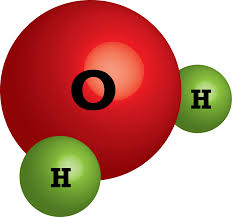
How many atoms of Hydrogen are in H2O
a)
1
b)
2
c)
3
d)
more than 3
2.
How many different elements are present in H2COCH2
a)
5
b)
4
c)
3
d)
2
3.
The ______ are numbers found on the lower right-hand side of an element symbol.
a)
Coefficient
b)
Exponent
c)
Multiplier
d)
Subscript
4.
Coefficients in chemical formulas...
a)
Multiply just the first atom
b)
Add to the subscripts at the end of the molecule
c)
Multiply elements without subscripts
d)
Multiply EVERYTHING!
5.
4CF2Cl2
a)
C = 4, F = 4, Cl = 2
b)
C = 1, F = 8, Cl = 8
c)
C = 4, F = 8, Cl = 8
d)
C = 1, F = 4, Cl = 8
6.
H2SO4
a)
H = 2, S = 4, O = 4
b)
H = 2, S = 1, O = 4
c)
H = 8, S = 4, O = 4
d)
H = 2, SO = 4
7.
How many different elements are present in this molecule?
3 NH4C2H3O2
a)
15
b)
36
c)
5
d)
4
8.
A ______ is a number written in front of a chemical formula.
a)
Coefficient
b)
Subscript
c)
Exponent
d)
Coordinator
9.
How many Hydrogen atoms are in 4H2O?
a)
6
b)
8
c)
2
d)
4
10.
How many Sodium atoms are in 6NaCl?
a)
1
b)
12
c)
6
11.
How many atoms are present if there is no subscript following the element symbol?
a)
0
b)
2
c)
only 1
d)
1 million
12.
Coefficients tell the number of __________ in a formula.
a)
Molecules
b)
Atoms
c)
Elements
d)
Oxygen
13.
In the equation shown, what are the product(s)?
a)
N2 + H2
b)
NH3
14.
CaCO3
What is the TOTAL number of atoms that make up this compound?
(a)
15.
Examples are water (H2O) and carbon dioxide (CO2).
a)
elements
b)
compounds
16.
What does the number 4 represent in 4NH3?
a)
Subscript
b)
Superscript
c)
Coefficient
17.
The blue atoms are called
a)
metals
b)
nonmetals
c)
metalloids
d)
noble gases
18.
How many atoms of Hydrogen are in this compound?
a)
1
b)
2
c)
3
d)
4
19.
We breathe oxygen. Its chemical formula is O2. Is this formula an element or a compound?
a)
element
b)
compound
c)
neither
d)
both
20.
The red numbers in the image below represent ________
a)
subscripts
b)
coefficients
c)
I don't know, and don't want to try
d)
None of the answers are correct
Answer Key
Subscripts and Coefficients Practice 2022
Total questions: 20
1.
b)
2
2.
c)
3
3.
d)
Subscript
4.
d)
Multiply EVERYTHING!
5.
c)
C = 4, F = 8, Cl = 8
6.
b)
H = 2, S = 1, O = 4
7.
d)
4
8.
a)
Coefficient
9.
b)
8
10.
c)
6
11.
c)
only 1
12.
a)
Molecules
13.
b)
NH3
14.
5
15.
b)
compounds
16.
c)
Coefficient
17.
a) metals
18.
b)
2
19.
a)
element
20.
b) coefficients
140 %
Browse by subjects
Browse by grades
Browse by format
FAQs
What does the Subscripts and Coefficients Practice 2022 worksheet cover?
This Grade 7 science worksheet uses 18 multiple-choice questions, one fill-in-the-blank item, and one multiple-select item to assess how students interpret subscripts and coefficients in chemical formulas. Students count atoms and different elements in formulas such as H₂O, H₂SO₄, 4H₂O, and 6NaCl, calculate total atoms, identify compounds, and recognize the product in a simple equation.
How can I use this worksheet to teach students to read subscripts and coefficients?
Introduce the worksheet by modeling a formula such as H₂O: explain that the subscript applies to the element immediately before it, while a missing subscript means one atom. Then model how a coefficient, as in 4H₂O, multiplies every atom in the formula before students complete the counting questions and explain how they reached each answer. Use the formula-counting items as guided practice before assigning the compound and product-identification questions independently.
What mistakes should I watch for when students complete this chemical formulas worksheet?
Students may count a coefficient as applying only to the first element, overlook that an element without a subscript represents one atom, or confuse the number of different elements with the total number of atoms. Watch especially for errors in formulas such as 4CF₂Cl₂ and 3NH₄C₂H₃O₂, where students must apply the coefficient to every element and combine the resulting atom counts.
How do I assign and grade this subscripts and coefficients worksheet?
The worksheet is available as a printable PDF and as a digital quiz on Wayground, and it includes a complete answer key for checking the 20 responses. For printable submissions, you can scan student work with the Wayground for Teachers app to support grading and review.
How can I differentiate this chemical formula counting worksheet for my students?
In the worksheet’s Advanced Settings, adjust font spacing or font size to make the chemical formulas and answer choices easier to read, and enable a dyslexia-friendly font when helpful. You can also translate the worksheet into another language while keeping the subscripts, coefficients, and atom-counting tasks intact.
Where can I find more worksheets like this on Wayground?
Wayground offers a comprehensive collection of free printable worksheets and practice problems across subjects, with downloadable PDFs and answer keys to help students master essential skills and concepts. Browse more resources at https://wayground.com/en-us/worksheets.