

Wayground
Quiz Review ECM, Counting Atoms, Balancing Equations - Printable Science Worksheets class 7 - Wayground

Quiz Review ECM, Counting Atoms, Balancing Equations

Becca Williams

Created by Becca Williams

26 questions

7th Grade

Science

Updated Apr 2026

Quiz Review ECM, Counting Atoms, Balancing Equations is a Grade 7 science review worksheet covering elements, compounds, mixtures, chemical changes, and introductory chemical equations. Across 26 items, students classify substances such as NaCl, H₂, and H₂ + Mg; distinguish homogeneous and heterogeneous mixtures; identify reactants and products; and recognize the law of conservation of matter. The worksheet also builds chemical-notation skills through questions about subscripts, coefficients, total atoms in formulas such as H₂SO₄ and 3H₂O₂, the number of molecules represented by 2C₆H₁₂O₆, and the roles of protons and valence electrons. It includes 23 multiple-choice questions, 2 multiple-select questions, and 1 fill-in-the-blank item. This free printable worksheet includes a complete answer key and is designed for Grade 7 science review, independent practice, or quiz preparation.

Worksheet settings

Font size

S
M
L
XL
WaygroundWorksheets

Quiz Review ECM, Counting Atoms, Balancing Equations

Total questions: 26

Name
Class
Date
1.

NaCl

a)

Element

b)

Compound

c)

Mixture

2.

H2

a)

Element

b)

Compound

c)

Mixture

3.

H2 + Mg

a)

Element

b)

Compound

c)

Mixture

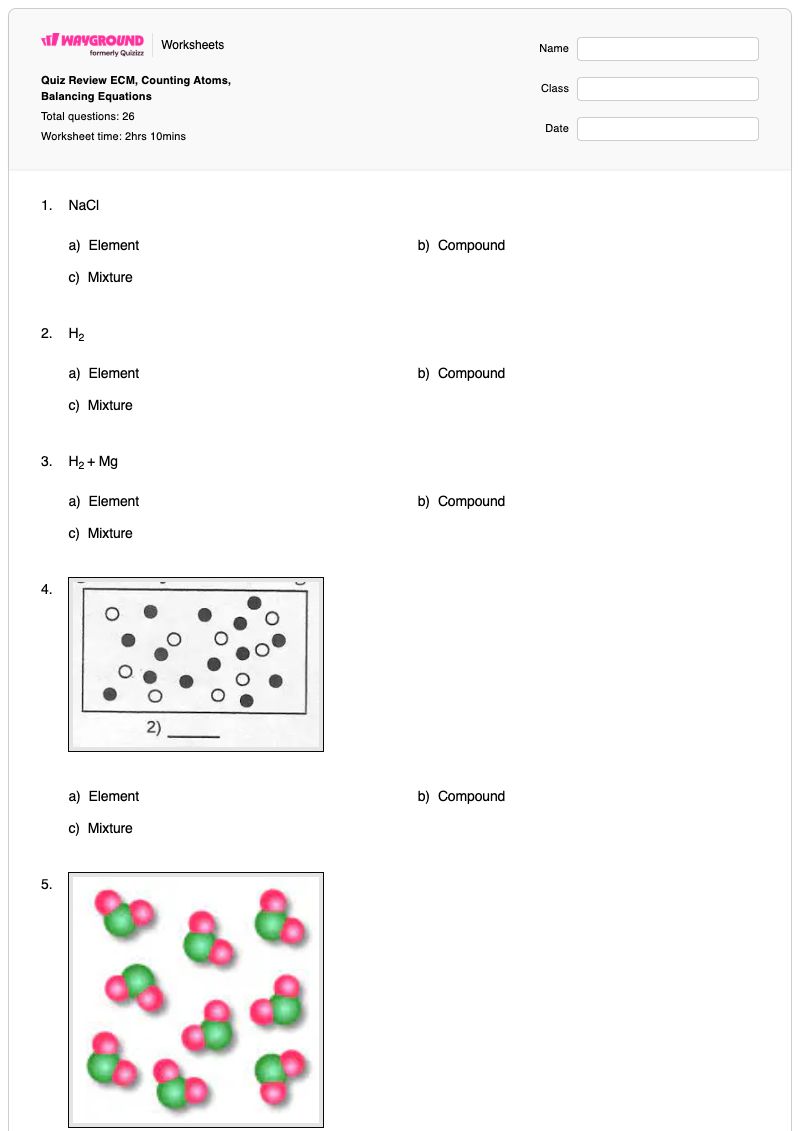
4.
Question Image
a)

Element

b)

Compound

c)

Mixture

5.
What does this pic illustrate?

What does this pic illustrate?

a)

Element

b)

Mixture of Compunds

c)

Mixture of elemets

d)

Compounds

6.

Which of the following is matched incorrectly.

a)

Air: compound

b)

Steel alloy: homogeneous mixture

c)

Glucose (C6H12O6): compound

d)

Cookies & Cream: heterogenous mixture

7.
A change in which NEW substances are formed.
a)
Chemical change
b)
Physical change
c)
Casual change
d)
Formal change
8.
2H2 + O2 ----> 2H2O What is the product?
a)
------>
b)
2H2O
c)
2H2+ O2
9.
2H2 + O2 --------> 2H2O What  are the reactants?
a)
----->
b)
2H2O
c)
2H2 +O2
10.
How many atoms are there TOTAL in:
H2SO4
a)
6
b)
5
c)
7
d)
3
11.

What determines the reactivity of an element?

a)

protons

b)

neutrons

c)

electrons

d)

valence electrons

12.

What determines the identity of an element?

a)

protons

b)

neutrons

c)

electrons

d)

valence electrons

13.

How many molecules are represented by 2C6H12O6 ?

(a)  

14.

How many atoms are in 3H₂O₂ ?

a)

4

b)

12

c)

18

d)

24

15.
What is a coefficient?
a)
The small number on the right of the chemical symbol.
b)
The large number to the left of a formula.
16.
The law of conservation of matter states that
a)
chemical reactions change matter.
b)
in chemical reactions, the identity of reactants and products is conserved.
c)
atoms are neither created nor destroyed in chemical reactions.
d)
a chemical equation must be balanced.
17.

How many Oxygen atoms are in Al₂(SO₄)₃?

a)

4

b)

12

c)

7

d)

24

18.
The blue numbers in the image below represent ________
a)
I don't know, and don't want to try
b)
coefficients
c)
subscripts
d)
none of the answers are correct
19.
The red numbers in the image below represent ________
a)
subscripts
b)
coefficients
c)
I don't know, and don't want to try
d)
None of the answers are correct
20.

Identify if the following equation is unbalanced or balanced.

O3+2C→3OC

a)

Unbalanced

b)

Balanced

21.

Identify if the following equation is unbalanced or balanced.

2(N)2→4N

a)

Unbalanced

b)

Balanced

22.

2N2  + O2  →  2N2O2N_2\ \ +\ O_2\ \ \rightarrow\ \ 2N_2O  

a)

Balanced

b)

Unbalanced

23.

Ca  +  HCl  →  CaCl2  +  H2Ca\ \ +\ \ HCl\ \ \rightarrow\ \ CaCl_2\ \ +\ \ H_2  

a)

Balanced

b)

Unbalanced

24.

What is the left part of a chemical equation called?

2H2 + O2 ---> 2H2O

a)

Reactants

b)

Yields

c)

Products

d)

Chemical equation

25.

What is the right part of a chemical equation called?

2H2 + O2 ---> 2H2O

a)

Reactants

b)

Yields

c)

Products

d)

Chemical Equation

26.

Determine the coefficients to make the following equation balanced?

__N2 + __O2--> __NO

a)

1, 1, 1

b)

1, 1, 2

c)

2, 2, 2

d)

1, 2, 2

WaygroundAnswer Key

Quiz Review ECM, Counting Atoms, Balancing Equations

Total questions: 26

1.
b)

Compound

2.
a)

Element

3.
c)

Mixture

4.
c)

Mixture

5.
d)

Compounds

6.
a)

Air: compound

7.
a) Chemical change
8.
b) 2H2O
9.
c) 2H2 +O2
10.
c) 7
11.
d)

valence electrons

12.
a)

protons

13.
2, two
14.
b)

12

15.
b) The large number to the left of a formula.
16.
c) atoms are neither created nor destroyed in chemical reactions.
17.
b)

12

18.
c) subscripts
19.
b) coefficients
20.
a)

Unbalanced

21.
b)

Balanced

22.
a)

Balanced

23.
b)

Unbalanced

24.
a)

Reactants

25.
c)

Products

26.
b)

1, 1, 2

FAQs

What does this Grade 7 science worksheet cover?

This worksheet reviews how to classify elements, compounds, and mixtures, identify chemical changes, and interpret basic chemical equations. Its 26 items also ask students to count atoms and molecules using subscripts and coefficients, identify reactants and products, and connect protons with element identity and valence electrons with reactivity. The mix of multiple-choice, multiple-select, and fill-in-the-blank questions gives students practice applying chemical notation rather than only recalling definitions.

How can I use this worksheet to teach elements, compounds, mixtures, and chemical formulas?

Introduce the classification items first by having students explain why examples such as NaCl, H₂, and H₂ + Mg represent different kinds of matter. Then model how to read a formula: use subscripts to count atoms, coefficients to count molecules or formula units, and the equation’s left and right sides to identify reactants and products. Use the answer key after completion to discuss why air is a mixture rather than a compound and how the conservation of matter relates to chemical equations.

What mistakes should I watch for when students complete this chemistry review worksheet?

Watch for students confusing a coefficient with a subscript, counting only the elements in H₂SO₄ instead of adding all seven atoms, or failing to multiply every atom in H₂O₂ by the coefficient in 3H₂O₂. Students may also reverse reactants and products in 2H₂ + O₂ → 2H₂O, classify air as a compound, or choose electrons instead of protons when identifying an element. Check the multiple-select items carefully because the questions about element identity and reactivity require selecting the specified determining particle.

How do I assign and grade this worksheet?

This worksheet is available as a printable PDF and as a digital quiz on Wayground, so you can use the same review content for paper-based or online practice. It includes a complete answer key for the classification, atom-counting, chemical-equation, and particle-identification items. For printable submissions, you can scan student work with the Wayground for Teachers app to help grade responses efficiently.

How can I differentiate this chemical formulas worksheet for my students?

In the worksheet’s Advanced Settings, adjust font spacing or font size to make the chemical formulas, subscripts, coefficients, and answer choices easier to read. You can also apply a dyslexia-friendly font or translate the worksheet into another language while preserving its multiple-choice, multiple-select, and fill-in-the-blank format.

Where can I find more worksheets like this on Wayground?

Wayground offers a comprehensive collection of free printable worksheets and practice problems across subjects, with downloadable PDFs and answer keys to help students master essential skills and concepts. Browse more resources at https://wayground.com/en-us/worksheets.
