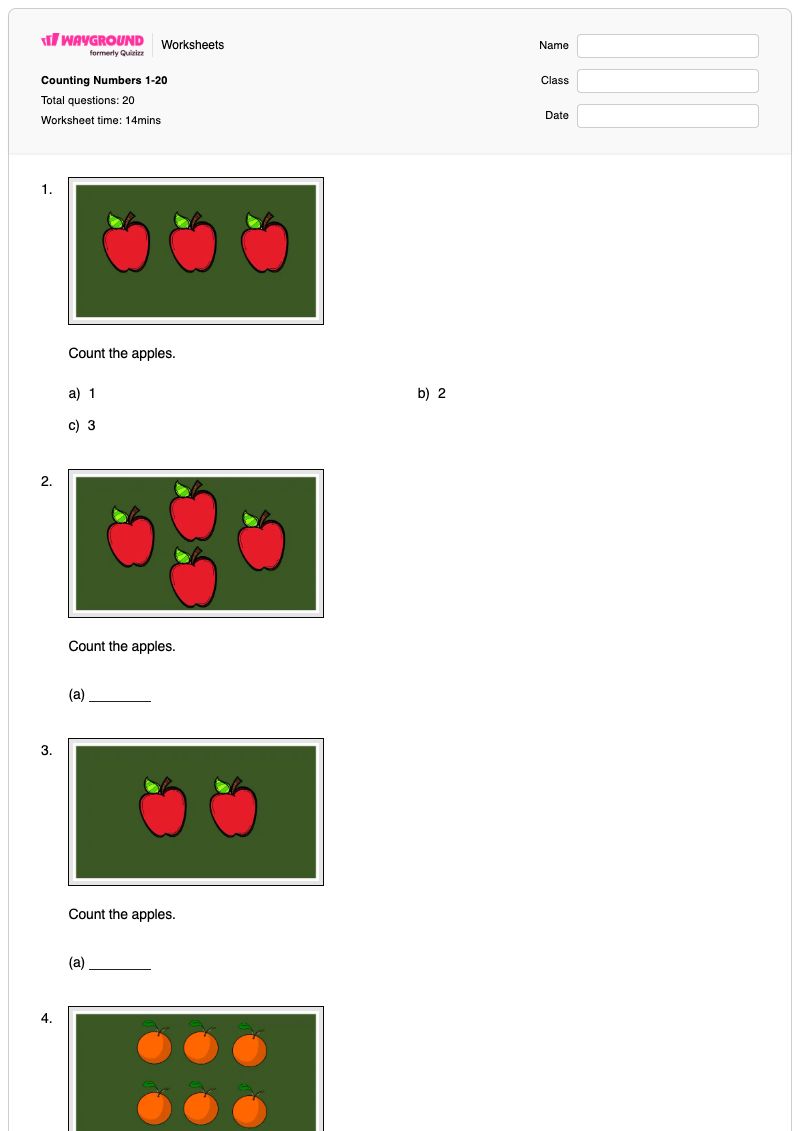
Counting Numbers 1-20 is a mathematics worksheet for Kindergarten through Grade 3 that builds early number sense within the 1–20 range. Students count pictured groups of apples and oranges, identify numerals, and answer questions about which number comes before, after, next, or in the middle of a sequence. The 20 items include 15 multiple-choice questions and 5 fill-in-the-blank questions, giving students practice with both selected-response and written-number tasks.
This free printable worksheet is useful for introducing, reinforcing, or checking one-to-one counting and number-order skills. The varied prompts help teachers see whether students can connect quantities to numerals and recognize relationships among neighboring numbers, including values near 20. It includes a complete answer key for efficient checking and can support independent practice, small-group instruction, or a quick mathematics assessment.
Worksheet settings
Font size
S
M
L
XL
Worksheets
Counting Numbers 1-20
Total questions: 20
Name
Class
Date
1.
Count the apples.
a)
1
b)
2
c)
3
2.
Count the apples.
(a)
3.
Count the apples.
(a)
4.
Count the oranges.
a)
4
b)
6
c)
5
5.
(a)
6.
Count the oranges.
a)
10
b)
8
c)
6
7.
What number comes next?
a)
15
b)
14
c)
12
8.
What is the middle number?
a)
9
b)
11
c)
12
9.
What number comes before?
a)
13
b)
17
c)
14
10.
What is the middle number?
a)
20
b)
18
c)
16
11.
What number comes after?
(a)
12.
How many?
(a)
13.
2
a)
b)
c)
14.
4
a)
b)
15.
6
a)
b)
16.
10
a)
b)
17.
7
a)
b)
18.
9
a)
b)
19.
5
a)
b)
20.
9
a)
b)
Answer Key
Counting Numbers 1-20
Total questions: 20
1.
c)
3
2.
4
3.
2
4.
b)
6
5.
8
6.
a)
10
7.
a)
15
8.
a)
9
9.
c)
14
10.
b)
18
11.
20
12.
1
13.
b)
14.
a)
15.
b)
16.
a)
17.
a)
18.
b)
19.
a)
20.
a)
140 %
Browse by subjects
Browse by grades
Browse by format
FAQs
What does the Counting Numbers 1-20 worksheet cover?
This worksheet practices counting groups of apples and oranges, recognizing numbers from 1 to 20, and identifying the number that comes before, after, next, or in the middle. Its 20 items combine 15 multiple-choice questions with 5 fill-in-the-blank prompts, so students apply counting and number-order skills in both selected-response and written formats.
How can I use this worksheet to teach counting and number order from 1 to 20?
Begin by having students count each pictured group aloud and touch one object for each number word. Then model how a number line helps identify the number before, after, next, or between two numbers, and use the worksheet prompts for guided practice before students work independently. Ask students to explain how they know an answer, especially when choosing among the number-order options.
What mistakes should I watch for when students complete this counting worksheet?
Watch for students skipping or counting an object twice in the apple and orange groups, then selecting a numeral that does not match the total. In the sequence questions, students may confuse before with after or choose an endpoint instead of the number in the middle. Fill-in-the-blank items also show whether students can produce the numeral independently rather than recognize it from answer choices.
How do I assign and grade the Counting Numbers 1-20 worksheet?
On Wayground, you can use this worksheet as a printable PDF or assign it as a digital quiz. It includes a complete answer key, and printable submissions can be graded by scanning student work with the Wayground for Teachers app. The printable format also gives schools an option for reducing screen time.
How can I differentiate this counting and number-order worksheet for my students?
Use the worksheet’s Advanced Settings to adjust font spacing or choose a larger font size so the counting pictures and number-order prompts are easier to follow. You can also enable a dyslexia-friendly font or translate the worksheet into another language when students need those file-level supports. These changes can make the apple and orange counting items and the before/after/middle questions more accessible without changing the skills assessed.
Where can I find more worksheets like this on Wayground?
Wayground offers a comprehensive collection of free printable worksheets and practice problems across all subjects, with downloadable PDFs and answer keys to help students master essential skills and concepts. Browse more resources at https://wayground.com/en-us/worksheets.


 Worksheets


