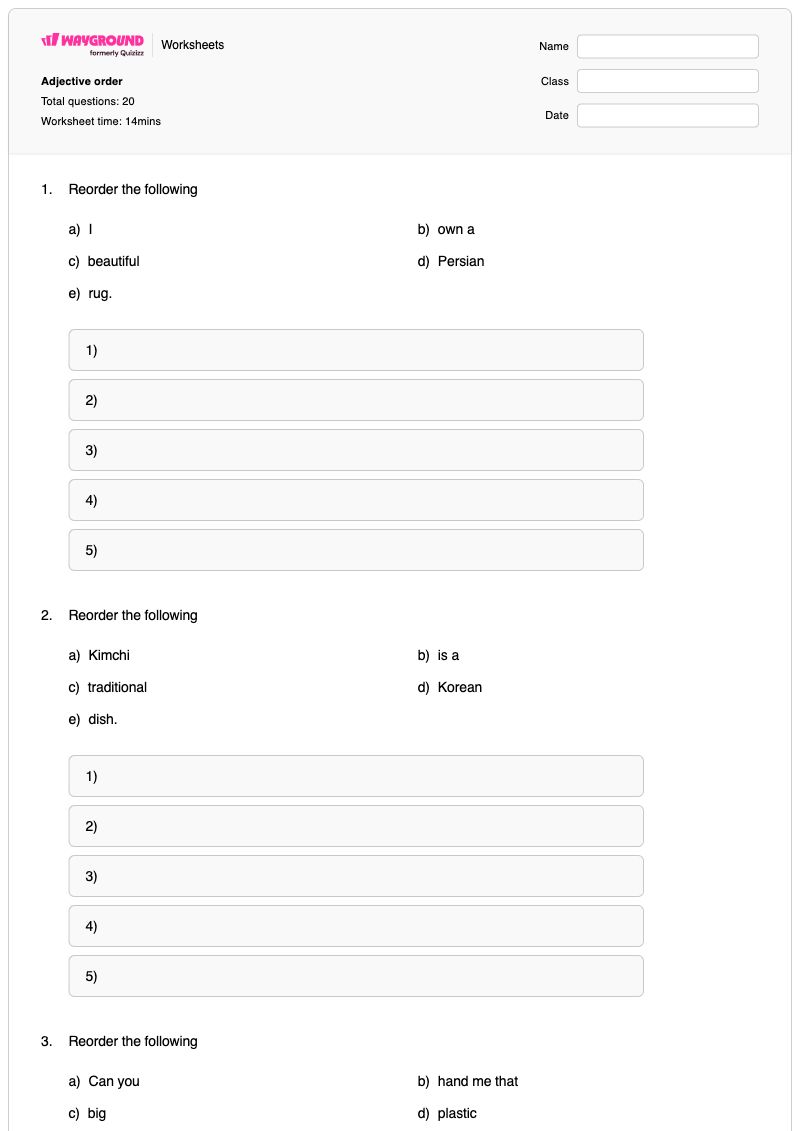
Adjective Order is a Grade 9 English worksheet that helps students arrange multiple adjectives correctly before a noun. Across 20 questions, students complete nine sentence-ordering items, five drag-and-drop collocation items, and six dropdown questions. The examples require students to distinguish adjective sequence in phrases such as descriptions involving size, material, color, nationality, or opinion, while the dropdown items extend practice to adjective forms such as relaxing and relaxed.
This worksheet is designed for guided practice, independent review, or a formative check of adjective order and adjective choice. Students build accuracy by reconstructing complete sentences, selecting natural adjective-noun combinations such as “photo ID” and “art museum,” and choosing the adjective that fits the sentence meaning. It is a free printable worksheet with a complete answer key for Grade 9 English instruction.
Worksheet settings
Font size
S
M
L
XL
Worksheets
Adjective order
Total questions: 20
Name
Class
Date
1.
Reorder the following
a)
I
b)
own a
c)
beautiful
d)
Persian
e)
rug.
1)
2)
3)
4)
5)
2.
Reorder the following
a)
Kimchi
b)
is a
c)
traditional
d)
Korean
e)
dish.
1)
2)
3)
4)
5)
3.
Reorder the following
a)
Can you
b)
hand me that
c)
big
d)
plastic
e)
spoon?
1)
2)
3)
4)
5)
4.
Reorder the following
a)
I went
b)
to a
c)
large
d)
private
e)
school.
1)
2)
3)
4)
5)
5.
Reorder the following
a)
You can't
b)
live without
c)
good,
d)
clean
e)
water
1)
2)
3)
4)
5)
6.
Reorder the following
a)
small
b)
electric
c)
cars
d)
are
e)
available.
1)
2)
3)
4)
5)
7.
Reorder the following
a)
FAst food
b)
is
c)
tasty,
d)
convenient and
e)
cheap.
1)
2)
3)
4)
5)
8.
Reorder the following
a)
La Raza is a
b)
large
c)
national
d)
Hispanic
e)
organization
1)
2)
3)
4)
5)
9.
Reorder the following
a)
There's a
b)
new
c)
large
d)
green
e)
space in our town.
1)
2)
3)
4)
5)
10.
Do you have a (a) map for this area? I think I'm lost!
Choose from the below words
road
art
baseball
childhood
photo
11.
Are you a (a) fan?
Choose from the below words
baseball
art
childhood
photo
road
12.
Do you carry with you a (a) ID?
Choose from the below words
photo
art
childhood
road
baseball
13.
What's your favorite (a) memory?
Choose from the below words
childhood
art
road
baseball
photo
14.
Did you enjoy touring the (a) museum?
Choose from the below words
art
road
baseball
photo
childhood
15.
Climbing a mountain is not a (a) activity.
Choose from the below words
relaxing
relaxed
16.
travelling around the world would be an (a) experience.
Choose from the below words
exciting
excited
17.
an (a) person can find things quickly.
Choose from the below words
organized
organizing
18.
He was (a) after taking a long hike in the mountains.
Choose from the below words
exhausted
exhausting
19.
It is not unusual to feel (a) when not reaching set goals.
Choose from the below words
disappointed
disappointing
20.
The magic show was pretty (a) .
Choose from the below words
amazing
amazed
Answer Key
Adjective order
Total questions: 20
1.
a, b, c, d, e
2.
a, b, c, d, e
3.
a, b, c, d, e
4.
a, b, c, d, e
5.
a, b, c, d, e
6.
a, b, c, d, e
7.
a, b, c, d, e
8.
a, b, c, d, e
9.
a, b, c, d, e
10.
road
11.
baseball
12.
photo
13.
childhood
14.
art
15.
relaxing
16.
exciting
17.
organized
18.
exhausted
19.
disappointed
20.
amazing
140 %
Browse by subjects
Browse by grades
Browse by format
FAQs
What does this adjective order worksheet cover?
This Grade 9 English worksheet practises arranging adjectives in the correct order before a noun and choosing between related adjective forms. Its 20 items combine sentence reordering, drag-and-drop collocations such as “baseball fan” and “childhood memory,” and dropdown choices such as “relaxing” versus “relaxed,” helping students apply adjective order and meaning in complete sentences.
How can I use this worksheet to teach adjective order?
Begin by having students identify the noun in each sentence, then ask them to explain what each adjective describes before arranging the words. Use the nine ordering items to model how combinations such as “beautiful Persian rug” and “big plastic spoon” are structured, then move to the drag-and-drop and dropdown sections to practise fixed adjective-noun combinations and adjective forms in context.
What mistakes should I watch for when students complete this worksheet?
Students may place the noun in the wrong position while reordering a sentence, or reverse adjectives that describe different qualities, such as size, material, color, or origin. In the drag-and-drop items, watch for unnatural combinations such as selecting “photo” for the museum prompt instead of the word that forms “art museum.” In the dropdown section, students may confuse an adjective describing something that causes a feeling, such as “relaxing,” with one describing how a person feels, such as “relaxed.”
How do I assign and grade this adjective order worksheet?
You can assign the adjective order worksheet as a printable PDF or as a digital quiz on Wayground. It includes a complete answer key, and printable student work can be graded by scanning it with the Wayground for Teachers app. The printable format also gives schools an option for reducing screen time.
How can I differentiate this adjective order worksheet for my students?
Use the worksheet’s Advanced Settings to adjust font spacing and font size so the reordering, drag-and-drop, and dropdown prompts are easier to read. You can also enable a dyslexia-friendly font or translate the worksheet into another language when that better supports access to the adjective-order practice.
Where can I find more worksheets like this on Wayground?
Wayground offers a broad collection of free printable worksheets and practice problems across subjects, with downloadable PDFs and answer keys to support essential skills and concepts. Browse more resources at https://wayground.com/en-us/worksheets.


 Worksheets