

Digestive System Review is a Grade 6 science worksheet with 20 questions that combines digestive-system knowledge with foundational life science and chemistry review. Students identify the order and functions of digestive organs, recognize where digestion begins and where absorption occurs, distinguish physical from chemical digestion, and identify the roles of bile and mucus. The worksheet also reviews organ-system organization, mixtures and chemical changes, and periodic-table organization and symbols.
The set includes 18 multiple-choice questions, one multiple-select question, and one fill-in-the-blank item. Students must select the two digestive organs that follow the stomach, complete the biological organization sequence, and apply vocabulary such as organ system, mixture, chemical change, physical digestion, and chemical digestion. This free printable worksheet includes a complete answer key for efficient review, independent practice, or assessment.
Worksheet settings
Font size
S
M
L
XL
Worksheets
Digestive System Review
Total questions: 20
Name
Class
Date
1.
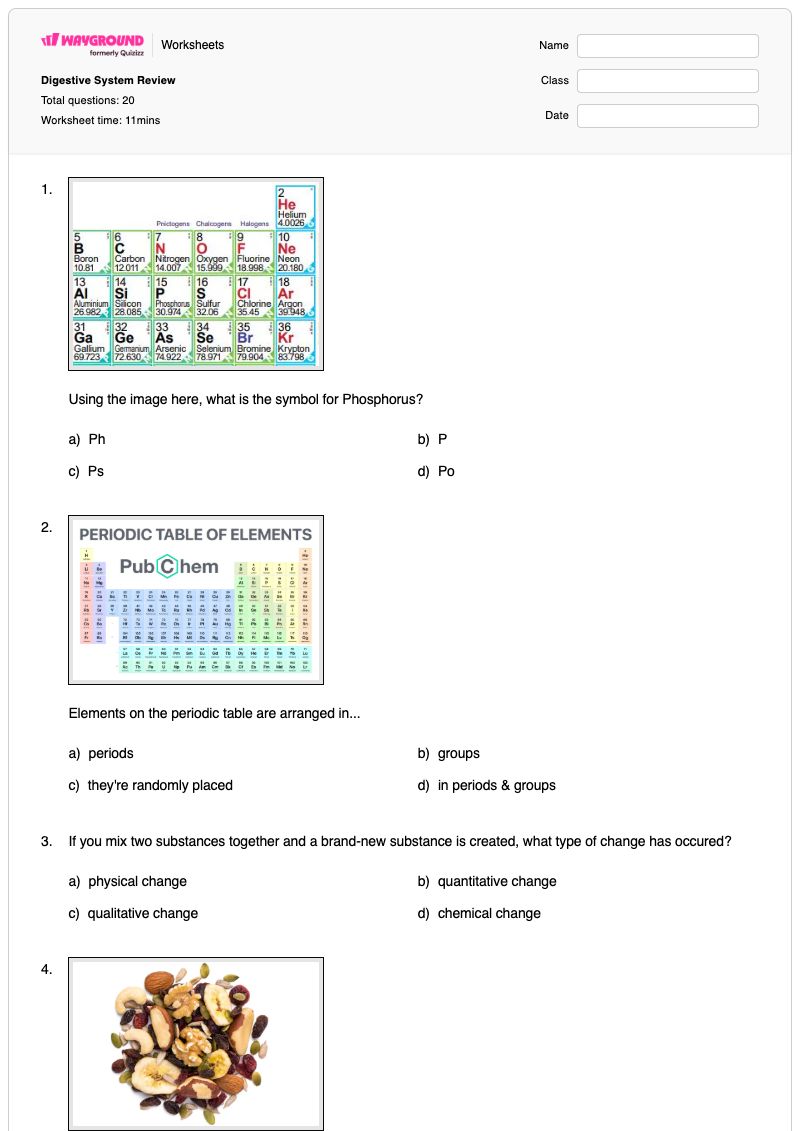
Using the image here, what is the symbol for Phosphorus?
a)
Ph
b)
P
c)
Ps
d)
Po
2.
Elements on the periodic table are arranged in...
a)
periods
b)
groups
c)
they're randomly placed
d)
in periods & groups
3.
If you mix two substances together and a brand-new substance is created, what type of change has occured?
a)
physical change
b)
quantitative change
c)
qualitative change
d)
chemical change
4.
If I combine many substances together, but could later easily seperate them, what have I made?
a)
mixture
b)
compound
c)
element
d)
atom
5.
True or False: Origami (paper folding) is an example of a physical change.
a)
True
b)
False
6.
True or False: Digestion is an example of physical change.
a)
True
b)
False
7.
Fill in the blank:
cell, tissue, organ, _________, organism
a)
stomach
b)
element
c)
compound
d)
organ system
8.
After food leaves the esophagus, it enters the stomach. From here, it will enter the _____ and then the _______. (Select two.)
a)
Liver
b)
Small intestine
c)
Gallbladder
d)
Large intestine
9.
The liver produces a digestive enzyme that breaks down fats in the small intestine. What is this enzyme called?
a)
mucus
b)
hydrochloric acid
c)
bile
d)
saliva
10.
What substance coats the inside of the stomach to protect it from its own acid?
a)
mucus
b)
hydrochloric acid
c)
bile
d)
saliva
11.
Where does digestion begin?
a)
mouth
b)
esophagus
c)
stomach
d)
small intesine
12.
Where does excess water get absorbed from undigested food?
a)
esophagus
b)
stomach
c)
small intestine
d)
large intestine
13.
The majority of digestion and absorption occurs here. Name this organ.
(a)
14.
Your teeth rip and tear your food into smaller pieces. This is an example of what type of digestion?
a)
physical digestion
b)
chemical digestion
15.
Bile from the liver breaks down fats in the food that you eat. Is this an example of physical or chemical digestion?
a)
physical digestion
b)
chemical digestion
16.
Amylase is an enzyme found in our saliva. Amylase changes starch into...
a)
glucose
b)
salt
c)
iron
d)
starch
17.
An _______ is a chemical that changes color when in the presence of a certain substance. (Example: Iodine changes to black when in the presence of starch.)
a)
acid
b)
base
c)
neutral
d)
indicator
18.
A substance has a pH level of 4. What is this substance?
a)
acid
b)
neutral
c)
base
19.
A substance has a pH of 12. What is this substance?
a)
acid
b)
neutral
c)
base
20.
A substance has a pH of 7. What is this substance?
a)
acid
b)
neutral
c)
base
Answer Key
Digestive System Review
Total questions: 20
1.
b)
P
2.
d)
in periods & groups
3.
d)
chemical change
4.
a)
mixture
5.
a)
True
6.
b)
False
7.
d)
organ system
8.
b)
Small intestine
, d)
Large intestine
9.
c)
bile
10.
a)
mucus
11.
a)
mouth
12.
d)
large intestine
13.
small intestine, small intestines
14.
a)
physical digestion
15.
b)
chemical digestion
16.
a)
glucose
17.
d)
indicator
18.
a)
acid
19.
c)
base
20.
b)
neutral
140 %
Browse by subjects
Browse by grades
Browse by format
FAQs
What does the Digestive System Review worksheet cover?
This Grade 6 science worksheet uses 18 multiple-choice questions, one multiple-select item, and one fill-in-the-blank question to review digestive-system structures and processes. Students sequence the organs food passes through, identify where digestion and absorption occur, distinguish physical from chemical digestion, and connect these ideas with questions about mixtures, chemical changes, organ systems, and periodic-table symbols.
How can I use this worksheet to teach the digestive system and related science concepts?
Introduce the digestive pathway by having students trace food from the mouth through the esophagus, stomach, small intestine, and large intestine, then discuss the roles of bile, mucus, and absorption. Use the multiple-select and fill-in-the-blank items to prompt explanation rather than guessing, and follow with the physical-versus-chemical-change questions to connect digestion to the worksheet’s chemistry review.
What mistakes should I watch for when students complete this digestive system review?
Watch for students reversing the small and large intestines, selecting only one organ in the multiple-select question, or confusing bile from the liver with mucus that protects the stomach. Students may also confuse physical digestion by the teeth with chemical digestion involving bile, mistake a mixture for a compound, or leave out organ system when completing the biological organization sequence.
How do I assign and grade this worksheet?
The Digestive System Review worksheet is available as a printable PDF and as a digital quiz on Wayground, with a complete answer key for all 20 items. Printable submissions can be graded by scanning student work with the Wayground for Teachers app, while the digital quiz supports online completion and grading.
How can I differentiate this digestive system worksheet for my students?
In the worksheet’s Advanced Settings, adjust font spacing and font size to make the digestive vocabulary, multiple-choice options, and fill-in-the-blank item easier to read. You can also enable a dyslexia-friendly font or translate the worksheet into another language to support access to terms such as esophagus, bile, organ system, and chemical digestion.
Where can I find more worksheets like this on Wayground?
Wayground offers a comprehensive collection of free printable worksheets and practice problems across subjects, with downloadable PDFs and answer keys to help students master essential skills and concepts. Browse more resources at https://wayground.com/en-us/worksheets.