Distance, Rate, Time Exit Ticket is a Grade 6 mathematics worksheet that helps students apply the three distance-rate-time relationships to real-world situations. Across 10 questions, students solve 4 fill-in-the-blank problems and 6 multiple-choice problems involving miles, kilometers, and centimeters. They find distance from a rate and time, calculate time from distance and rate, determine rate from distance and time, compare travel speeds, and identify the number of formulas used in this relationship set.
The varied contexts—including skiing, swimming, cycling, running, driving, and insect movement—give students practice choosing the correct operation while keeping track of decimal values and measurement units. The format works well as a quick independent check, review activity, or end-of-lesson assessment for Grade 6 math instruction. This free printable worksheet includes a complete answer key for efficient checking and feedback.
Worksheet settings
Font size
S
M
L
XL
Worksheets
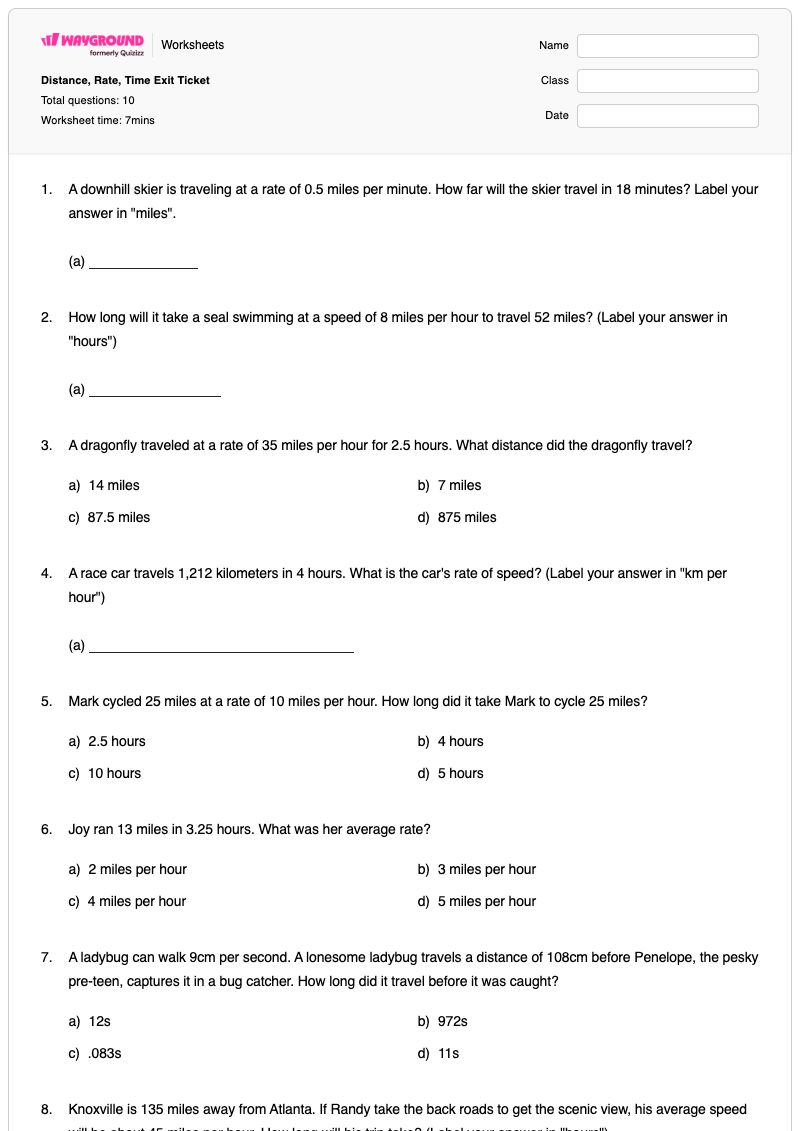
Distance, Rate, Time Exit Ticket
Total questions: 10
Name
Class
Date
1.
A downhill skier is traveling at a rate of 0.5 miles per minute. How far will the skier travel in 18 minutes? Label your answer in "miles".
(a)
2.
How long will it take a seal swimming at a speed of 8 miles per hour to travel 52 miles? (Label your answer in "hours")
(a)
3.
A dragonfly traveled at a rate of 35 miles per hour for 2.5 hours. What distance did the dragonfly travel?
a)
14 miles
b)
7 miles
c)
87.5 miles
d)
875 miles
4.
A race car travels 1,212 kilometers in 4 hours. What is the car's rate of speed? (Label your answer in "km per hour")
(a)
5.
Mark cycled 25 miles at a rate of 10 miles per hour. How long did it take Mark to cycle 25 miles?
a)
2.5 hours
b)
4 hours
c)
10 hours
d)
5 hours
6.
Joy ran 13 miles in 3.25 hours. What was her average rate?
a)
2 miles per hour
b)
3 miles per hour
c)
4 miles per hour
d)
5 miles per hour
7.
A ladybug can walk 9cm per second. A lonesome ladybug travels a distance of 108cm before Penelope, the pesky pre-teen, captures it in a bug catcher. How long did it travel before it was caught?
a)
12s
b)
972s
c)
.083s
d)
11s
8.
Knoxville is 135 miles away from Atlanta. If Randy take the back roads to get the scenic view, his average speed will be about 45 miles per hour. How long will his trip take? (Label your answer in "hours")
(a)
9.
Seth rode his mountain bike 36km at a speed of 8km/hr. Grant road his dirt bike 48km at a speed of 10km/hr. Whose trip was the fastest?
a)
Seth
b)
Grant
10.
How many formulas are there for finding distance, rate, and time?
a)
1
b)
2
c)
3
d)
4
Answer Key
Distance, Rate, Time Exit Ticket
Total questions: 10
1.
9 miles, 9, 9miles
2.
6.5 hrs, 6.5 hours, 6.5hours, 6.5
3.
c)
87.5 miles
4.
303 km per hour, 303, 303 kilometers per hour, 303 km per hr
5.
a)
2.5 hours
6.
c)
4 miles per hour
7.
a)
12s
8.
3 hours, 3 hrs, 3, 3 hour
9.
a)
Seth
10.
c)
3
140 %
Browse by subjects
Browse by grades
Browse by format
FAQs
What does the Distance, Rate, Time Exit Ticket help students practice?
This Grade 6 worksheet helps students solve distance, rate, and time problems by selecting the appropriate relationship for each situation. Its 4 fill-in-the-blank and 6 multiple-choice questions require students to calculate distance, time, or rate, compare two travel rates, and label answers in units such as miles, hours, kilometers per hour, and seconds.
How can I use this worksheet to teach distance, rate, and time?
Introduce the three distance-rate-time relationships with a simple travel example, then model how the known quantities determine whether students need to find distance, time, or rate. Use the worksheet’s skier, seal, dragonfly, and race-car problems to think aloud about the operation and units before students complete the remaining fill-in-the-blank and multiple-choice items independently. Review one problem of each type and ask students to explain why their answer’s unit matches the quantity being found.
What mistakes should I watch for on this distance, rate, and time worksheet?
Students may multiply when they should divide, such as finding the seal’s travel time from 52 miles and 8 miles per hour, or may use the wrong operation when finding rate from distance and time. Watch for misplaced decimals in problems such as 35 miles per hour for 2.5 hours, incorrect unit labels, and comparisons based only on distance rather than the calculated travel rate, as in the Seth and Grant question.
How do I assign and grade this distance, rate, and time worksheet?
You can assign the Distance, Rate, Time Exit Ticket as a printable PDF or as a digital quiz on Wayground. It includes a complete answer key, and printable submissions can be graded by scanning student work with the Wayground for Teachers app. The printable format also gives schools an option for reducing screen time while students solve the 10 calculation and reasoning questions.
How can I differentiate this distance, rate, and time worksheet for my students?
Use the worksheet’s Advanced Settings to adjust font spacing and font size so the decimal calculations, answer choices, and unit labels are easier to read. You can also enable a dyslexia-friendly font or translate the distance, rate, and time questions into another language when that better supports access to the problems.
Where can I find more worksheets like this on Wayground?
Wayground offers a broad collection of free printable worksheets and practice problems across all subjects, with downloadable PDFs and answer keys to support essential skills and concepts. Browse more resources at https://wayground.com/en-us/worksheets.

 Worksheets