Color - Part 1 is a Grade 9 Arts worksheet that builds foundational color-theory vocabulary and classification skills. Students complete 10 multiple-choice questions about value, hue, the color wheel, primary colors, secondary colors, and the color combinations used to create orange and another mixed color.
The worksheet also asks students to apply these ideas to visual examples by identifying hues in an artwork and determining whether a portrait uses primary colors or a dog painting uses secondary colors. This format helps students connect definitions and color-mixing rules with what they observe in art, rather than memorizing terms in isolation. Use this free printable worksheet for guided practice, independent review, or a quick check of students’ understanding; a complete answer key is included for efficient checking.
Worksheet settings
Font size
S
M
L
XL
Worksheets
Color - Part 1
Total questions: 10
Name
Class
Date
1.
The lightness or darkness of a color is known as ...
a)
color
b)
saturation
c)
value
d)
hue
2.
The color wheel is used to
a)
see all colors.
b)
see which primary colors create the secondary colors.
c)
show the connection between colors and organizes these colors into groups.
3.
The primary colors are pure and create any other colors in the color wheel. The 3 primary colors are:
a)
red, green, yellow
b)
red, blue, yellow
c)
green, blue, purple
d)
purple, green, orange
4.
The secondary colors are created by mixing 2 of the primary colors. The colors that are part of this group is:
a)
orange, green, yellow
b)
Green, purple, blue
c)
red, blue, yellow
d)
orange, green, purple
5.
The concept "hue" can also mean:
a)
color
b)
tint
c)
shade
d)
saturation
6.
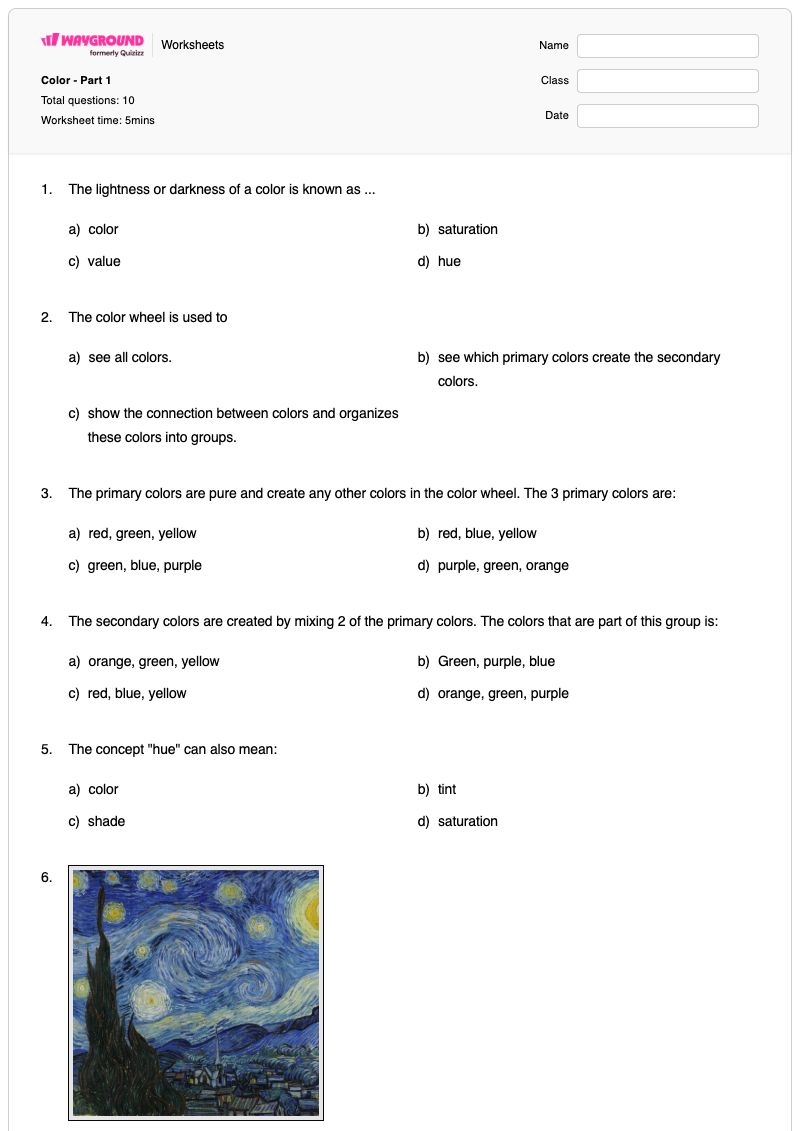
Observe carefully this piece. What hues are shown in this art work?
a)
Primary colors
b)
blue, yellow, white, brown, black, green
c)
purple, blue, black, green
d)
secondary colors
7.
Which color group is used to create this portrait?
a)
Secondary colors
b)
Primary colors
8.
Which color group was used to color this painting of the dog?
a)
Secondary colors
b)
Primary colors
9.
Which colors should we mix to get orange?
a)
Blue + red
b)
yellow + blue
c)
red + yellow
d)
orange + green
10.
Which colors do we mix to get this color?
a)
red + orange
b)
red + blue
c)
yellow + red
d)
red + green
Answer Key
Color - Part 1
Total questions: 10
1.
c)
value
2.
c)
show the connection between colors and organizes these colors into groups.
3.
b)
red, blue, yellow
4.
d)
orange, green, purple
5.
a)
color
6.
b)
blue, yellow, white, brown, black, green
7.
b)
Primary colors
8.
a)
Secondary colors
9.
c)
red + yellow
10.
b)
red + blue
140 %
Browse by subjects
Browse by grades
Browse by format
FAQs
What does the Color - Part 1 worksheet cover?
This Grade 9 Arts worksheet uses 10 multiple-choice questions to practice identifying value as the lightness or darkness of a color, recognizing hue as color, and understanding how the color wheel organizes color relationships. Students also classify primary and secondary colors, identify color groups in artwork, and select color pairs that create mixed colors such as orange.
How can I use this worksheet to teach primary and secondary colors?
Introduce the color wheel and have students first discuss how the worksheet distinguishes primary colors—red, blue, and yellow—from secondary colors—orange, green, and purple. Then use the multiple-choice items on artworks as an application step, asking students to explain which visible color group supports each choice before they complete the color-mixing questions.
What mistakes should I watch for when students complete this color theory worksheet?
Students may confuse hue with value, saturation, or shade, or choose all colors rather than the color wheel’s function of organizing color relationships. Watch for students grouping yellow with secondary colors, reversing which primary colors create orange, or identifying an artwork’s color group without checking the colors shown.
How do I assign and grade the Color - Part 1 worksheet?
You can assign this worksheet as a printable PDF or as a digital quiz on Wayground, and it includes a complete answer key for all 10 multiple-choice questions. For printable submissions, scan student work with the Wayground for Teachers app to support faster grading.
How can I differentiate this color theory worksheet for my students?
Under Advanced Settings, adjust font spacing or increase the font size so the 10 multiple-choice items and artwork-based prompts are easier to read. You can also apply a dyslexia-friendly font or translate the worksheet into another language while students work with the color vocabulary and mixing questions.
Where can I find more worksheets like this on Wayground?
Wayground offers a comprehensive collection of free printable worksheets and practice problems across subjects, with downloadable PDFs and answer keys to help students build essential skills and concepts. Browse more resources at https://wayground.com/en-us/worksheets.

 Worksheets


