This Grade 5 mathematics worksheet develops decimal place-value understanding through 21 questions: 19 multiple-choice items, one fill-in-the-blank item, and one multiple-select item. Students identify the tenths, hundredths, and thousandths places; write and read decimals; represent values with shaded grids; compare decimals; recognize equivalent forms such as 0.3 and 0.30; and determine how values change by factors of ten. The questions connect written notation, visual models, and the value of individual digits.
Use this free printable worksheet to reinforce instruction, provide independent practice, or check whether students can move between decimal words, numerals, models, and comparisons. It is designed for Grade 5 math learners who are building accuracy with decimals that include zeros in different places. The worksheet includes a complete answer key for efficient review and feedback, helping teachers identify whether errors come from reading place names, interpreting shaded models, comparing values, or understanding equivalent decimals.
Worksheet settings
Font size
S
M
L
XL
Worksheets
Decimal Place Value
Total questions: 21
Name
Class
Date
1.
Which of these shows seven hundredths?
a)
700
b)
0.07
c)
0.007
d)
70
2.
In 0.04, the 4 is in the ____________ place.
a)
ones
b)
hundredths
c)
tenths
d)
thousandths
3.
In 0.004, the digit 4 is in the __________ place.
a)
ones
b)
tenths
c)
hundredths
d)
thousandths
4.
The digit 4 has a greater value in__________.
a)
0.004
b)
0.04
5.
Fill in the blank:
0.003, (a) , 0.3, 3, 30, 300
6.
0.06 is ___________ than 0.006
a)
10 times more
b)
1 tenth of
c)
100 times more
d)
10 less
7.
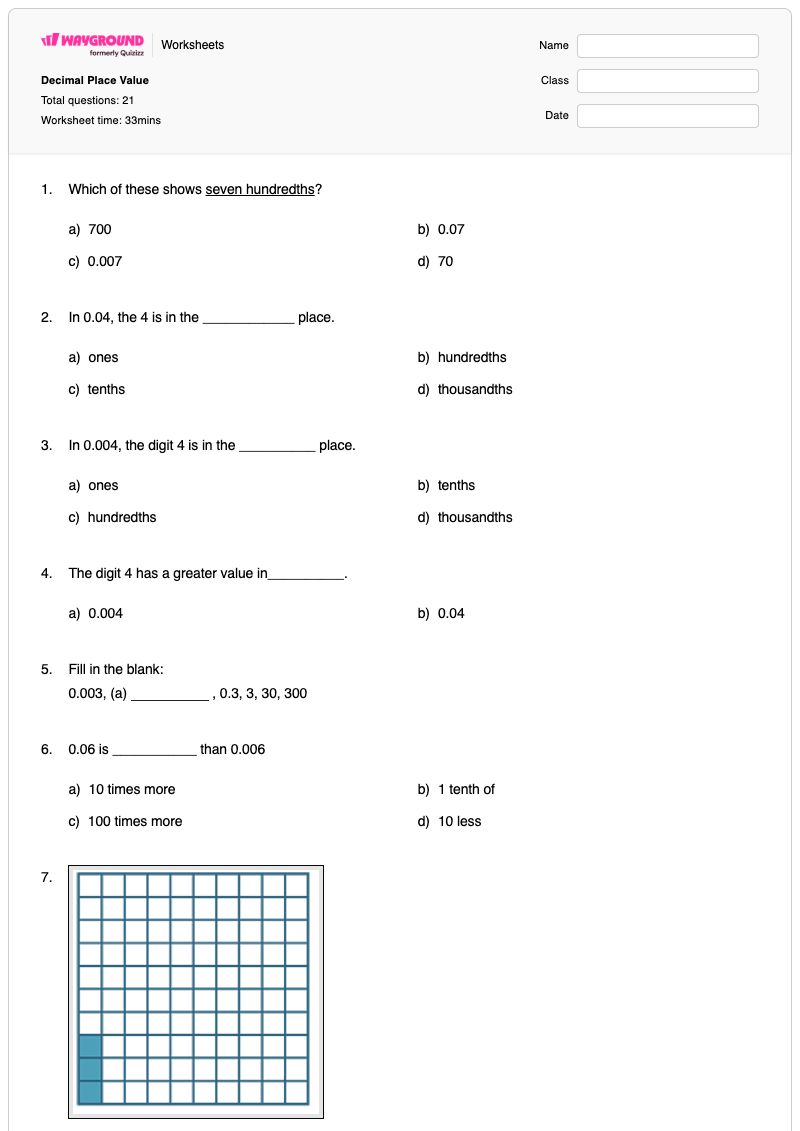
Label this grid with a decimal to show how much is shaded.
a)
300
b)
3
c)
0.03
d)
0.3
8.
Which of these grids is shaded to show 0.5?
a)
b)
c)
d)
9.
Which 2 numbers would have the same shaded grid?(choose 2 answers)
a)
0.3
b)
0.03
c)
0.30
d)
30
10.
How would you read this number: 0.03
a)
three
b)
three tenths
c)
three hundredths
d)
three thousandths
11.
How would you write this number: seven tenths
a)
0.7
b)
0.07
c)
0.007
d)
70
12.
Fill in the blank: 0.09_____0.009
a)
<
b)
>
c)
=
13.
Fill in the blank: 0.06____0.060
a)
<
b)
>
c)
=
14.
Use a decimal to label this shaded model:
a)
0.02
b)
20
c)
0.2
d)
0.4
15.
Which digit is in the tenths place? 236.4791
a)
3
b)
6
c)
4
d)
7
16.
Which of the decimals is equivalent to the value represented by the hundreds grid?
a)
0.37
b)
0.38
c)
0.83
d)
0.86
17.
What is the value of the 5 in the number 8.965
a)
5 Ones
b)
5 Tenths
c)
5 Thousands
d)
5 Thousandths
18.
Bradley says 0.80 is greater than 0.8 because 80 is greater than 8. Frankie says 0.8 is greater than 0.80. Jose says dudes they are the same value. Who is correct and why?
a)
Bradley is so correct because 80 is more than 8.
b)
Frankie is so correct because eight tenths is more than 80 hundredths.
c)
Jose is correct because 0.8 is equivalent to 0.80.
d)
None of them are correct. They are all crazy!
19.
263.709
Which digit is in the hundredths place?
a)
2
b)
9
c)
0
d)
7
20.
In the number below, what place value is the digit 2 in? 6.3529
a)
Hundredths
b)
Thousandths
c)
Ones
d)
Tenths
21.
What is the value of the underlined digit? 0.27316
a)
7 tenths
b)
7 hundredths
c)
7 thousandths
d)
7 ten-thousandths
Answer Key
Decimal Place Value
Total questions: 21
1.
b)
0.07
2.
b)
hundredths
3.
d)
thousandths
4.
b)
0.04
5.
0.03, .03, 0.30, .30
6.
a)
10 times more
7.
c)
0.03
8.
b)
9.
a)
0.3
, c)
0.30
10.
c)
three hundredths
11.
a)
0.7
12.
b)
>
13.
c)
=
14.
c)
0.2
15.
c) 4
16.
d) 0.86
17.
d)
5 Thousandths
18.
c) Jose is correct because 0.8 is equivalent to 0.80.
19.
c)
0
20.
b) Thousandths
21.
b)
7 hundredths
140 %
Browse by subjects
Browse by grades
Browse by format
FAQs
What does this Decimal Place Value worksheet cover?
This Grade 5 worksheet uses 19 multiple-choice questions, one fill-in-the-blank item, and one multiple-select item to build decimal place-value fluency. Students identify tenths, hundredths, and thousandths; read and write decimals; label shaded grids; compare values such as 0.09 and 0.009; and recognize equivalent decimals such as 0.3 and 0.30.
How can I use this worksheet to teach decimal place value?
Begin with a place-value chart and shaded grids, then model how a digit’s value changes from tenths to hundredths to thousandths. Have students explain why 0.04 represents four hundredths, why 0.06 is ten times 0.006, and why trailing zeros do not change 0.060. Use the worksheet’s reading, writing, model-labeling, and comparison items in that sequence so students connect representations before working independently.
What mistakes should I watch for when students complete this decimal place-value worksheet?
Watch for students confusing hundredths and thousandths when zeros appear, such as reading 0.004 as four hundredths instead of four thousandths. Students may also compare the number of digits rather than place value, treat 0.060 as different from 0.06, or select 0.03 instead of 0.3 when interpreting a shaded grid. Check that they distinguish a digit’s location from its value and read decimal names precisely.
How do I assign and grade this decimal place-value worksheet?
The Decimal Place Value worksheet is available as a printable PDF and as a digital quiz on Wayground, and it includes a complete answer key. For printable submissions, scan student work with the Wayground for Teachers app to streamline grading and review. The printable option can also support schools that are reducing screen time.
How can I differentiate this decimal place-value worksheet for my students?
Use the worksheet’s Advanced Settings to adjust font spacing and font size so the decimal notation, comparison symbols, and shaded-grid prompts are easier to read. You can also apply a dyslexia-friendly font or translate the worksheet into another language. These options can make the place-value items and visual models more accessible without changing the decimal skills being assessed.
Where can I find more worksheets like this on Wayground?
Wayground offers a broad collection of free printable worksheets and practice problems across subjects, with downloadable PDFs and answer keys to support essential skills and concepts. Browse more resources at https://wayground.com/en-us/worksheets.

 Worksheets


