

Wayground
Factor Theorem L2 - Printable Mathematics Worksheets - Wayground

Factor Theorem L2

20 questions

10th - 10th Grade

Mathematics

Factor Theorem L2 is a Grade 10 mathematics worksheet that builds fluency with using the Factor Theorem to test whether expressions such as (x − 1), (x + 2), or (x − 3) are factors of a polynomial. Students evaluate the polynomial at the corresponding positive or negative value and interpret whether the result is zero. The worksheet contains 20 questions: 16 multiple-choice items and 4 fill-in-the-blank items. Students also use synthetic division with the polynomial P(x) = x⁴ + 2x³ − 13x² − 14x + 24 to identify missing values and select the resulting factored form for different linear divisors. This free printable worksheet is designed for Grade 10 mathematics practice, review, or assessment, and it includes an answer key so teachers can check students’ evaluations, synthetic-division results, and factored expressions efficiently.

Worksheet settings

Font size

S
M
L
XL
Worksheets

Factor Theorem L2

Total questions: 20

Name
Class
Date
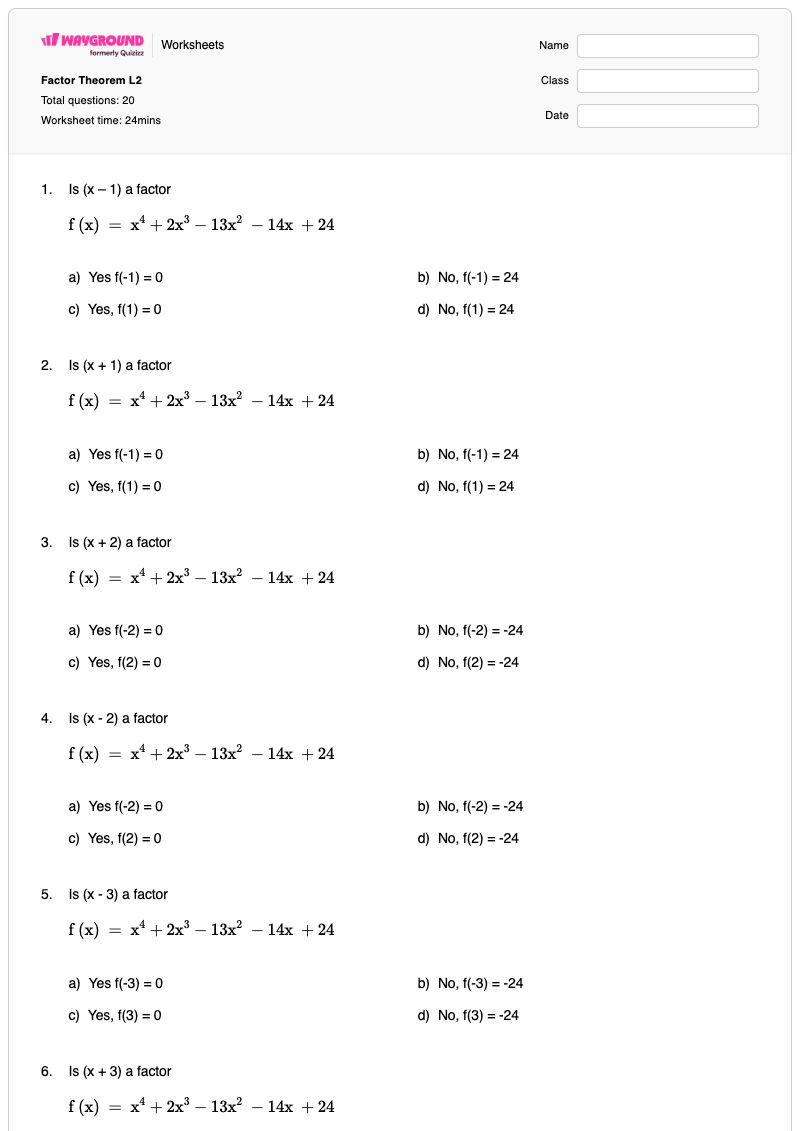
1.

Is (x – 1) a factor

f(x) = x4+2x3−13x2 −14x +24f\left(x\right)\ =\ x^4+2x^3-13x^2\ -14x\ +24  

a)

Yes f(-1) = 0

b)

No, f(-1) = 24

c)

Yes, f(1) = 0

d)

No, f(1) = 24

2.

Is (x + 1) a factor

f(x) = x4+2x3−13x2 −14x +24f\left(x\right)\ =\ x^4+2x^3-13x^2\ -14x\ +24  

a)

Yes f(-1) = 0

b)

No, f(-1) = 24

c)

Yes, f(1) = 0

d)

No, f(1) = 24

3.

Is (x + 2) a factor

f(x) = x4+2x3−13x2 −14x +24f\left(x\right)\ =\ x^4+2x^3-13x^2\ -14x\ +24  

a)

Yes f(-2) = 0

b)

No, f(-2) = -24

c)

Yes, f(2) = 0

d)

No, f(2) = -24

4.

Is (x - 2) a factor

f(x) = x4+2x3−13x2 −14x +24f\left(x\right)\ =\ x^4+2x^3-13x^2\ -14x\ +24  

a)

Yes f(-2) = 0

b)

No, f(-2) = -24

c)

Yes, f(2) = 0

d)

No, f(2) = -24

5.

Is (x - 3) a factor

f(x) = x4+2x3−13x2 −14x +24f\left(x\right)\ =\ x^4+2x^3-13x^2\ -14x\ +24  

a)

Yes f(-3) = 0

b)

No, f(-3) = -24

c)

Yes, f(3) = 0

d)

No, f(3) = -24

6.

Is (x + 3) a factor

f(x) = x4+2x3−13x2 −14x +24f\left(x\right)\ =\ x^4+2x^3-13x^2\ -14x\ +24  

a)

Yes f(-3) = 0

b)

No, f(-3) = -24

c)

Yes, f(3) = 0

d)

No, f(3) = -24

7.

Is (x + 4) a factor

f(x) = x4+2x3−13x2 −14x +24f\left(x\right)\ =\ x^4+2x^3-13x^2\ -14x\ +24  

a)

Yes f(-4) = 0

b)

No, f(-4) = -24

c)

Yes, f(4) = 0

d)

No, f(4) = -24

8.

Is (x - 4) a factor

f(x) = x4+2x3−13x2 −14x +24f\left(x\right)\ =\ x^4+2x^3-13x^2\ -14x\ +24  

a)

Yes f(-4) = 0

b)

No, f(-4) = 144

c)

Yes, f(4) = 0

d)

No, f(4) = 144

9.

Given the dividend

P(x) = x4 + 2x3 - 13x2 - 14x + 24 and divisor (x - 1)

Determine the missing number according to the synthetic division.

a)

a = 1

b = -2

c = -13

d = 26

e = -24

b)

a = 1

b = 3

c = 2

d = 6

e = -24

c)

a = 1

b = 1

c = -10

d = -10

e = -24

d)

a = 1

b = -4

c = -5

d = 20

e = -24

10.

Given the dividend

P(x) = x4 + 2x3 - 13x2 - 14x + 24 and divisor (x + 2)

Determine the missing number according to the synthetic division.

a)

a = 1

b = -2

c = -13

d = 26

e = -24

b)

a = 1

b = 3

c = 2

d = 6

e = -24

c)

a = 1

b = 1

c = -10

d = -10

e = -24

d)

a = 1

b = -4

c = -5

d = 20

e = -24

11.

Given the dividend

P(x) = x4 + 2x3 - 13x2 - 14x + 24 and divisor (x - 3)

Determine the missing number according to the synthetic division.

a)

a = 1

b = -2

c = -13

d = 26

e = -24

b)

a = 1

b = 3

c = 2

d = 6

e = -24

c)

a = 1

b = 1

c = -10

d = -10

e = -24

d)

a = 1

b = -4

c = -5

d = 20

e = -24

12.

Given the dividend

P(x) = x4 + 2x3 - 13x2 - 14x + 24 and divisor (x + 4)

Determine the missing number according to the synthetic division.

a)

a = 1

b = -2

c = -13

d = 26

e = -24

b)

a = 1

b = 3

c = 2

d = 6

e = -24

c)

a = 1

b = 1

c = -10

d = -10

e = -24

d)

a = 1

b = -4

c = -5

d = 20

e = -24

13.

Given the dividend

P(x) = x4 + 2x3 - 13x2 - 14x + 24 and divisor (x - 1)

Determine factoring for P(x) according to the synthetic division (picture)

a)

(x - 1)(x3 - 2x2 - 5x + 6)

b)

(x - 1)(x3 - 13x + 12)

c)

(x - 1)(x3 + 5x2 + 2x - 8)

d)

(x - 1)(x3 + 3x2 - 10x - 24)

14.

Given the dividend

P(x) = x4 + 2x3 - 13x2 - 14x + 24 and divisor (x + 2)

Determine factoring for P(x) according to the synthetic division (picture)

a)

(x + 2)(x3 - 2x2 - 5x + 6)

b)

(x + 2)(x3 - 13x + 12)

c)

(x + 2)(x3 + 5x2 + 2x - 8)

d)

(x + 2)(x3 + 3x2 - 10x - 24)

15.

Given the dividend

P(x) = x4 + 2x3 - 13x2 - 14x + 24 and divisor (x - 3)

Determine factoring for P(x) according to the synthetic division (picture)

a)

(x - 3)(x3 - 2x2 - 5x + 6)

b)

(x - 3)(x3 - 13x + 12)

c)

(x - 3)(x3 + 5x2 + 2x - 8)

d)

(x - 3)(x3 + 3x2 - 10x - 24)

16.

Given the dividend

P(x) = x4 + 2x3 - 13x2 - 14x + 24 and divisor (x + 4)

Determine factoring for P(x) according to the synthetic division (picture)

a)

(x + 4)(x3 - 2x2 - 5x + 6)

b)

(x + 4)(x3 - 13x + 12)

c)

(x + 4)(x3 + 5x2 + 2x - 8)

d)

(x + 4)(x3 + 3x2 - 10x - 24)

17.

Use the factor/remainder theorem to determine the remainder for the given polynomial dividend H(x) with the divisor G(x)

where H(x) = 2x3 + 6x2 - 20x - 48 and G(x) = x + 2

Hint: what the value to make G(x) = 0, then plug the value into H(x)

H( ) = 2( )3 + 6( )2 - 20( ) - 48 = ?

(a)  

18.

Use the factor/remainder theorem to determine the remainder for the given polynomial dividend H(x) with the divisor G(x)

where H(x) = 2x3 + 6x2 - 20x - 48 and G(x) = x - 2

Hint: what the value to make G(x) = 0, then plug the value into H(x)

H( ) = 2( )3 + 6( )2 - 20( ) - 48 = ?

(a)  

19.

Use the factor/remainder theorem to determine the remainder for the given polynomial dividend H(x) with the divisor G(x)

where H(x) = -2x3 + 20x2 - 62x + 60 and G(x) = x - 5

Hint: what the value to make G(x) = 0, then plug the value into H(x)

H( ) = -2( )3 + 20( )2 - 62( ) + 60 = ?

(a)  

20.

Use the factor/remainder theorem to determine the remainder for the given polynomial dividend H(x) with the divisor G(x)

where H(x) = -2x3 + 20x2 - 62x + 60 and G(x) = x + 5

Hint: what the value to make G(x) = 0, then plug the value into H(x)

H( ) = -2( )3 + 20( )2 - 62( ) + 60 = ?

(a)  

Answer Key

Factor Theorem L2

Total questions: 20

1.
c)

Yes, f(1) = 0

2.
b)

No, f(-1) = 24

3.
a)

Yes f(-2) = 0

4.
d)

No, f(2) = -24

5.
c)

Yes, f(3) = 0

6.
b)

No, f(-3) = -24

7.
a)

Yes f(-4) = 0

8.
d)

No, f(4) = 144

9.
c)

a = 1

b = 1

c = -10

d = -10

e = -24

10.
a)

a = 1

b = -2

c = -13

d = 26

e = -24

11.
b)

a = 1

b = 3

c = 2

d = 6

e = -24

12.
d)

a = 1

b = -4

c = -5

d = 20

e = -24

13.
d)

(x - 1)(x3 + 3x2 - 10x - 24)

14.
b)

(x + 2)(x3 - 13x + 12)

15.
c)

(x - 3)(x3 + 5x2 + 2x - 8)

16.
a)

(x + 4)(x3 - 2x2 - 5x + 6)

17.
0
18.
-48
19.
0
20.
1120, 1,120

FAQs

What does the Factor Theorem L2 worksheet cover?

This Grade 10 worksheet has students apply the Factor Theorem by evaluating a polynomial at the value associated with a linear expression and deciding whether the result is zero. It also includes synthetic-division questions in which students complete missing values and identify the factored form of P(x) = x⁴ + 2x³ − 13x² − 14x + 24.

How can I use this worksheet to teach the Factor Theorem and synthetic division?

Introduce the sign connection first: for (x − a), students test f(a), while for (x + a), they test f(−a). Then model one evaluation and one synthetic-division setup using the worksheet’s polynomial before having students work through the multiple-choice and fill-in-the-blank items, asking them to explain why a zero remainder confirms a factor.

What mistakes should I watch for when students complete this worksheet?

Watch for students substituting the wrong sign, such as testing f(1) for (x + 1) instead of f(−1), or selecting a factor when the evaluated result is not zero. In the synthetic-division items, students may place the divisor value incorrectly, copy coefficients inaccurately, or treat an intermediate value as the final remainder. When selecting a factored form, check that students use the correct linear divisor and the complete quotient.

How do I assign and grade this Factor Theorem worksheet?

The worksheet is available as a printable PDF and as a digital quiz on Wayground, and it includes a complete answer key for the factor checks, synthetic-division values, and factored forms. Printable submissions can be graded by scanning student work with the Wayground for Teachers app. The printable option can also support schools that are reducing screen time.

How can I differentiate this synthetic-division worksheet for my students?

Use the worksheet’s Advanced Settings to increase font size or widen font spacing so the polynomial expressions, coefficient rows, and answer choices are easier to read. You can also select a dyslexia-friendly font or translate the worksheet into another language while students practise the factor checks and synthetic-division items.

Where can I find more worksheets like this on Wayground?

Wayground offers a comprehensive collection of free printable worksheets and practice problems across all subjects, with downloadable PDFs and answer keys to support essential skills and concepts. Browse more resources at https://wayground.com/en-us/worksheets.