Review of Fundamental Theorem of Algebra is a mathematics worksheet for Grades 10–12 that reinforces how polynomial degree, roots, the remainder theorem, synthetic division, and the quadratic formula work together. Across 19 questions—16 multiple choice and 3 fill-in-the-blank—students identify remainders and roots, recall the steps for adding and multiplying in synthetic division, determine the number of roots from an equation’s highest power, and decide how many synthetic divisions are needed before using factoring or the quadratic formula.
The worksheet also checks whether students can recognize a zero remainder when a given root has been used and identify the correct starting values for the quadratic formula. These focused questions make it useful for reviewing procedures, checking prerequisite understanding, or identifying errors before students solve polynomial equations independently. This free printable worksheet includes a complete answer key for efficient review and assessment.
Worksheet settings
Font size
S
M
L
XL
Worksheets
Review of Fundamental Theorem of Algebra
Total questions: 19
Name
Class
Date
1.
The remainder theorem says: If the remainder is equal to ______ then the number you are dividing with is a root.
a)
0
b)
1
c)
the possible root
d)
-1
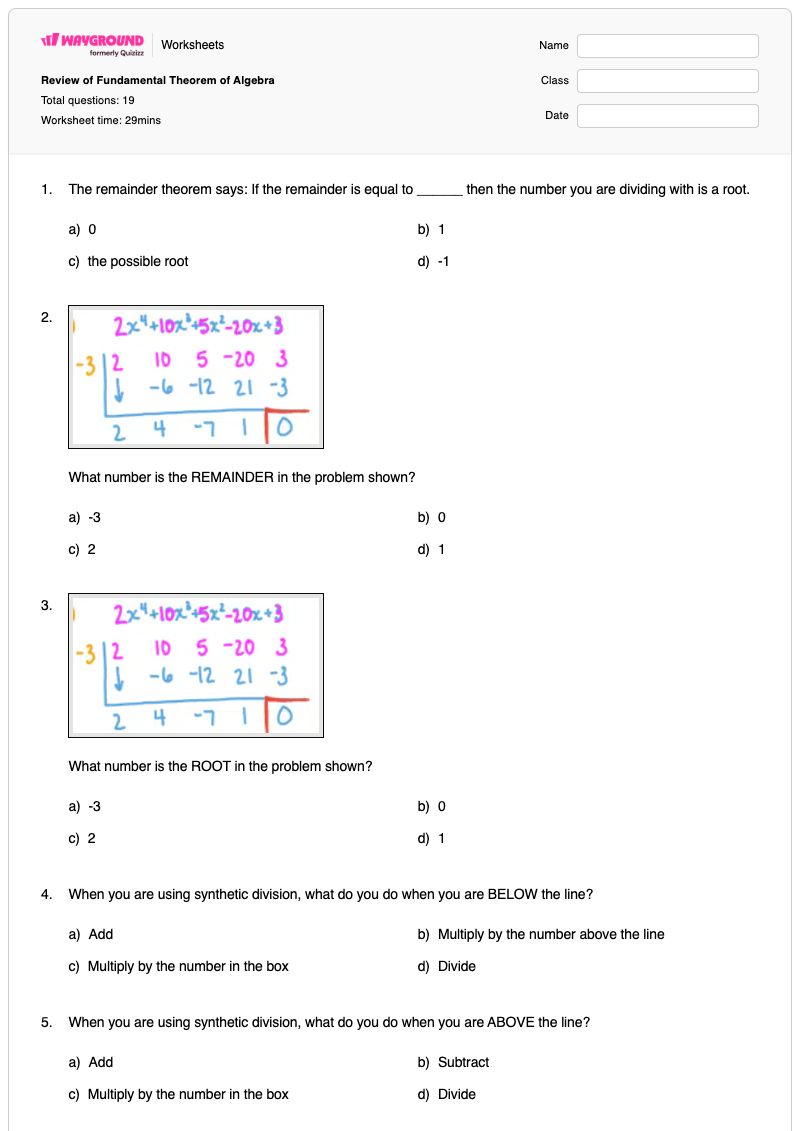
2.
What number is the REMAINDER in the problem shown?
a)
-3
b)
0
c)
2
d)
1
3.
What number is the ROOT in the problem shown?
a)
-3
b)
0
c)
2
d)
1
4.
When you are using synthetic division, what do you do when you are BELOW the line?
a)
Add
b)
Multiply by the number above the line
c)
Multiply by the number in the box
d)
Divide
5.
When you are using synthetic division, what do you do when you are ABOVE the line?
a)
Add
b)
Subtract
c)
Multiply by the number in the box
d)
Divide
6.
How do you know how many roots an equation has?
a)
The largest coefficient
b)
The number of powers
c)
The largest power
d)
They always have 2
7.
How many roots would the pictured equation have?
(a)
8.
How many roots would the pictured equation have?
(a)
9.
When we are done synthetic dividing we want our new power to be _____ so that we can factor or use quadratic formula.
a)
one
b)
three
c)
four
d)
two
10.
How many times would you have to do synthetic division in this problem when finding roots?
a)
2
b)
1
c)
3
d)
4
11.
How many times would you have to do synthetic division in this problem when finding roots?
a)
2
b)
1
c)
3
d)
4
12.
When given a root, we know we divided correctly if our remainder is:
(a)
13.
When starting the quadratic formula for this problem, you start with:
a)
-8
b)
1
c)
8
d)
-26
14.
When starting the quadratic formula for this problem, you start with:
a)
-4
b)
4
c)
1
d)
-5
15.
What would you type in the calculator : 2(1)8±(−8)2−4(1)(−26) ?
a)
The entire thing
b)
(−8)2−4(1)(−26)
c)
(−8)2−4(1)(−26)
d)
8±(−8)2−4(1)(−26)
16.
What do you type now?: 28±168
a)
2(8±168)
b)
2(8+168)
c)
2(8168)
d)
2(8+168)
17.
What do you get as answers?: 28±168
a)
14.5, 1.5
b)
10.5, -2.5
c)
14.5
d)
10.5
18.
What would you type in the calculator : 2(1)−4±(4)2−4(1)(−5) ?
a)
(4)2−4(1)(−5)
b)
(4)2−4(1)(−5)
c)
The entire thing
d)
−4±(4)2−4(1)(−5)
19.
What do you get as answers?: 2−4±36
a)
7, -7
b)
1
c)
1, 7
d)
1, -5
Answer Key
Review of Fundamental Theorem of Algebra
Total questions: 19
1.
a)
0
2.
b)
0
3.
a)
-3
4.
c)
Multiply by the number in the box
5.
a)
Add
6.
c)
The largest power
7.
5, five
8.
2, two
9.
d)
two
10.
a)
2
11.
b)
1
12.
0, zero
13.
c)
8
14.
a)
-4
15.
c)
(−8)2−4(1)(−26)
16.
b)
2(8+168)
17.
b)
10.5, -2.5
18.
a)
(4)2−4(1)(−5)
19.
d)
1, -5
140 %
Browse by subjects
Browse by grades
Browse by format
FAQs
What does the Review of Fundamental Theorem of Algebra worksheet cover?
This Grade 10–12 mathematics worksheet reviews how to use the remainder theorem, interpret roots and remainders, carry out the add-and-multiply steps of synthetic division, count roots from a polynomial’s highest power, and begin the quadratic formula. Its 19 items use multiple-choice and fill-in-the-blank formats to check both procedural knowledge and decisions such as how many synthetic divisions are required.
How can I use this worksheet to teach the remainder theorem and synthetic division?
Use the worksheet after modeling one synthetic-division example, pausing to connect a zero remainder with a valid root. Have students explain why the number in the box is used for multiplication below the line and why values are added above the line, then complete the questions that ask when the process is finished and how many divisions are needed before applying factoring or the quadratic formula.
What mistakes should I watch for when students complete this polynomial review worksheet?
Watch for students reversing the meanings of root and remainder, choosing a nonzero remainder even when a given value is a root, or multiplying by the wrong value during synthetic division. Students may also confuse the polynomial’s highest power with its largest coefficient, stop synthetic division before reaching a quadratic, miscount the required divisions, or copy the wrong signed coefficient when starting the quadratic formula.
How do I assign and grade this worksheet?
This worksheet is available as a printable PDF and as a digital quiz on Wayground, so you can use the same review of roots, remainders, synthetic division, and quadratic-formula setup in either format. It includes a complete answer key, and printable submissions can be graded by scanning student work with the Wayground for Teachers app.
How can I differentiate this worksheet for my students?
Use the worksheet’s Advanced Settings to adjust font spacing or choose a larger font size so the synthetic-division prompts, polynomial powers, and quadratic-formula values are easier to read. You can also apply a dyslexia-friendly font or translate the worksheet into another language while preserving its multiple-choice and fill-in-the-blank format.
Where can I find more worksheets like this on Wayground?
Wayground offers a broad collection of free printable worksheets and practice problems across subjects, with downloadable PDFs and answer keys to support mastery of essential skills and concepts. Browse more resources at https://wayground.com/en-us/worksheets.

 Worksheets


