This Grade 9–12 mathematics worksheet gives students focused practice with polynomial division, especially synthetic division. Across 15 multiple-choice questions, students organize polynomial coefficients, insert zero placeholders for missing terms, select the correct synthetic-division value from a linear factor, identify quotients and remainders, and write division results in proper form. Several items also ask students to evaluate or identify a remainder when a polynomial is divided by a factor such as x − 5, x − 3, or x + 1.
The questions are designed to strengthen accuracy with signs, coefficient order, quotient degree, and remainder notation while giving teachers opportunities to identify procedural errors. Students in Algebra or other secondary mathematics courses can use the worksheet for guided practice, independent review, or a quick check of polynomial-division fluency. It is a free printable worksheet with a complete answer key, making it practical for classroom instruction, homework, or assessment preparation.
Worksheet settings
Font size
S
M
L
XL
Worksheets
Synthetic and Long division
Total questions: 15
Name
Class
Date
1.
(2x3 - 5x2 + 3x + 7) ÷ (x - 2)
a)
2x3 - x2 + x + 9
b)
2x2 - x + 1
c)
2x2 - x + 1 + 9/x-2
d)
2x2 - 9x - 15 - 23/x-2
2.
(2x3 + 5x2 + 9) ÷ (x + 3)
a)
2x2 - x + 3
b)
2x3 - x2 + 3x
c)
2x2 + 11x + 33 + 108/x+3
d)
2x2 - 5x + 12
3.
(3x3 - 2x2 - 7x + 6) ÷ (x + 1)
a)
3x3 - 5x2 - 2x + 8
b)
3x2 + x - 6
c)
3x2 - 5x - 2 + 8/x+1
d)
3x3 + x2 - 6x
4.
(2x3 + 7x2 - 6x - 8) ÷ (x + 4)
a)
2x2 - x - 2
b)
2x3 - x2 - 2x
c)
2x2 + 15x + 54 + 208/x+4
d)
2x3 + 15x2 + 54x + 208
5.
What should be the order of the polynomial coefficients if (3x - 4x3+ 6x4 + 1) / (x + 3)
a)
3 0 -4 6 1
b)
6 -4 3 1 0
c)
6 -4 0 3 1
d)
-6 4 0 -3 -1
6.
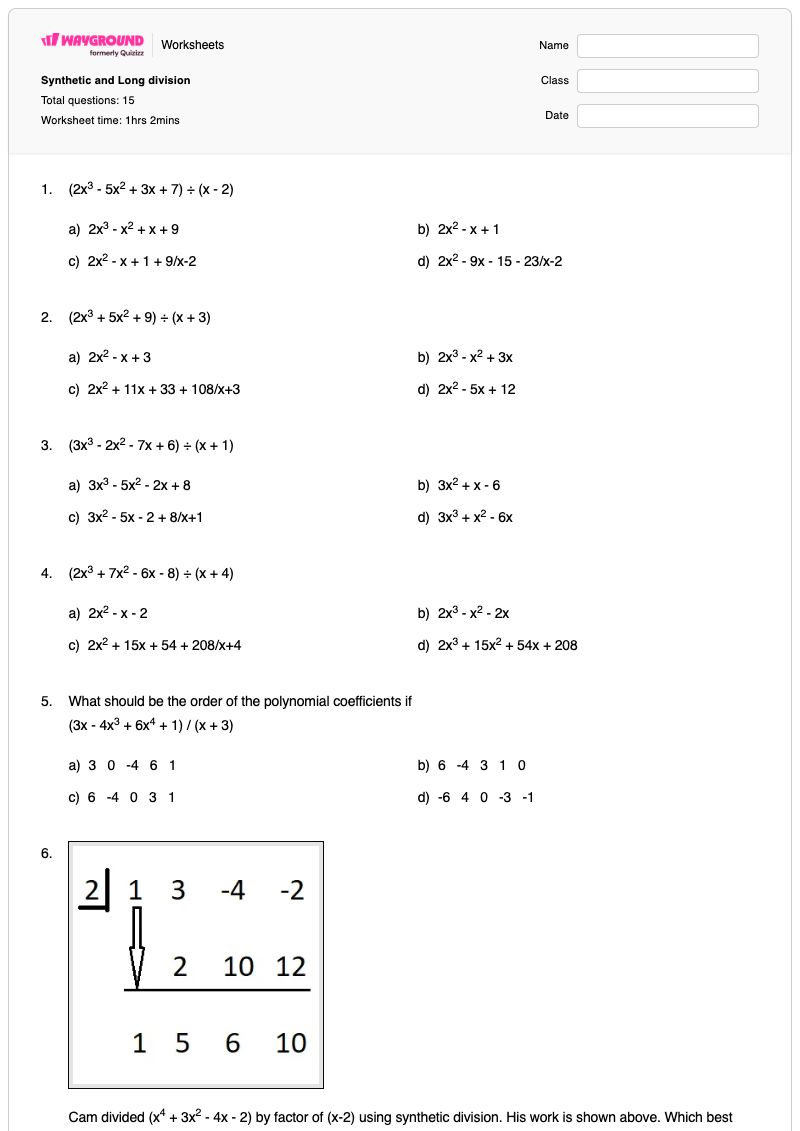
Cam divided (x4 + 3x2 - 4x - 2) by factor of (x-2) using synthetic division. His work is shown above. Which best describes his mistake?
a)
Cam wrote the remainder incorrectly.
b)
Cam did not use a zero place holder for the x3 term.
c)
Cam added instead of subtracting the rows.
d)
Cam should have used -2 as his division since the factor was x-2.
7.
What is the proper way to write the answer for the following problem?
a)
2x3-x2-25x+12
b)
2x4-x3-25x2-12x+0
c)
2x3-x2-25x-12
d)
2x4-x3-25x2-12x-0
8.
a)
x - 7
b)
x2 - 7
c)
x + 7
d)
x2 + 3x - 54
9.
What is the remainder of (4x3 - 3x2 - 4x +2) ÷ (x - 3)?
a)
-71
b)
71
c)
145
10.
What is the remainder of (x3 - 5x2 - 8x +1) ÷ (x + 1)?
a)
-13
b)
1
c)
3
11.
What is the remainder R when the polynomial p(x) is divided by (x-5)? p(x) = x3 - 5x2 + 2x - 10
a)
0
b)
2x-10
c)
-2x-10
d)
2x+10
12.
a)
A
b)
B
c)
C
d)
D
13.
What is the proper way to write the answer for the following problem?
a)
2x3-x2-25x-12
b)
2x4-x3-25x2-12x+0
14.
What is the proper way to write the answer for the following problem?
a)
2x3-x2-25x-12
b)
2x4-x3-25x2-12x+0
15.
Divide using synthetic division (2x³ + 4x² - 5) by (x + 3).
a)
2x² + 2x - 4 R(-12)
b)
2x² - 2x + 6 R(-23)
c)
2x² - 2x + 8 R(-20)
d)
2x² - 4x + 1 R0
Answer Key
Synthetic and Long division
Total questions: 15
1.
c) 2x2 - x + 1 + 9/x-2
2.
a) 2x2 - x + 3
3.
c) 3x2 - 5x - 2 + 8/x+1
4.
a) 2x2 - x - 2
5.
c) 6 -4 0 3 1
6.
b)
Cam did not use a zero place holder for the x3 term.
7.
c)
2x3-x2-25x-12
8.
a) x - 7
9.
b)
71
10.
c)
3
11.
a) 0
12.
c)
C
13.
a) 2x3-x2-25x-12
14.
a) 2x3-x2-25x-12
15.
b) 2x² - 2x + 6 R(-23)
140 %
Browse by subjects
Browse by grades
Browse by format
FAQs
What does the Synthetic and Long division worksheet cover?
This worksheet covers polynomial division through 15 multiple-choice questions focused largely on synthetic division. Students practice ordering coefficients, using zero placeholders for missing powers, choosing the correct divisor value, finding quotients and remainders, and writing answers in proper quotient-and-remainder form.
How can I use this worksheet to teach synthetic division?
Introduce the coefficient-ordering items first, emphasizing that a missing term such as x³ must be represented by a zero coefficient. Then model how the factor determines the synthetic value—for example, x − 2 uses 2, while x + 3 uses −3—and have students apply the process to the quotient and remainder questions. Use the error-analysis item about a missing zero placeholder as a discussion prompt before assigning the remaining multiple-choice problems independently.
What mistakes should I watch for when students complete this polynomial-division worksheet?
Watch for students omitting a zero placeholder when a polynomial lacks a power, using the wrong sign for the synthetic value, or confusing the final synthetic-division entry with a quotient coefficient. Students may also write the quotient with the original polynomial’s degree or misstate the remainder, so check that the quotient degree is one less than the dividend’s degree and that the remainder is reported separately when required.
How do I assign and grade this polynomial-division worksheet?
The worksheet is available as a printable PDF and as a digital quiz on Wayground, and it includes a complete answer key for the 15 multiple-choice questions. You can grade printable submissions by scanning student work with the Wayground for Teachers app. The printable format also supports classrooms that are reducing screen time.
How can I differentiate this synthetic-division worksheet for my students?
Under the worksheet’s Advanced Settings, adjust font spacing or choose a larger font size to make the coefficient arrays, polynomial expressions, and answer choices easier to scan. You can also enable a dyslexia-friendly font or translate the worksheet into another language while retaining the synthetic-division question format.
Where can I find more worksheets like this on Wayground?
Wayground offers a broad collection of free printable worksheets and practice problems across all subjects, with downloadable PDFs and answer keys to support mastery of essential skills and concepts. Browse more resources at https://wayground.com/en-us/worksheets.

 Worksheets


