

Wayground
El Nino and La Nina - Printable Science Worksheets - Wayground

El Nino and La Nina

10 questions

8th - 8th Grade

Science

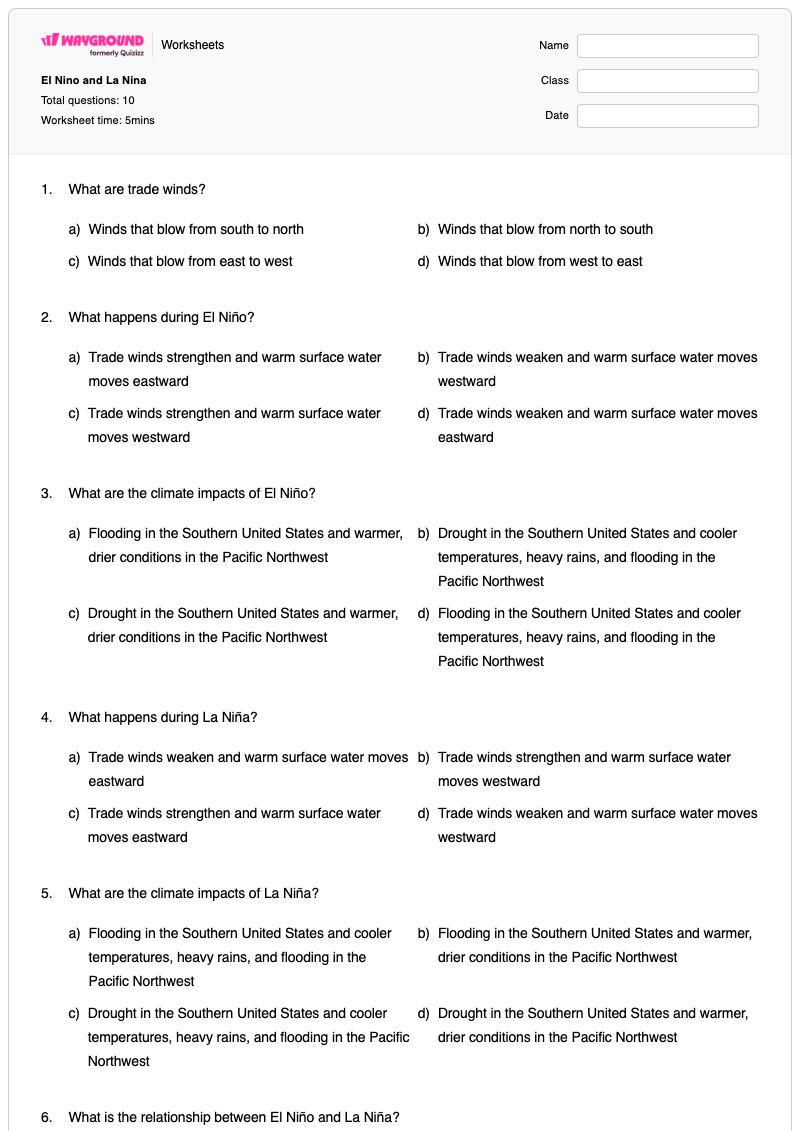
El Nino and La Nina is a Grade 8 science worksheet with 10 multiple-choice questions that checks students’ understanding of trade winds, ocean-surface movement, and the opposite phases of the El Nino–La Nina cycle. Students identify how weakened or strengthened trade winds shift warm water, connect each phase to regional climate impacts, and examine effects on the jet stream. The questions also ask students to recognize how these climate patterns can influence extreme weather, food production, water supply, and human health. This free printable worksheet is useful for introducing or reviewing the causes and effects of El Nino and La Nina, checking vocabulary and cause-and-effect reasoning, or assessing understanding after instruction. It includes a complete answer key for efficient review and grading.

Worksheet settings

Font size

S
M
L
XL
Worksheets

El Nino and La Nina

Total questions: 10

Name
Class
Date
1.

What are trade winds?

a)

Winds that blow from south to north

b)

Winds that blow from north to south

c)

Winds that blow from east to west

d)

Winds that blow from west to east

2.

What happens during El Niño?

a)

Trade winds strengthen and warm surface water moves eastward

b)

Trade winds weaken and warm surface water moves westward

c)

Trade winds strengthen and warm surface water moves westward

d)

Trade winds weaken and warm surface water moves eastward

3.

What are the climate impacts of El Niño?

a)

Flooding in the Southern United States and warmer, drier conditions in the Pacific Northwest

b)

Drought in the Southern United States and cooler temperatures, heavy rains, and flooding in the Pacific Northwest

c)

Drought in the Southern United States and warmer, drier conditions in the Pacific Northwest

d)

Flooding in the Southern United States and cooler temperatures, heavy rains, and flooding in the Pacific Northwest

4.

What happens during La Niña?

a)

Trade winds weaken and warm surface water moves eastward

b)

Trade winds strengthen and warm surface water moves westward

c)

Trade winds strengthen and warm surface water moves eastward

d)

Trade winds weaken and warm surface water moves westward

5.

What are the climate impacts of La Niña?

a)

Flooding in the Southern United States and cooler temperatures, heavy rains, and flooding in the Pacific Northwest

b)

Flooding in the Southern United States and warmer, drier conditions in the Pacific Northwest

c)

Drought in the Southern United States and cooler temperatures, heavy rains, and flooding in the Pacific Northwest

d)

Drought in the Southern United States and warmer, drier conditions in the Pacific Northwest

6.

What is the relationship between El Niño and La Niña?

a)

They have no relationship

b)

El Niño and La Niña are the same phenomenon

c)

El Niño and La Niña are opposite phases of a cycle

d)

El Niño and La Niña occur simultaneously

7.

What can El Niño and La Niña influence?

a)

Only weather in Asia

b)

Only weather in the United States

c)

Only ocean temperatures

d)

Extreme weather, food production, water supply, and human health

8.

What is the impact of El Niño on the jet stream?

a)

Weakening and southward shift

b)

Intensification and southward shift

c)

Weakening and northward shift

d)

Intensification and northward shift

9.

What is the impact of La Niña on the jet stream?

a)

Intensification and northward shift

b)

Weakening and northward shift

c)

Intensification and southward shift

d)

Weakening and southward shift

10.

What happens when trade winds become stronger than normal?

a)

They blow cool water back into the eastern Pacific and restart the upwelling of warm water in the western Pacific

b)

They blow cool water back into the western Pacific and restart the upwelling of warm water in the eastern Pacific

c)

They blow warm water back into the western Pacific and restart the upwelling of cool water in the eastern Pacific

d)

They blow warm water back into the eastern Pacific and restart the upwelling of cool water in the western Pacific

Answer Key

El Nino and La Nina

Total questions: 10

1.
c)

Winds that blow from east to west

2.
d)

Trade winds weaken and warm surface water moves eastward

3.
a)

Flooding in the Southern United States and warmer, drier conditions in the Pacific Northwest

4.
c)

Trade winds strengthen and warm surface water moves eastward

5.
c)

Drought in the Southern United States and cooler temperatures, heavy rains, and flooding in the Pacific Northwest

6.
c)

El Niño and La Niña are opposite phases of a cycle

7.
d)

Extreme weather, food production, water supply, and human health

8.
b)

Intensification and southward shift

9.
a)

Intensification and northward shift

10.
c)

They blow warm water back into the western Pacific and restart the upwelling of cool water in the eastern Pacific

FAQs

What does this El Nino and La Nina worksheet help Grade 8 students understand?

This 10-question multiple-choice worksheet helps students connect trade-wind changes with the movement of warm and cool Pacific Ocean water during El Nino and La Nina. It also checks whether they can distinguish the opposite phases of the cycle and identify related regional climate impacts, jet-stream shifts, and effects on extreme weather, food production, water supply, and human health.

How can I use this worksheet to teach El Nino and La Nina?

Introduce the worksheet by reviewing the direction of trade winds and tracing how weakened or strengthened winds move warm surface water in the Pacific. Have students explain each selected answer, especially when comparing the climate impacts and jet-stream changes associated with El Nino and La Nina, then use the final trade-wind item to discuss ocean upwelling and the cycle’s return to cooler eastern Pacific water.

What mistakes should I watch for when students complete this El Nino and La Nina worksheet?

Watch for students reversing the east-to-west direction of trade winds or confusing which phase weakens or strengthens them. Students may also mix up the westward and eastward movement of warm surface water, swap the climate impacts of El Nino and La Nina, or reverse the southward and northward jet-stream shifts. The final item may reveal confusion about warm-water movement and cool-water upwelling.

How do I assign and grade this El Nino and La Nina worksheet?

On Wayground, you can use this worksheet as a printable PDF or assign it as a digital quiz containing the same 10 multiple-choice questions. A complete answer key is included, and printable student work can be graded by scanning it with the Wayground for Teachers app. The printable format can also support schools that are reducing screen time.

How can I differentiate this El Nino and La Nina worksheet for my students?

Use the worksheet’s Advanced Settings to adjust font spacing or increase the font size so the multiple-choice options are easier to read. You can also apply a dyslexia-friendly font or translate the worksheet into another language when students need those file-level supports.

Where can I find more worksheets like this on Wayground?

Wayground offers a comprehensive collection of free printable worksheets and practice problems across subjects, with downloadable PDFs and answer keys to support essential skills and concepts. Browse more resources at https://wayground.com/en-us/worksheets.