

Wayground
Zones of Emotional Regulation - Printable Other Worksheets - Wayground

Zones of Emotional Regulation

14 questions

9th - 9th Grade

Other

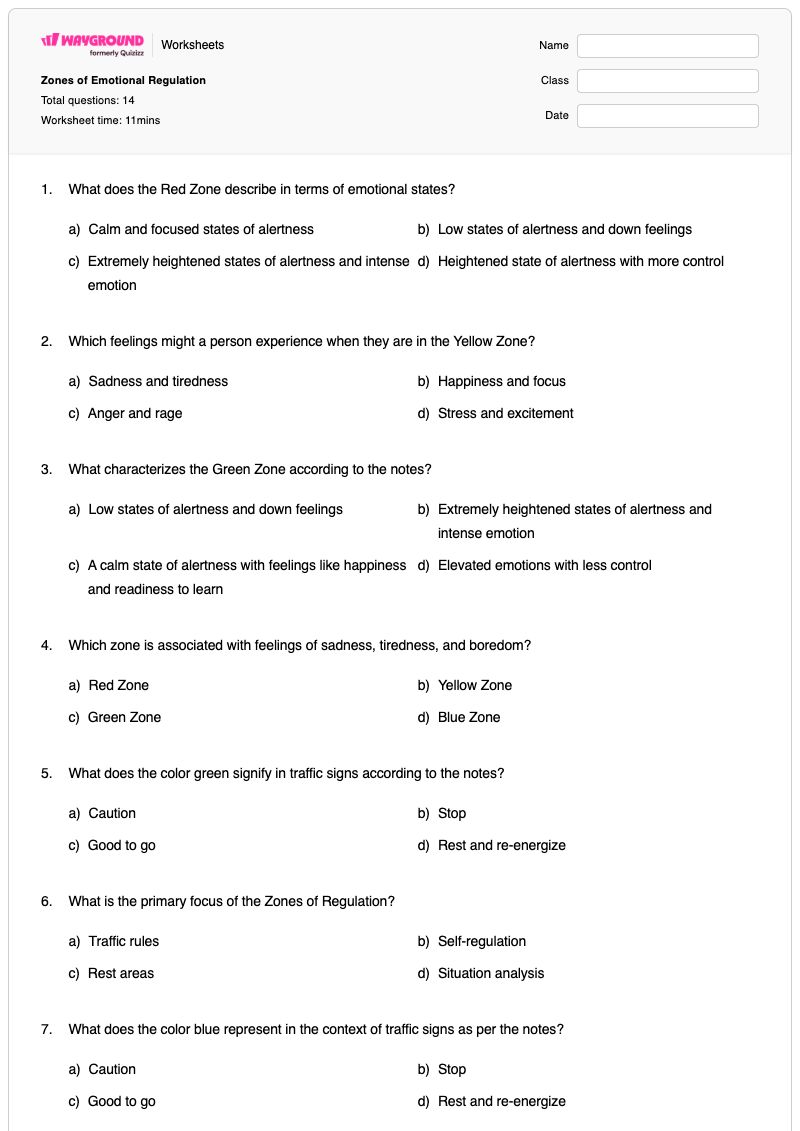
Zones of Emotional Regulation is a free printable Grade 9 worksheet that introduces the four color-coded emotional zones and their levels of alertness. Through 14 multiple-choice questions, students identify the Red Zone as intense emotion, the Yellow Zone as heightened alertness with less control, the Green Zone as calm readiness to learn, and the Blue Zone as low energy or down feelings. The worksheet also uses traffic-signal comparisons and everyday scenarios to connect each zone with situations such as illness, excitement, disappointment, or frustration. Students review that self-regulation is the focus and that experiencing all zones is natural. This worksheet is useful for checking whether students can recognize emotional states and apply the zone labels to brief scenarios, rather than simply memorize definitions. It includes a complete answer key for efficient review and is available as a free printable worksheet for classroom instruction, independent practice, or formative assessment.

Worksheet settings

Font size

S
M
L
XL
Worksheets

Zones of Emotional Regulation

Total questions: 14

Name
Class
Date
1.

What does the Red Zone describe in terms of emotional states?

a)

Calm and focused states of alertness

b)

Low states of alertness and down feelings

c)

Extremely heightened states of alertness and intense emotion

d)

Heightened state of alertness with more control

2.

Which feelings might a person experience when they are in the Yellow Zone?

a)

Sadness and tiredness

b)

Happiness and focus

c)

Anger and rage

d)

Stress and excitement

3.

What characterizes the Green Zone according to the notes?

a)

Low states of alertness and down feelings

b)

Extremely heightened states of alertness and intense emotion

c)

A calm state of alertness with feelings like happiness and readiness to learn

d)

Elevated emotions with less control

4.

Which zone is associated with feelings of sadness, tiredness, and boredom?

a)

Red Zone

b)

Yellow Zone

c)

Green Zone

d)

Blue Zone

5.

What does the color green signify in traffic signs according to the notes?

a)

Caution

b)

Stop

c)

Good to go

d)

Rest and re-energize

6.

What is the primary focus of the Zones of Regulation?

a)

Traffic rules

b)

Self-regulation

c)

Rest areas

d)

Situation analysis

7.

What does the color blue represent in the context of traffic signs as per the notes?

a)

Caution

b)

Stop

c)

Good to go

d)

Rest and re-energize

8.

What is advised to be natural according to the concluding notes?

a)

Experiencing all the zones

b)

Ignoring traffic signs

c)

Focusing only on green and red

d)

Avoiding self-regulation

9.

Scenario where the blue zone would be expected.

a)

You win the lottery.

b)

You see your best friend after a long time.

c)

You're sick and cannot go to an event.

10.

What does the Yellow Zone typically indicate in terms of traffic signal colors?

a)

Proceed with caution

b)

Stop immediately

c)

Go if the way is clear

d)

General warning

11.

Which emotional state is not typically associated with the Red Zone?

a)

Excitement

b)

Calmness

c)

Frustration

d)

Anxiety

12.

Scenario where the green zone would be expected.

a)

Any Saturday or Sunday.

b)

You're in a car accident.

c)

You fail a test.

13.

Scenario where the yellow zone would be expected.

a)

You win a trip.

b)

Your friend moved away.

c)

Your favorite team lost their game.

14.

Scenario where the red zone would be expected.

a)

You play your favorite game for hours.

b)

You lose the game by 35 points.

c)

You get to spend the day doing everything you want to do.

Answer Key

Zones of Emotional Regulation

Total questions: 14

1.
c)

Extremely heightened states of alertness and intense emotion

2.
d)

Stress and excitement

3.
c)

A calm state of alertness with feelings like happiness and readiness to learn

4.
d)

Blue Zone

5.
c)

Good to go

6.
b)

Self-regulation

7.
d)

Rest and re-energize

8.
a)

Experiencing all the zones

9.
c)

You're sick and cannot go to an event.

10.
a)

Proceed with caution

11.
b)

Calmness

12.
a)

Any Saturday or Sunday.

13.
a)

You win a trip.

14.
b)

You lose the game by 35 points.

FAQs

What does the Zones of Emotional Regulation worksheet help Grade 9 students learn?

This worksheet helps students distinguish the Blue, Green, Yellow, and Red Zones by their emotional states and levels of alertness. Its 14 multiple-choice questions also ask students to apply those definitions to everyday scenarios, such as being sick, winning a trip, or losing a game, while connecting the zones to traffic-signal meanings.

How can I use this worksheet to teach the four emotional regulation zones?

Introduce the four zones and their emotional characteristics before students complete the multiple-choice items. Then pause on the scenario questions and ask students to explain which details signal a Blue, Green, Yellow, or Red Zone response, reinforcing that the goal is self-regulation and that experiencing every zone is natural.

What mistakes should I watch for when students complete this emotional regulation worksheet?

Students may confuse the Yellow Zone’s heightened alertness with the Red Zone’s intense emotion and reduced control. They may also reverse the Blue and Green Zones, selecting Green for low-energy feelings or Blue for calm readiness to learn. In the scenario items, check that students use the situation described rather than choosing a zone based only on whether the event sounds positive or negative.

How do I assign and grade the Zones of Emotional Regulation worksheet?

The worksheet is available as a printable PDF and as a digital quiz on Wayground, and it includes a complete answer key for all 14 multiple-choice questions. You can grade printable submissions by scanning student work with the Wayground for Teachers app, or use the digital quiz for online responses and results.

How can I differentiate this emotional regulation worksheet for my students?

Under the worksheet’s Advanced Settings, adjust font spacing and font size to make the zone definitions, traffic-signal comparisons, and scenario choices easier to read. You can also enable a dyslexia-friendly font or translate the worksheet into another language when that better supports access to its emotional-regulation vocabulary.

Where can I find more worksheets like this on Wayground?

Wayground offers a comprehensive collection of free printable worksheets and practice problems across subjects, with downloadable PDFs and answer keys to support essential skills and concepts. Browse more resources at https://wayground.com/en-us/worksheets.