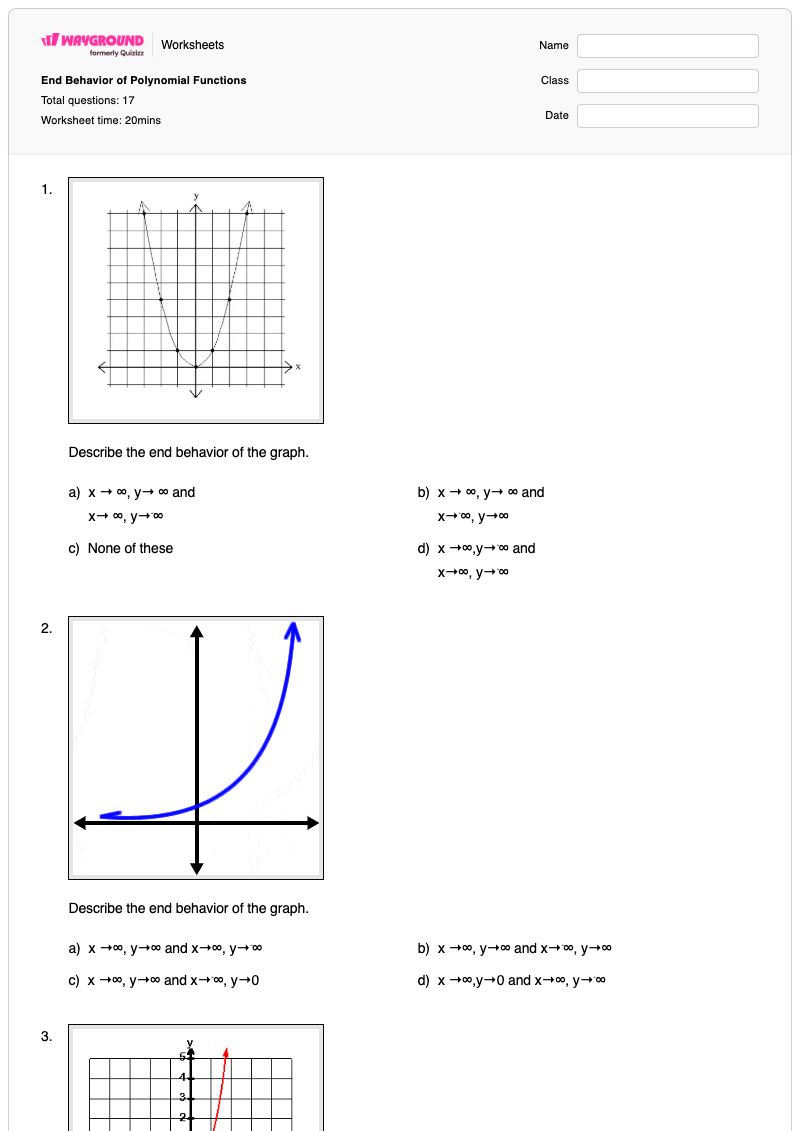

End Behavior of Polynomial Functions is a Grade 9 mathematics worksheet that develops students’ ability to interpret how polynomial graphs behave as x approaches positive and negative infinity. Across 17 multiple-choice questions, students describe graph end behavior, identify whether the degree is even or odd, determine the sign of the leading coefficient, and connect these features to the graph’s direction.
The worksheet also asks students to analyze polynomial equations, including putting a polynomial in standard form before determining its end behavior, completing limits written with infinity notation, identifying a leading coefficient’s sign from a graph, and selecting an equation that matches a stated end behavior. It is designed for guided practice, independent review, or a focused assessment of Grade 9 students’ understanding of how degree and leading-coefficient sign control polynomial graphs. This free printable worksheet includes a complete answer key.
Worksheet settings
Font size
S
M
L
XL
Worksheets
End Behavior of Polynomial Functions
Total questions: 17
Name
Class
Date
1.
Describe the end behavior of the graph.
a)
x → ∞, y→ ∞ and x→ ∞, y→⁻∞
b)
x → ∞, y→ ∞ and x→⁻∞, y→∞
c)
None of these
d)
x →∞,y→⁻∞ and x→∞, y→⁻∞
2.
Describe the end behavior of the graph.
a)
x →∞, y→∞ and x→∞, y→⁻∞
b)
x →∞, y→∞ and x→⁻∞, y→∞
c)
x →∞, y→∞ and x→⁻∞, y→0
d)
x →∞,y→0 and x→∞, y→⁻∞
3.
Describe the end behavior of the graph.
a)
x → ∞, y→ ∞ and x→∞, y→⁻∞
b)
x → ∞, y→ ∞ and x→⁻∞, y→∞
c)
x → ∞, y→ ∞ and x→⁻∞, y→ 0
d)
x → ∞,y→ ∞and x→ ⁻∞, y→ ⁻∞
4.
Describe the end behavior of the graph.
a)
x →∞, y→⁻∞ and x →⁻∞,y→⁻∞
b)
x →∞, y→∞ and x→⁻∞, y→∞
c)
x →∞, y→∞ and x→⁻∞, y→0
d)
x →∞,y→∞ and x→⁻∞, y→⁻∞
5.
Identify the degree of the polynomial and the sign of the leading coefficient
a)
Leading Coefficient Positive
Degree - Even
b)
Leading Coefficient Positive
Degree - Odd
c)
Leading Coefficient Negative
Degree - Even
d)
Leading Coefficient Negative
Degree - Odd
6.
Identify the degree of the polynomial and the sign of the leading coefficient
a)
Leading Coefficient Positive
Degree - Even
b)
Leading Coefficient Positive
Degree - Odd
c)
Leading Coefficient Negative
Degree - Even
d)
Leading Coefficient Negative
Degree - Odd
7.
The end behavior of a polynomial function is determined by the degree and the sign of the leading coefficient. Identify the degree of the polynomial and the sign of the leading coefficient
a)
Leading Coefficient Positive Degree - Even
b)
Leading Coefficient Positive Degree - Odd
c)
Leading Coefficient Negative Degree - Even
d)
Leading Coefficient Negative Degree - Odd
8.
Identify the degree of the polynomial and the sign of the leading coefficient
a)
Leading Coefficient Positive
Degree - Even
b)
Leading Coefficient Positive
Degree - Odd
c)
Leading Coefficient Negative
Degree - Even
d)
Leading Coefficient Negative
Degree - Odd
9.
Describe the end behavior of the function. y = 4x10
a)
down and down
b)
down and up
c)
up and down
d)
up and up
10.
Describe the end behavior of the function. (Put the polynomial in standard form first*) y = -6x + 4 + 9x3
a)
down and down
b)
down and up
c)
up and down
d)
up and up
11.
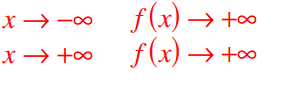
In the above graph complete the following end behavior: As x --> -∞, f(x) --> ____ As x --> +∞, f(x) --> ____
a)
-∞ -∞
b)
+∞ -∞
c)
-∞ +∞
d)
+∞ +∞
12.
In the above graph complete the following end behavior: (f(x)=y) As x --> -∞, f(x) --> ____ As x --> +∞, f(x) --> ____
a)
-∞ -∞
b)
+∞ -∞
c)
-∞ +∞
d)
+∞ +∞
13.
Using the above graph what is the sign of the leading coefficient?
a)
Positive
b)
Negative
14.
Which function has this end behavior? Note: f(x)=y
a)
-x2-3x+1
b)
-x3+2x2+3
c)
x4+3x3-4x+1
d)
x5-4x4+2x2-1
15.
Which function has this end behavior? Note: f(x)=y
a)
-1x4-3x3+3
b)
-2x7+2x4+4
c)
3x8+3x5-4x+7
d)
4x5-4x4+2x3-9
16.
Determine the end behavior of the graph of
f(x) = 3x4 + 2x - 5
a)
As x →∞, f(x) →∞.
As x→-∞, f(x) →-∞.
b)
As x →∞, f(x) →∞.
As x→-∞, f(x) →∞.
c)
As x →∞, f(x) →-∞.
As x→-∞, f(x) →∞.
d)
As x →∞, f(x) →-∞.
As x→-∞, f(x) →-∞.
17.
What is the degree of this polynomial function? Is the leading coefficient positive or negative?
(Note: quartic means 4th degree, cubic means 3rd degree polynomials)
a)
A fourth degree polynomial with a negative leading coefficient.
b)
A fourth degree polynomial with a positive leading coefficient.
c)
A cubic polynomial with a negative leading coefficient.
d)
A cubic polynomial with a positive leading coefficient.
Answer Key
End Behavior of Polynomial Functions
Total questions: 17
1.
b) x → ∞, y→ ∞ and x→⁻∞, y→∞
2.
c) x →∞, y→∞ and x→⁻∞, y→0
3.
d) x → ∞,y→ ∞and x→ ⁻∞, y→ ⁻∞
4.
a) x →∞, y→⁻∞ and x →⁻∞,y→⁻∞
5.
b)
Leading Coefficient Positive
Degree - Odd
6.
a)
Leading Coefficient Positive
Degree - Even
7.
d) Leading Coefficient Negative Degree - Odd
8.
c)
Leading Coefficient Negative
Degree - Even
9.
d) up and up
10.
b) down and up
11.
a) -∞ -∞
12.
d) +∞ +∞
13.
b) Negative
14.
c) x4+3x3-4x+1
15.
b) -2x7+2x4+4
16.
b)
As x →∞, f(x) →∞.
As x→-∞, f(x) →∞.
17.
b)
A fourth degree polynomial with a positive leading coefficient.
140 %
Browse by subjects
Browse by grades
Browse by format
FAQs
What does the End Behavior of Polynomial Functions worksheet cover?
This Grade 9 worksheet uses 17 multiple-choice questions to practice describing what happens to a polynomial graph as x approaches positive or negative infinity. Students infer end behavior from graphs, classify degree parity and leading-coefficient sign, evaluate equations such as y = 4x¹⁰, and match a graph’s end behavior to a polynomial function. These tasks build the skill of connecting a polynomial’s leading term to the direction of both ends of its graph.
How can I use this worksheet to teach polynomial end behavior?
Begin by reviewing the four combinations of even or odd degree and positive or negative leading coefficient, then have students predict whether each graph end rises or falls. Use the worksheet’s graph-based questions before moving to equation-based items, so students connect visual behavior with the leading term. For expressions such as y = -6x + 4 + 9x³, ask students to rewrite the polynomial in standard form and identify the highest-degree term before choosing an answer.
What mistakes should I watch for when students complete this worksheet?
Students may reverse the meanings of x approaching negative infinity and positive infinity, or report the graph’s left-end behavior as its right-end behavior. They may also confuse the effect of degree parity with the effect of the leading coefficient, especially when choosing among the four classifications. In the equation items, check that students put a polynomial such as -6x + 4 + 9x³ in standard form and use its highest-degree term rather than a lower-degree term.
How do I assign and grade this polynomial end behavior worksheet?
On Wayground, the worksheet is available both as a printable PDF and as a digital quiz, and it includes a complete answer key for the 17 multiple-choice questions. You can grade printable submissions by scanning student work with the Wayground for Teachers app, or use the digital quiz for online response collection and grading.
How can I differentiate this worksheet for my students?
Use the worksheet’s Advanced Settings to adjust font spacing or increase the font size so the graph-based choices, infinity notation, and polynomial expressions are easier to read. You can also enable a dyslexia-friendly font or translate the worksheet into another language while keeping the multiple-choice structure focused on polynomial end behavior.
Where can I find more free worksheets like this on Wayground?
Wayground offers a comprehensive collection of free printable worksheets and practice problems across all subjects, with downloadable PDFs and answer keys to support essential skills and concepts. Browse more resources at https://wayground.com/en-us/worksheets.