
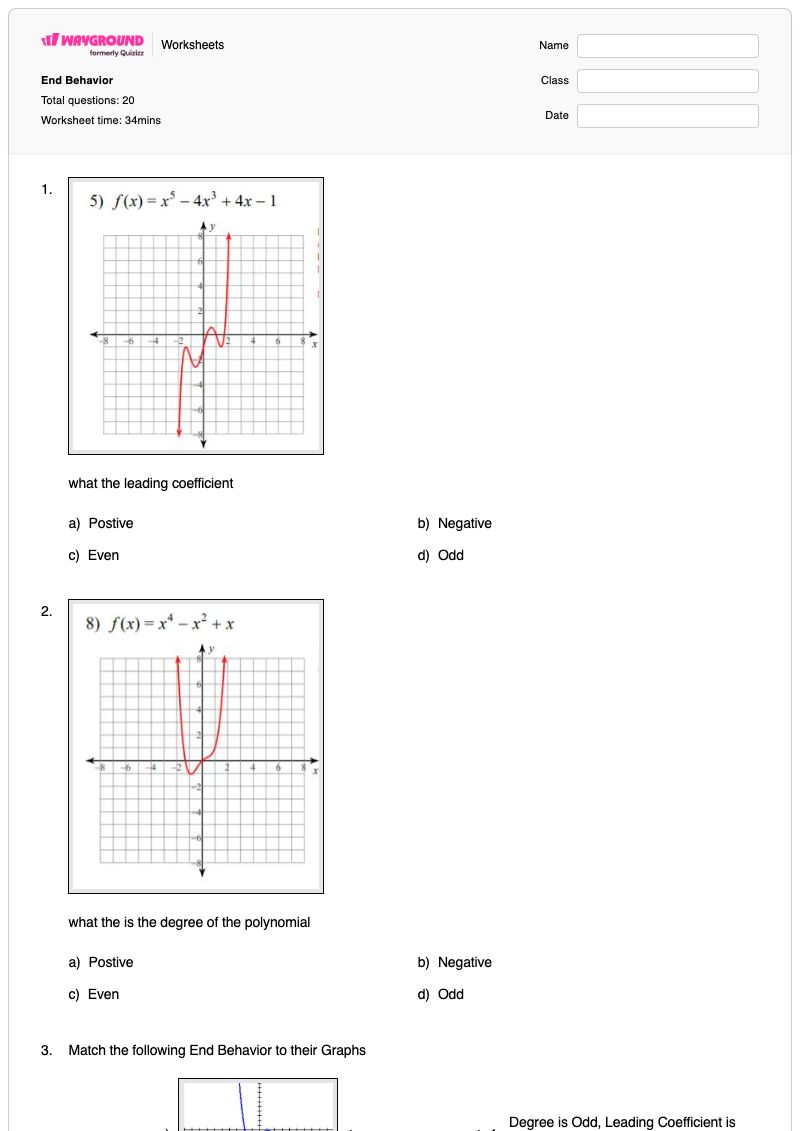

End Behavior is a Grade 10 mathematics worksheet that helps students analyze how polynomial graphs behave at their left and right ends. The 20-question set asks students to identify a polynomial’s degree and leading coefficient, recognize whether the degree is odd or even and the coefficient is positive or negative, complete end-behavior statements, and interpret graph-based examples. It includes 18 multiple-choice questions, one matching activity that connects end behaviors to graphs, and one multiple-select question about even-degree polynomials.
Students use both symbolic information and visual evidence to describe end behavior, making this worksheet useful for guided practice, independent work, or a formative check after instruction. The graph-matching and graph-description items reinforce the connection between polynomial features and the direction a graph takes on each side. This free printable worksheet includes a complete answer key for efficient review and grading, and it is also available as a digital quiz on Wayground.
Worksheet settings
Font size
S
M
L
XL
Worksheets
End Behavior
Total questions: 20
Name
Class
Date
1.
what the leading coefficient
a)
Postive
b)
Negative
c)
Even
d)
Odd
2.
what the is the degree of the polynomial
a)
Postive
b)
Negative
c)
Even
d)
Odd
3.
Match the following End Behavior to their Graphs
Degree is Odd, Leading Coefficient is Negative
Degree is Odd, Leading Coefficient is Positive
Degree is Even, Leading Coefficient is Negative
Degree is Even, Leading Coefficient is Positive
4.
What is the degree of the polynomial?
f(x)=2x4−3x2−2x−4?
a)
4
b)
3
c)
2
d)
1
5.
Check all the even degree polynomials:
a)
b)
c)
d)
e)
6.
What of the following is a correct end behavior?
a)
asx⟶∞,f(x)⟶∞
b)
asx⟶∞,f(x)⟶−∞
7.
What of the following is a correct end behavior?
a)
asx⟶−∞,f(x)⟶∞
b)
asx⟶−∞,f(x)⟶−∞
8.
What is the degree?
a)
Positive
b)
Negative
c)
Odd
d)
Even
9.
What is the leading coefficient?
a)
Positive
b)
Negative
c)
Odd
d)
Even
10.
In the above graph complete the following end behavior: Asx→−∞,f(x)→ _____
Asx→∞,f(x)→ ____
a)
-∞ -∞
b)
+∞ -∞
c)
-∞ +∞
d)
+∞ +∞
11.
In the above graph complete the following end behavior: Asx→−∞,f(x)→ ____
Asx→∞,f(x)→ ____
a)
-∞ -∞
b)
+∞ -∞
c)
-∞ +∞
d)
+∞ +∞
12.
Describe the end behavior of the graph.
a)
Asx→−∞,f(x)→∞Asx→∞,f(x)→−∞
b)
Asx→−∞,f(x)→∞Asx→∞,f(x)→∞
c)
Asx→−∞,f(x)→−∞
Asx→∞,f(x)→−∞
d)
Asx→−∞,f(x)→−∞
Asx→∞,f(x)→∞
13.
Which one means the function goes up on the left
a)
Asx→−∞,f(x)→∞
b)
Asx→−∞,f(x)→−∞
14.
Which one means the function goes down on the left
a)
Asx→−∞,f(x)→∞
b)
Asx→−∞,f(x)→−∞
15.
Which one means up
a)
f(x)→−∞
b)
f(x)→∞
16.
Which one means left
a)
x→−∞
b)
x→∞
17.
Describe the end behavior of the function.
f(x)=4x10
a)
L: down and R: down
b)
L: down and R: up
c)
L: up and R: down
d)
L: up and R: up
18.
What is the end behavior of
g(x)=−2x6+2x5−12x−6
a)
up/down
b)
down/up
c)
down/down
d)
up/up
19.
What is the end behavior of
h(x)=−8x5+22x4−4x3+11x−9
a)
up/down
b)
down/up
c)
up/up
d)
down/down
20.
What is the end behavior of
k(x)=7x9+5x6−4x−22
a)
UP/UP
b)
Down/Down
c)
Up/Down
d)
Down/UP
Answer Key
End Behavior
Total questions: 20
1.
a)
Postive
2.
c)
Even
3.
-
Degree is Odd, Leading Coefficient is Negative
, -
Degree is Odd, Leading Coefficient is Positive
, -
Degree is Even, Leading Coefficient is Negative
, -
Degree is Even, Leading Coefficient is Positive
4.
a)
4
5.
a) , c) , e)
6.
a)
asx⟶∞,f(x)⟶∞
7.
b)
asx⟶−∞,f(x)⟶−∞
8.
c) Odd
9.
b) Negative
10.
a) -∞ -∞
11.
d) +∞ +∞
12.
d)
Asx→−∞,f(x)→−∞
Asx→∞,f(x)→∞
13.
a)
Asx→−∞,f(x)→∞
14.
b)
Asx→−∞,f(x)→−∞
15.
b)
f(x)→∞
16.
a)
x→−∞
17.
d)
L: up and R: up
18.
c)
down/down
19.
a)
up/down
20.
d)
Down/UP
140 %
Browse by subjects
Browse by grades
Browse by format
FAQs
What does this End Behavior worksheet help students learn?
This Grade 10 worksheet develops students’ ability to identify polynomial end behavior using the degree, leading coefficient, and graph direction. Its 20 items combine multiple-choice questions, a graph-matching activity, and a multiple-select question so students practice classifying polynomial features, completing end-behavior statements, and connecting symbolic descriptions to graphs.
How can I use this worksheet to teach polynomial end behavior?
Begin by modeling how to inspect a polynomial’s degree and leading coefficient, then show how to read the graph from left to right when describing its end behavior. Use the matching item to have students explain why each end-behavior description belongs with a particular graph, followed by the multiple-choice graph questions as independent practice. Ask students to justify whether their descriptions refer to the graph’s left end, right end, or both.
What mistakes should I watch for when students complete this end behavior worksheet?
Watch for students confusing the degree’s odd-or-even classification with the leading coefficient’s positive-or-negative sign. Students may also reverse the order of the two ends when completing statements, misread whether a graph rises or falls on the left, or select only one response on the multiple-select item when more than one even-degree polynomial applies. The graph-matching questions can reveal whether an error comes from reading the visual direction or from interpreting the polynomial features.
How do I assign and grade this End Behavior worksheet?
You can assign this End Behavior worksheet as a printable PDF or as a digital quiz on Wayground. It includes a complete answer key, and printable student work can be graded by scanning it with the Wayground for Teachers app. The printable format also gives schools an option for reducing screen time while students practice identifying polynomial end behavior.
How can I differentiate this polynomial end behavior worksheet for my students?
In the worksheet’s Advanced Settings, adjust font spacing or choose a larger font size to make the degree, coefficient, answer choices, and graph-based prompts easier to read. You can also apply a dyslexia-friendly font or translate the worksheet into another language. These options modify the worksheet file while preserving its multiple-choice, matching, and multiple-select format.
Where can I find more worksheets like this on Wayground?
Wayground offers a comprehensive collection of free printable worksheets and practice problems across subjects, with downloadable PDFs and answer keys to help students master essential skills and concepts. Browse more resources at https://wayground.com/en-us/worksheets.