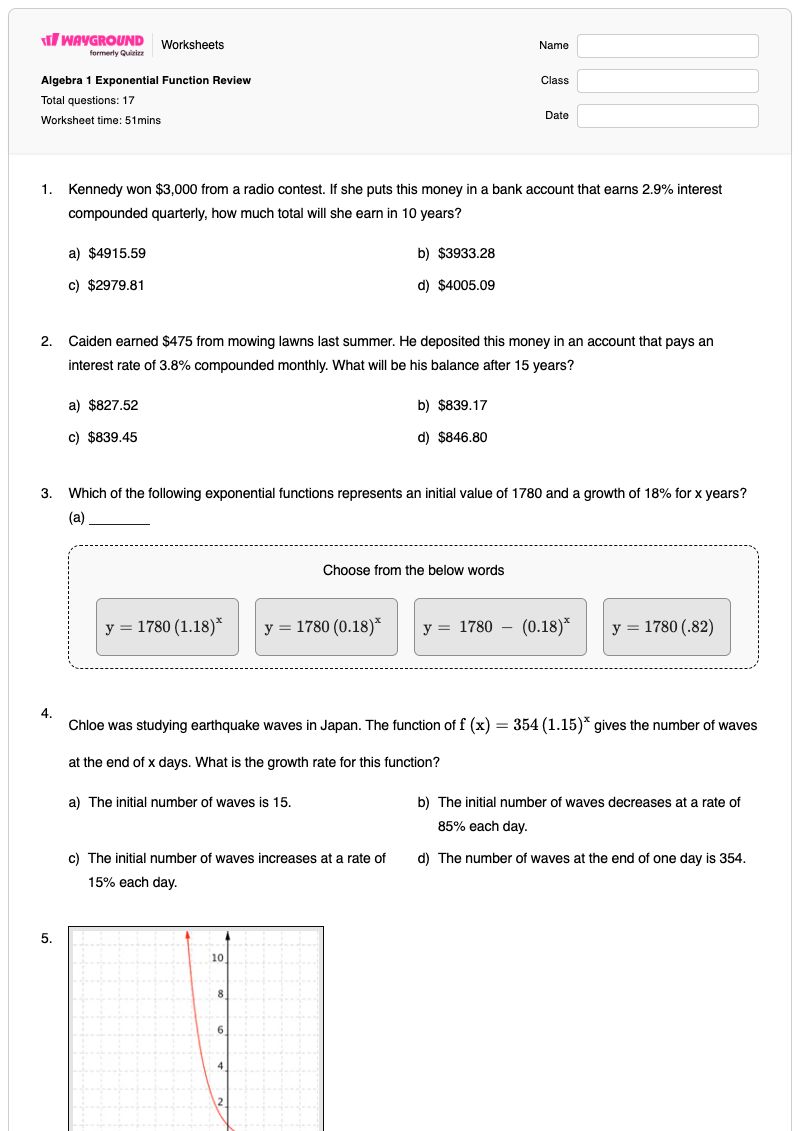
Algebra 1 Exponential Function Review is a free printable Grade 9 mathematics worksheet that strengthens students’ ability to recognize, write, and evaluate exponential models. Across 17 items—including 13 multiple-choice questions, drag-and-drop and image-labeling tasks, a dropdown, and a multiple-select question—students identify initial values, growth and decay rates, growth or decay factors, and the difference between linear and exponential patterns. They also apply exponential functions to compound-interest, savings, and car-depreciation situations.
This review worksheet moves from interpreting parts of an exponential function to selecting equations and calculating values after a specified number of years. It gives teachers a focused way to check whether students can convert percentage changes into factors such as 1.03 or 0.92 and distinguish repeated multiplication from constant addition. The worksheet is suitable for Grade 9 Algebra 1 review, independent practice, homework, or a formative assessment, and includes a complete answer key for efficient checking.
Worksheet settings
Font size
S
M
L
XL
Worksheets
Algebra 1 Exponential Function Review
Total questions: 17
Name
Class
Date
1.
Kennedy won $3,000 from a radio contest. If she puts this money in a bank account that earns 2.9% interest compounded quarterly, how much total will she earn in 10 years?
a)
$4915.59
b)
$3933.28
c)
$2979.81
d)
$4005.09
2.
Caiden earned $475 from mowing lawns last summer. He deposited this money in an account that pays an interest rate of 3.8% compounded monthly. What will be his balance after 15 years?
a)
$827.52
b)
$839.17
c)
$839.45
d)
$846.80
3.
Which of the following exponential functions represents an initial value of 1780 and a growth of 18% for x years?
(a)
Choose from the below words
y=1780(1.18)x
y=1780(0.18)x
y=1780−(0.18)x
y=1780(.82)
4.
Chloe was studying earthquake waves in Japan. The function of f(x)=354(1.15)x gives the number of waves at the end of x days. What is the growth rate for this function?
a)
The initial number of waves is 15.
b)
The initial number of waves decreases at a rate of 85% each day.
c)
The initial number of waves increases at a rate of 15% each day.
d)
The number of waves at the end of one day is 354.
5.
This is an example of:
a)
Linear Growth
b)
Linear Decay
c)
Exponential Growth
d)
Exponential Decay
6.
This is an example of:
(a)
Choose from the below words
Exponential Growth
Linear Growth
Linear Decay
Exponential Decay
7.
Select all the equations that represent exponential decay.
a)
y=21(4)x
b)
y=4(21)x
c)
y=80(1.4)x
d)
y=60(0.7)x
e)
y=3(0.6)x
8.
Please label each part of the function with the appropriate descricription.
a)
final value
b)
initial value
c)
growth/decay factor
d)
time
1
2
3
4
1)
2)
3)
4)
9.
What is the growth rate in the problem below?
f(t) = 300(1.05)t
a)
300
b)
1.05
c)
t
d)
y
10.
A new savings account is opened with $400 and gains 3% every year. What is the exponential function?
a)
f(x)=400(1+3)x
b)
f(x)=400(1-0.03)x
c)
f(x)=400(1+0.03)x
d)
f(x)=400(0.03)x
11.
A new savings account is opened with $400 and gains 3% every yr. What's the amount after 5 years?
a)
$415
b)
$463.71
c)
$343.49
d)
$460.12
12.
The value of a car is $15,000 and depreciates at a rate of 8% per year. What is the exponential equation?
a)
y=8(15,000)x
b)
y=15,000(1.08)x
c)
y=15,000(0.92)x
d)
y=15,000(0.08)x
13.
The value of a car is $15,000 and depreciates at a rate of 8% per year. What is the value after 7 years?
a)
$800
b)
$8367.70
c)
$6600
d)
$25,707.36
14.
What type of pattern do linear functions have?
a)
Adds by the same number every time
b)
Multiplies by the same number every time
c)
Square roots all the inputs
d)
Squares all the inputs
15.
What type of pattern do exponential functions have?
a)
Adds by the same number every time
b)
Multiplies by the same number every time
c)
Square roots all the inputs
d)
Squares all the inputs
16.
Which of the following functions shows an initial amount of $15 and an increase of 35% each year?
a)
y = 15(35)x
b)
y = 15(1.35)x
c)
y = 15(0.35)x
d)
y = 35(1.15)x
17.
If you deposited $4,000 at an interest rate of 3.4% compounded quarterly for three years what is the multiplier?
a)
1.034
b)
1.0085
c)
0.0085
d)
0.966
Answer Key
Algebra 1 Exponential Function Review
Total questions: 17
1.
d) $4005.09
2.
b) $839.17
3.
y=1780(1.18)x
4.
c)
The initial number of waves increases at a rate of 15% each day.
5.
d)
Exponential Decay
6.
Exponential Growth
7.
d)
y=60(0.7)x
, b)
y=4(21)x
, e)
y=3(0.6)x
8.
a
b
c
d
9.
b)
1.05
10.
c) f(x)=400(1+0.03)x
11.
b) $463.71
12.
c) y=15,000(0.92)x
13.
b) $8367.70
14.
a)
Adds by the same number every time
15.
b)
Multiplies by the same number every time
16.
b) y = 15(1.35)x
17.
b)
1.0085
140 %
Browse by subjects
Browse by grades
Browse by format
FAQs
What does the Algebra 1 Exponential Function Review worksheet cover?
This 17-question Grade 9 review covers identifying initial values, growth and decay rates, growth or decay factors, and the difference between linear and exponential patterns. Its multiple-choice, drag-and-drop, dropdown, multiple-select, and image-labeling items require students to interpret exponential notation, write models for savings and depreciation, and calculate values using compound interest or repeated percentage change.
How can I use this worksheet to teach exponential growth and decay?
Introduce the worksheet by modeling how a percentage change becomes a factor: growth uses 1 plus the rate, while decay uses 1 minus the rate. Then have students label the initial value, factor, and time in an exponential equation before solving the savings and car-depreciation problems. Use the classification and select-all items to prompt students to explain why exponential patterns multiply by a constant factor rather than add a constant amount.
What mistakes should I watch for when students complete this exponential functions worksheet?
Students may confuse the growth or decay rate with the growth factor, such as choosing 3 instead of 1.03 for a 3% increase or using 1.08 instead of 0.92 for 8% depreciation. Watch for errors in identifying the initial value and time variable, treating an exponential pattern as linear, and using the annual rate directly in compound-interest problems without accounting for the compounding frequency.
How do I assign and grade this exponential function worksheet?
The worksheet is available as a printable PDF and as a digital quiz on Wayground, so you can assign the format that fits your Grade 9 Algebra 1 review. It includes a complete answer key for checking the function interpretations, percentage models, and numerical calculations. For printable submissions, scan student work with the Wayground for Teachers app to help grade responses efficiently.
How can I differentiate this exponential growth and decay worksheet for my students?
Use the worksheet’s Advanced Settings to adjust font spacing and font size so the exponential equations, answer choices, and labeling prompts are easier to read. You can also enable a dyslexia-friendly font or translate the worksheet into another language when appropriate. These options modify the worksheet file while preserving its growth, decay, compound-interest, and depreciation practice.
Where can I find more worksheets like this on Wayground?
Wayground offers a comprehensive collection of free printable worksheets and practice problems across subjects, with downloadable PDFs and answer keys to help students master essential skills and concepts. Browse more resources at https://wayground.com/en-us/worksheets.

 Worksheets
