

Wayground
Analyzing exponential word problems - Printable Mathematics Worksheets - Wayground

Analyzing exponential word problems

11 questions

9th - 9th Grade

Mathematics

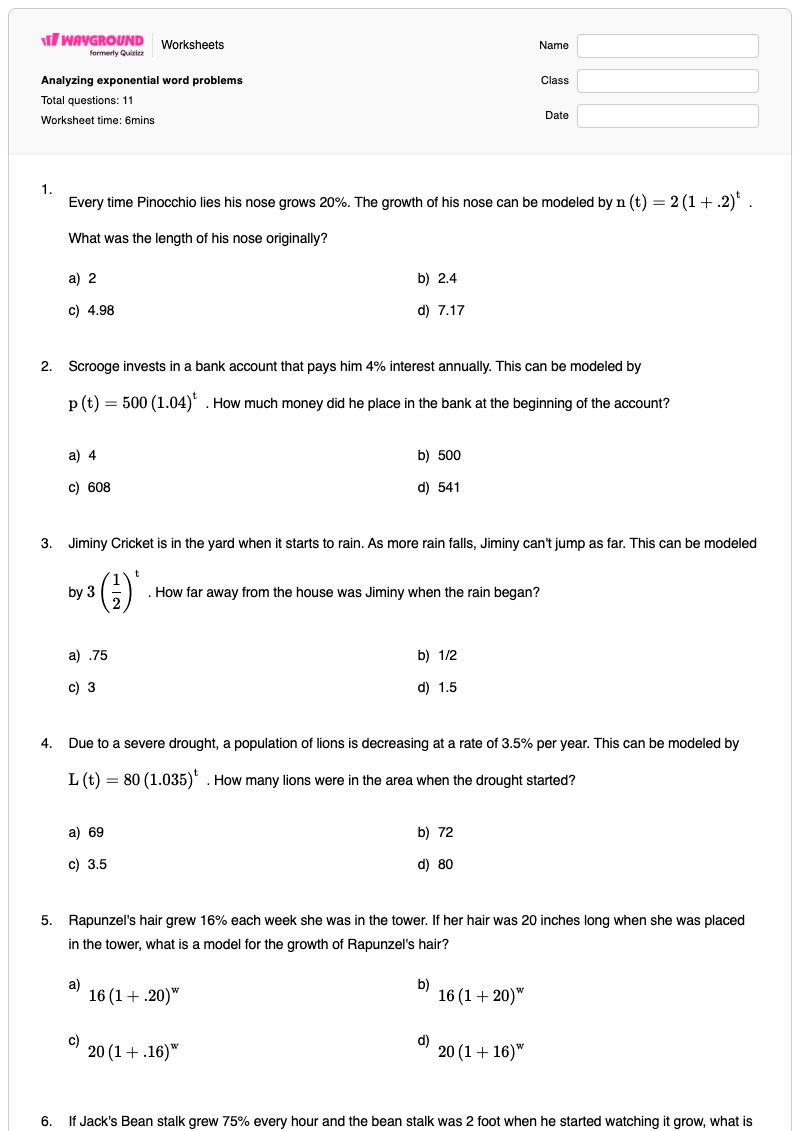
Analyzing exponential word problems is a free printable Grade 9 mathematics worksheet with 11 multiple-choice questions. Students interpret exponential models in familiar growth and decay contexts, including Pinocchio’s nose growing, annual bank interest, rainfall reducing jumping distance, a drought-driven lion population decline, and changes to Rapunzel’s hair, Jack’s beanstalk, and the little pig’s house. The worksheet asks learners to work backward from an exponential model to find an initial value, write models from a starting value and percentage change, and identify equivalent exponential expressions. These varied question types help students connect percent increase and decrease to exponential equations rather than treating each problem as a separate procedure. An answer key is included so teachers can review model setup, initial values, and equivalent forms efficiently. Use the worksheet for guided practice, independent work, homework, or a short formative assessment.

Worksheet settings

Font size

S
M
L
XL
Worksheets

Analyzing exponential word problems

Total questions: 11

Name
Class
Date
1.

Every time Pinocchio lies his nose grows 20%. The growth of his nose can be modeled by n(t)=2(1+.2)tn\left(t\right)=2\left(1+.2\right)^t  . What was the length of his nose originally?

a)

2

b)

2.4

c)

4.98

d)

7.17

2.

Scrooge invests in a bank account that pays him 4% interest annually. This can be modeled by p(t)=500(1.04)tp\left(t\right)=500\left(1.04\right)^t  . How much money did he place in the bank at the beginning of the account?

a)

4

b)

500

c)

608

d)

541

3.

Jiminy Cricket is in the yard when it starts to rain. As more rain falls, Jiminy can't jump as far. This can be modeled by 3(12)t3\left(\frac{1}{2}\right)^t  . How far away from the house was Jiminy when the rain began?

a)

.75

b)

1/2

c)

3

d)

1.5

4.

Due to a severe drought, a population of lions is decreasing at a rate of 3.5% per year. This can be modeled by L(t)=80(1.035)tL\left(t\right)=80\left(1.035\right)^t  . How many lions were in the area when the drought started?

a)

69

b)

72

c)

3.5

d)

80

5.

Rapunzel's hair grew 16% each week she was in the tower. If her hair was 20 inches long when she was placed in the tower, what is a model for the growth of Rapunzel's hair?

a)

16(1+.20)w16\left(1+.20\right)^w  

b)

16(1+20)w16\left(1+20\right)^w  

c)

20(1+.16)w20\left(1+.16\right)^w  

d)

20(1+16)w20\left(1+16\right)^w  

6.

If Jack's Bean stalk grew 75% every hour and the bean stalk was 2 foot when he started watching it grow, what is a model for the growth of the bean stalk?

a)

2(1+75)h2\left(1+75\right)^h  

b)

2(1+.75)h2\left(1+.75\right)^h  

c)

75(1+2)h75\left(1+2\right)^h  

d)

7(1+.02)h7\left(1+.02\right)^h  

7.

If the wolf blew down 36% of the little pig's house each time he puffed and blew, and the house started at 35 feet high, what is a model for how high the house is with each huff and puff?

a)

36(1−35)p36\left(1-35\right)^p  

b)

36(1−.35)p36\left(1-.35\right)^p  

c)

35(1−36)p35\left(1-36\right)^p  

d)

35(1−.36)p35\left(1-.36\right)^p  

8.

Which is the same as 300(1−.17)t300\left(1-.17\right)^t  

a)

300(1.17)t300\left(1.17\right)^t  

b)

300(.83)t300\left(.83\right)^t  

c)

300(.93)t300\left(.93\right)^t  

9.

Which is the same as 200(1−.76)t200\left(1-.76\right)^t  

a)

200(.24)t200\left(.24\right)^t  

b)

200(.34)t200\left(.34\right)^t  

c)

200(1.76)t200\left(1.76\right)^t  

10.

Which is the same as 2050(1−.96)t2050\left(1-.96\right)^t  

a)

200(.04)t200\left(.04\right)^t  

b)

200(.40)t200\left(.40\right)^t  

c)

200(1.96)t200\left(1.96\right)^t  

11.

Which is the same as 50(1+.55)t50\left(1+.55\right)^t  

a)

200(.55)t200\left(.55\right)^t  

b)

200(1.55)t200\left(1.55\right)^t  

c)

200(0.45)t200\left(0.45\right)^t  

Answer Key

Analyzing exponential word problems

Total questions: 11

1.
a)

2

2.
b)

500

3.
c)

3

4.
d)

80

5.
c)

20(1+.16)w20\left(1+.16\right)^w  

6.
b)

2(1+.75)h2\left(1+.75\right)^h  

7.
d)

35(1−.36)p35\left(1-.36\right)^p  

8.
b)

300(.83)t300\left(.83\right)^t  

9.
a)

200(.24)t200\left(.24\right)^t  

10.
a)

200(.04)t200\left(.04\right)^t  

11.
b)

200(1.55)t200\left(1.55\right)^t  

FAQs

What does this worksheet cover?

This Grade 9 worksheet covers writing and interpreting exponential growth and decay models through 11 multiple-choice questions. Students find initial values from given models, create models from starting amounts and percentage changes, and recognize equivalent exponential expressions in story contexts such as interest, population decline, and repeated growth.

How can I use this worksheet to teach exponential word problems?

Introduce the worksheet by having students identify the starting value, growth or decay rate, and time interval in each story before looking at answer choices. Model one problem in which students work backward to find an initial amount, then have pairs write the exponential models for the hair, beanstalk, and house scenarios and explain why growth uses a factor greater than 1 while decay uses a factor between 0 and 1. Finish with the equivalent-expression items as a check that students can recognize the same model in different forms.

What mistakes should I watch for when students complete this worksheet?

Students may report the percent change as the initial value, such as choosing 4 instead of the original $500 investment, or confuse the current value with the amount at the beginning of the situation. When writing models, watch for using 0.16 instead of the growth factor 1.16, or using 0.36 instead of 0.64 when a house loses 36% each time. Students may also reverse the roles of the initial value and the exponential factor when selecting equivalent expressions.

How do I assign and grade this worksheet?

This worksheet is available as a printable PDF and as a digital quiz on Wayground, with a complete answer key for all 11 multiple-choice questions. Assign the PDF for written practice or open the digital version for online responses and automatic review; printable submissions can also be graded by scanning student work with the Wayground for Teachers app.

How can I differentiate this exponential word-problem worksheet for my students?

Use the worksheet’s Advanced Settings to adjust font spacing or increase the font size so the multiple-choice scenarios and answer choices are easier to read. You can also apply a dyslexia-friendly font or translate the worksheet into another language, helping students access the exponential-model questions without changing the mathematical task.

Where can I find more worksheets like this on Wayground?

Wayground offers a comprehensive collection of free printable worksheets and practice problems across subjects, with downloadable PDFs and answer keys to support mastery of essential skills and concepts. Browse more resources at https://wayground.com/en-us/worksheets.