

Wayground
Exponential Growth and Decay Word Problems Practice - Printable Mathematics Worksheets - Wayground

Exponential Growth and Decay Word Problems Practice

15 questions

9th - 12th Grade

Mathematics

Exponential Growth and Decay Word Problems Practice is a free printable mathematics worksheet for students in Grades 9–12. It includes 15 items—three multiple-select questions, eight multiple-choice questions, and four fill-in-the-blank questions—that focus on writing exponential models from percentage changes, identifying initial quantities, and classifying functions as growth or decay. Students then apply these models to population, voting, market, subscription, erosion, emissions, animal population, and technology depreciation scenarios. The questions require students to select or calculate the correct growth or decay factor, substitute elapsed time, and round results to whole numbers or cents when directed. This format helps students connect equations such as P = 8(1.23)^t and Q = 3.1(0.78)^t to practical situations. The worksheet includes a complete answer key for checking student work.

Worksheet settings

Font size

S
M
L
XL
Worksheets

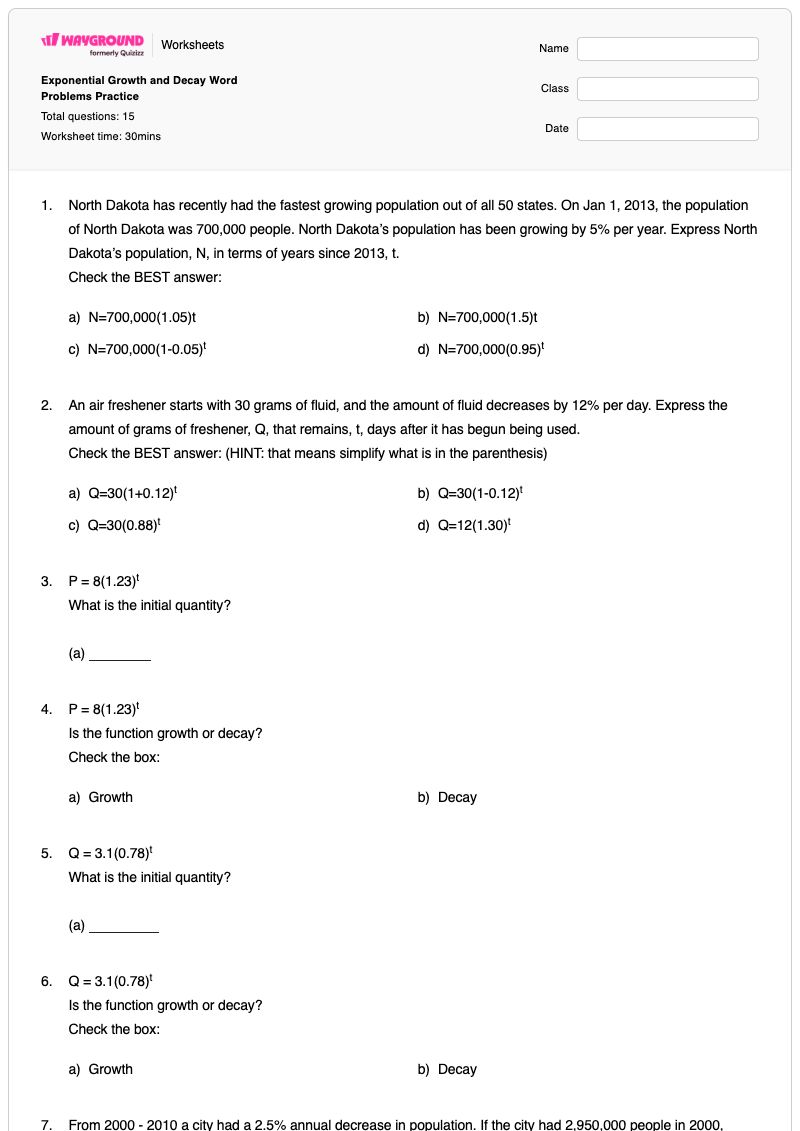
Exponential Growth and Decay Word Problems Practice

Total questions: 15

Name
Class
Date
1.

North Dakota has recently had the fastest growing population out of all 50 states. On Jan 1, 2013, the population of North Dakota was 700,000 people. North Dakota’s population has been growing by 5% per year. Express North Dakota’s population, N, in terms of years since 2013, t.

Check the BEST answer:

a)

N=700,000(1.05)t

b)

N=700,000(1.5)t

c)

N=700,000(1-0.05)t

d)

N=700,000(0.95)t

2.

An air freshener starts with 30 grams of fluid, and the amount of fluid decreases by 12% per day. Express the amount of grams of freshener, Q, that remains, t, days after it has begun being used.

Check the BEST answer: (HINT: that means simplify what is in the parenthesis)

a)

Q=30(1+0.12)t

b)

Q=30(1-0.12)t

c)

Q=30(0.88)t

d)

Q=12(1.30)t

3.

P = 8(1.23)t

What is the initial quantity?

(a)  

4.

P = 8(1.23)t

Is the function growth or decay?

Check the box:

a)

Growth

b)

Decay

5.

Q = 3.1(0.78)t

What is the initial quantity?

(a)  

6.

Q = 3.1(0.78)t

Is the function growth or decay?

Check the box:

a)

Growth

b)

Decay

7.

From 2000 - 2010 a city had a 2.5% annual decrease in population. If the city had 2,950,000 people in 2000, determine the city’s population in 2008.

Round to the nearest (a)   (these are people)... so whole number!

8.

You buy a car for $8000 that depreciates at a rate of 11% a year. How much is the car worth after 5 years?

Round to the nearest cent. (two decimal places)

(a)  

9.

Middletown High School has student elections every year. Lately, the school has seen a 5% decrease in voting from election to election. If 910 students voted this year, how many will be expected to vote 8 years from now? (Round to the nearest whole number if necessary).

a)

604

b)

777

c)

29

d)

198

10.

More and more people are purchasing food from farmers' markets. As a consequence, a market researcher predicts that the number of farmers' markets will increase by 15% each year. If there are 6,200 farmers' markets this year, how many will there be in 10 years? (Round to the nearest whole number if necessary).

a)

25,082

b)

12,937

c)

62,000

d)

43,511

11.

A publishing industry report predicts that magazine subscriptions will drop by 10% each year. If this prediction is correct, then how many subscribers will a magazine with 98,000 subscribers have in 10 years? (Round to the nearest whole number if necessary).

a)

34,170

b)

16,348

c)

7690

d)

76,023

12.

A cliff overlooking Oak Grove Lake is experiencing erosion, losing elevation at a rate of 5% every millennium. The cliff's current elevation is 1,200 meters. What will its elevation be in 6 millennia? (Round to the nearest whole number if necessary).

a)

882

b)

465

c)

349

d)

975

13.

Thanks to its environmental initiatives, Silvergrove has cut its annual CO2 emissions by 5%. This year, the town produced 290,000 metric tons of emissions. If the downward trend continues, how much CO2 will be produced 7 years from now? (Round to the nearest whole number if necessary).

a)

202,518

b)

135,792

c)

78,376

d)

20,658

14.

The mice population is 25,000 and is decreasing by 20% each year. What will be the mice population after 3 years?

a)

12,800

b)

15,777

c)

102, 475

d)

2,500

15.

Your new computer cost $1500 but it depreciates in value by about 18% each year. How much will your computer be worth in 6 years? (Round to the nearest cent.)

a)

$456.01

b)

$556.98

c)

$778.22

d)

$332.63

Answer Key

Exponential Growth and Decay Word Problems Practice

Total questions: 15

1.
a)

N=700,000(1.05)t

2.
c)

Q=30(0.88)t

3.
8
4.
a)

Growth

5.
3.1
6.
b)

Decay

7.
2409123, 2,409,123
8.
$4467.25, 4467.25
9.
a)

604

10.
a)

25,082

11.
a)

34,170

12.
a)

882

13.
a)

202,518

14.
a)

12,800

15.
a)

$456.01

FAQs

What does this exponential growth and decay worksheet help students practice?

This worksheet helps students write and evaluate exponential models for percentage increases and decreases. Across 15 multiple-select, multiple-choice, and fill-in-the-blank items, students identify initial quantities, distinguish growth from decay, choose factors such as 1.05 or 0.88, and calculate values after a specified number of years, days, or other periods.

How can I use this worksheet to teach exponential growth and decay word problems?

Begin by modeling how a percentage change becomes a multiplier: increases use 1 plus the rate, while decreases use 1 minus the rate. Use the worksheet’s equation items, such as P = 8(1.23)^t and Q = 3.1(0.78)^t, to identify the initial quantity and classify growth or decay before assigning the population, depreciation, emissions, and other application problems. Ask students to explain why the exponent represents the number of time periods.

What mistakes should I watch for on this exponential growth and decay worksheet?

Watch for students using the percentage itself instead of the growth or decay factor—for example, choosing 1.5 instead of 1.05 for 5% growth or using 1.12 for a 12% decrease. Students may also confuse the initial quantity with the rate, label a base greater than 1 as decay, or round too early instead of following the requested whole-number or cent rounding in the word problems.

How do I assign and grade this worksheet?

This exponential growth and decay worksheet is available as a printable PDF and as a digital quiz on Wayground, and it includes a complete answer key. You can grade printable submissions by scanning student work with the Wayground for Teachers app, while the digital version supports online completion and grading.

How can I differentiate this exponential growth and decay worksheet for my students?

Use the worksheet’s Advanced Settings to adjust font spacing and font size so the exponential expressions, answer choices, and multi-step word problems are easier to read. You can also apply a dyslexia-friendly font or translate the worksheet into another language, which can support access to the written scenarios without changing the growth and decay calculations.

Where can I find more worksheets like this on Wayground?

Wayground offers a comprehensive collection of free printable worksheets and practice problems across subjects, with downloadable PDFs and answer keys to help students master essential skills and concepts. Browse more resources at https://wayground.com/en-us/worksheets.