
 Worksheets
Exponential vs. Constant Growth & Decay
Total questions: 20
Name
Class
Date
1.
The attendance at the art museum at the New Year’s opening was 250 people. The attendance has been increasing at a rate of 3% each month. How many people will attend by the end of a year?
a)
356
b)
265
c)
5825
d)
1329
2.
The population of Bloom Falls, Mass. (population 937) is slowly moving to a bigger city.
Every year the population drops by 4.5%. What is the population after 3 years?
Every year the population drops by 4.5%. What is the population after 3 years?
a)
1,069 people
b)
894 people
c)
816 people
d)
854 people
3.

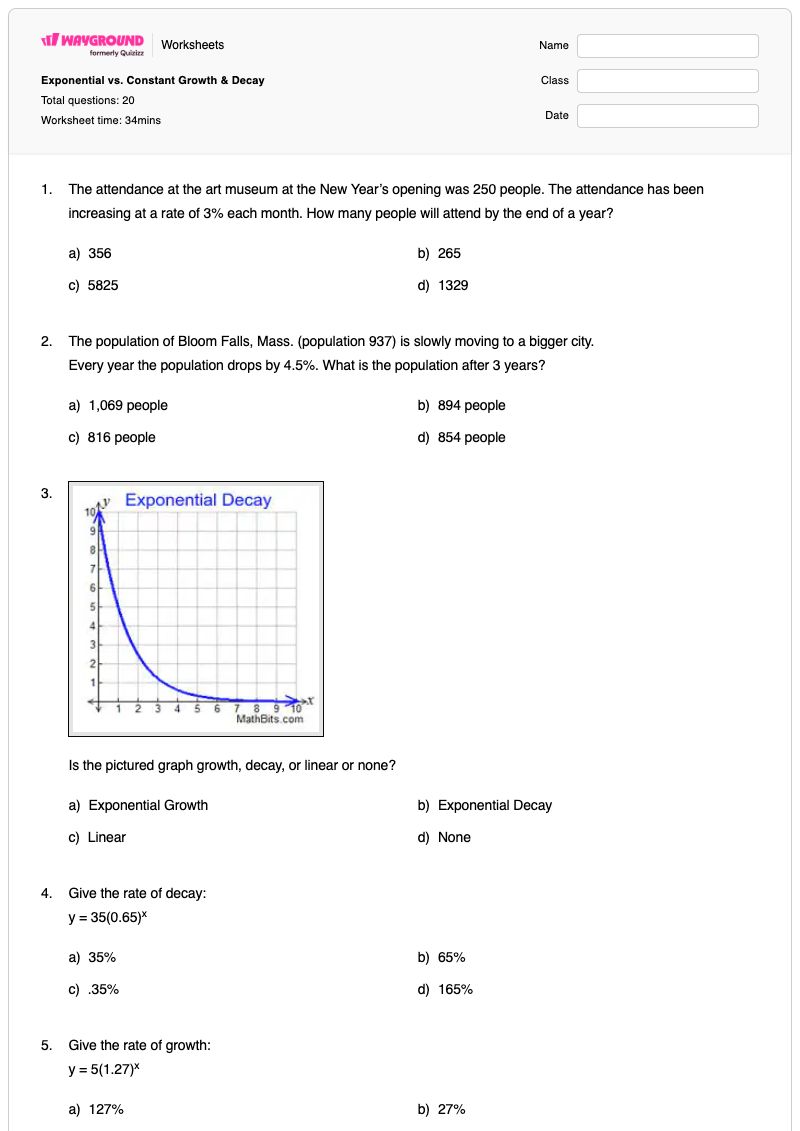
Is the pictured graph growth, decay, or linear or none?
a)
Exponential Growth
b)
Exponential Decay
c)
Linear
d)
None
4.
Give the rate of decay:
y = 35(0.65)x
y = 35(0.65)x
a)
35%
b)
65%
c)
.35%
d)
165%
5.
Give the rate of growth:
y = 5(1.27)x
y = 5(1.27)x
a)
127%
b)
27%
c)
5
6.
The population of turtles is doubling every 3 months. If there are 400 turtles now, how many will there be in 2 years? (Choose equation)
a)
y = 400(2)2
b)
y = 400(2)6
c)
y = 400(2)8
d)
y = 400 + 2(8)
7.

Is this exponential growth or decay?
a)
Growth, because of 7
b)
Decay, because of 1.2
c)
Growth because of 1.2
d)
Decay because of 7
8.
Pick the equation that is exponential growth
a)
y=2(0.5)x
b)
y = 0.5(2)x
c)
y = .5x - 2
d)
y = 2x + .5
9.
Which of the following functions shows an initial amount of $15 and an increase of 35% each year?
a)
y = 15(35)x
b)
y = 15(1.35)x
c)
y = 15(0.35)x
d)
y = 35(1.15)x
10.
Your 2 year investment of $5,300 earns 2.9% and is compounded annually. What will your total return be?
a)
$5,304.46
b)
$5,611.86
c)
$5,613.28
d)
$8,819.73
11.
A city has a population of 21,517 based on a census taken in 1998. If the population is expected to grow by 11% annually, what will the population be in the year 2030?
a)
606,900
b)
517
c)
492,573
d)
None of these
12.
What type of function is this equation:
y= 4x+1
y= 4x+1
a)
Linear
b)
Exponential
c)
Neither
13.
What type of function describes the story below?
You have $5 and triple your money every day.
You have $5 and triple your money every day.
a)
Linear
b)
Exponential
c)
Neither
14.

Is the pictured graph exponential growth, exponential decay, linear growth, or none?
a)
Exponential Growth
b)
Exponential Decay
c)
Linear Growth
d)
None of the above
15.

What function type models this graph?
a)
Exponential Growth
b)
Exponential Decay
c)
Linear Growth
d)
Quadratic
16.
Twenty years ago, Mr. Stern purchased his home for $160,000. Since then, the value of the home has increased about 5% per year. How much is the home worth today?
a)
$176,783.29
b)
$424,527.63
c)
$57,357.75
d)
$532,041,076.80
17.
Write an equation that models the following situation:
Caroline's hair was known to grow very rapidly. It began at a length of 6 in and grew at a rate of 14% a week.
Caroline's hair was known to grow very rapidly. It began at a length of 6 in and grew at a rate of 14% a week.
a)
y=6(0.14)x
b)
y=6(1+14)x
c)
y=6(1.14)x
d)
y=6(0.86)x
18.
What type of function is this equation:
y= -3x + 12
y= -3x + 12
a)
Constant Growth
b)
Exponential Growth
c)
Exponential Decay
d)
Constant Decrease
19.
Connor bought a brand new Ford F-150 for $45,000. Unfortunately, the value of the truck depreciates at a rate of 1.3% per month. Which equation shows the value of the truck?
a)
45,000(1.3)x
b)
45,000(1.013)x
c)
45,000(.987)x
d)
45,000(.013)x
20.
Connor bought a brand new Ford F-150 for $45,000. Unfortunately, the value of the truck depreciates at a rate of 1.3% per month. Use your equation to find the value of the truck after 5 years.
a)
$42,150.07
b)
$20,523.03
c)
$.17
d)
$22,428.94
Answer KeyExponential vs. Constant Growth & Decay
Total questions: 20
1.
a) 356
2.
c) 816 people
3.
b) Exponential Decay
4.
a) 35%
5.
b) 27%
6.
c) y = 400(2)8
7.
c) Growth because of 1.2
8.
b) y = 0.5(2)x
9.
b) y = 15(1.35)x
10.
b) $5,611.86
11.
a) 606,900
12.
b) Exponential
13.
b) Exponential
14.
a) Exponential Growth
15.
a) Exponential Growth
16.
b) $424,527.63
17.
c) y=6(1.14)x
18.
d) Constant Decrease
19.
c) 45,000(.987)x
20.
b) $20,523.03
140 %