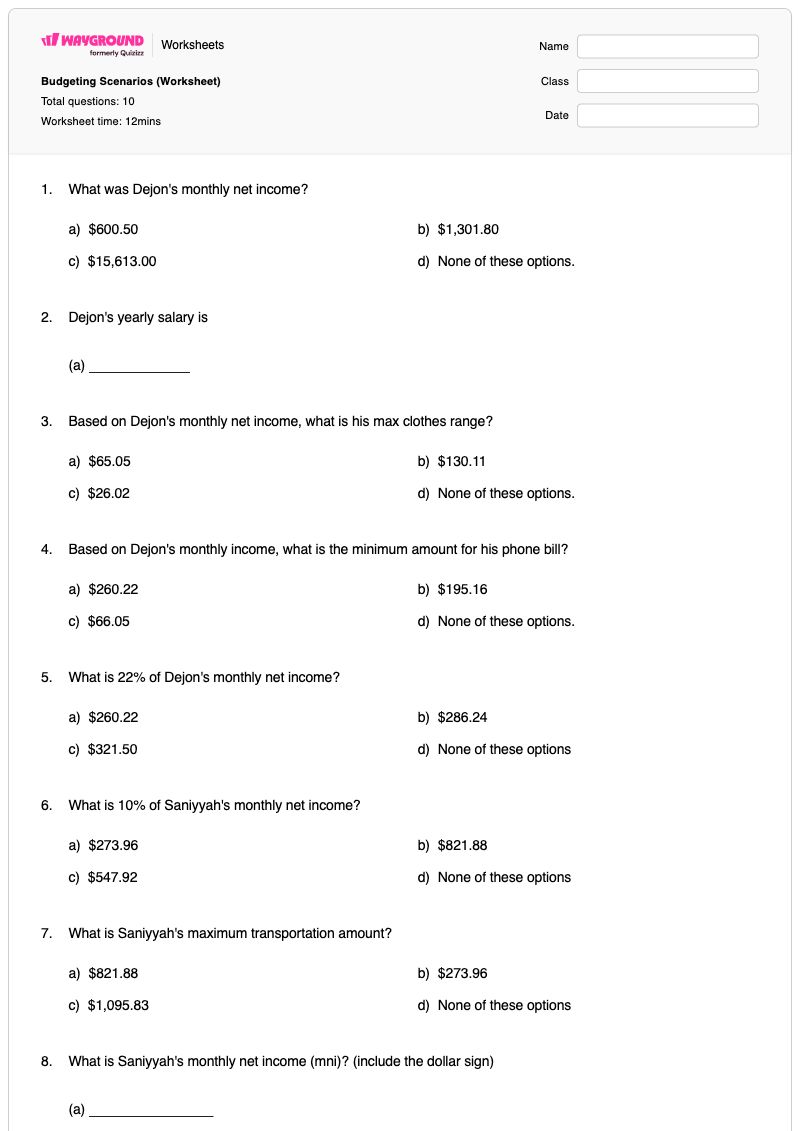
Budgeting Scenarios is a Grade 12 mathematics worksheet that develops practical percentage and personal-finance calculation skills. Across 10 items—8 multiple-choice questions and 2 fill-in-the-blank questions—students interpret annual salary and monthly net income, calculate percentage amounts, and determine budget limits for clothing, phone bills, transportation, and life insurance. The scenarios use Dejon’s and Saniyyah’s income figures so students apply calculations to realistic budgeting decisions rather than solve disconnected percentage problems.
This worksheet is useful for independent practice, guided instruction, or a personal-finance assessment. Students must move between yearly and monthly income, express answers in dollars, select “None of these options” when appropriate, and distinguish maximum amounts from minimum amounts. It is a free printable worksheet with a complete answer key, making it easy to review calculation methods and identify errors in percent-based budgeting.
Worksheet settings
Font size
S
M
L
XL
Worksheets
Budgeting Scenarios (Worksheet)
Total questions: 10
Name
Class
Date
1.
What was Dejon's monthly net income?
a)
$600.50
b)
$1,301.80
c)
$15,613.00
d)
None of these options.
2.
Dejon's yearly salary is
(a)
3.
Based on Dejon's monthly net income, what is his max clothes range?
a)
$65.05
b)
$130.11
c)
$26.02
d)
None of these options.
4.
Based on Dejon's monthly income, what is the minimum amount for his phone bill?
a)
$260.22
b)
$195.16
c)
$66.05
d)
None of these options.
5.
What is 22% of Dejon's monthly net income?
a)
$260.22
b)
$286.24
c)
$321.50
d)
None of these options
6.
What is 10% of Saniyyah's monthly net income?
a)
$273.96
b)
$821.88
c)
$547.92
d)
None of these options
7.
What is Saniyyah's maximum transportation amount?
a)
$821.88
b)
$273.96
c)
$1,095.83
d)
None of these options
8.
What is Saniyyah's monthly net income (mni)? (include the dollar sign)
(a)
9.
What is 35% of Saniyyah's monthly net income?
a)
$1920.75
b)
$109.58
c)
$1095.83
d)
None of these options
10.
What is Saniyyah's minimum Life Insurance amount?
a)
$821.88
b)
$547.92
c)
$732.94
d)
None of these options
Answer Key
Budgeting Scenarios (Worksheet)
Total questions: 10
1.
d)
None of these options.
2.
$15613
3.
a)
$65.05
4.
d)
None of these options.
5.
b)
$286.24
6.
c)
$547.92
7.
a)
$821.88
8.
$5479.17
9.
d)
None of these options
10.
b)
$547.92
140 %
Browse by subjects
Browse by grades
Browse by format
FAQs
What does the Budgeting Scenarios worksheet cover?
This Grade 12 mathematics worksheet uses 10 budgeting questions—8 multiple choice and 2 fill-in-the-blank—to practise converting between yearly salary and monthly net income and calculating percentage-based amounts. Students apply those calculations to clothing, phone bills, transportation, and life insurance limits for two income scenarios, including items where they must recognize that none of the listed answers is correct.
How can I use this worksheet to teach percentage-based budgeting?
Begin by having students identify whether each item gives an annual salary or monthly net income, then model converting the time period before calculating a percentage. Work through one Dejon item and one Saniyyah item, emphasizing the difference between a maximum and a minimum amount. Students can then complete the remaining multiple-choice and fill-in-the-blank questions, explaining how they checked dollar formatting, rounding, and the reason an answer may not appear among the options.
What mistakes should I watch for when students complete this budgeting worksheet?
Students may divide or multiply by 12 incorrectly when moving between Dejon’s yearly salary and monthly net income, or use a whole number instead of a decimal when finding percentages such as 22%, 10%, or 35%. They may also confuse maximum transportation or clothing amounts with minimum phone-bill or life-insurance amounts, overlook the “None of these options” choice, or omit the dollar sign in the Saniyyah monthly-net-income response.
How do I assign and grade this Budgeting Scenarios worksheet?
You can assign this worksheet as a printable PDF or as a digital quiz on Wayground, and it includes a complete answer key for the 8 multiple-choice and 2 fill-in-the-blank items. Printable submissions can be graded by scanning student work with the Wayground for Teachers app. The printable format also supports classrooms that are reducing screen time.
How can I differentiate this budgeting worksheet for my students?
Use the worksheet’s Advanced Settings to adjust font spacing and font size so the percentage calculations, answer choices, and fill-in responses are easier to read. You can also enable a dyslexia-friendly font or translate the worksheet into another language, helping students access the income and budgeting vocabulary used in the Dejon and Saniyyah scenarios.
Where can I find more worksheets like this on Wayground?
Wayground offers a broad collection of free printable worksheets and practice problems across subjects, with downloadable PDFs and answer keys to support essential skills and concepts. Browse more resources at https://wayground.com/en-us/worksheets.


 Worksheets