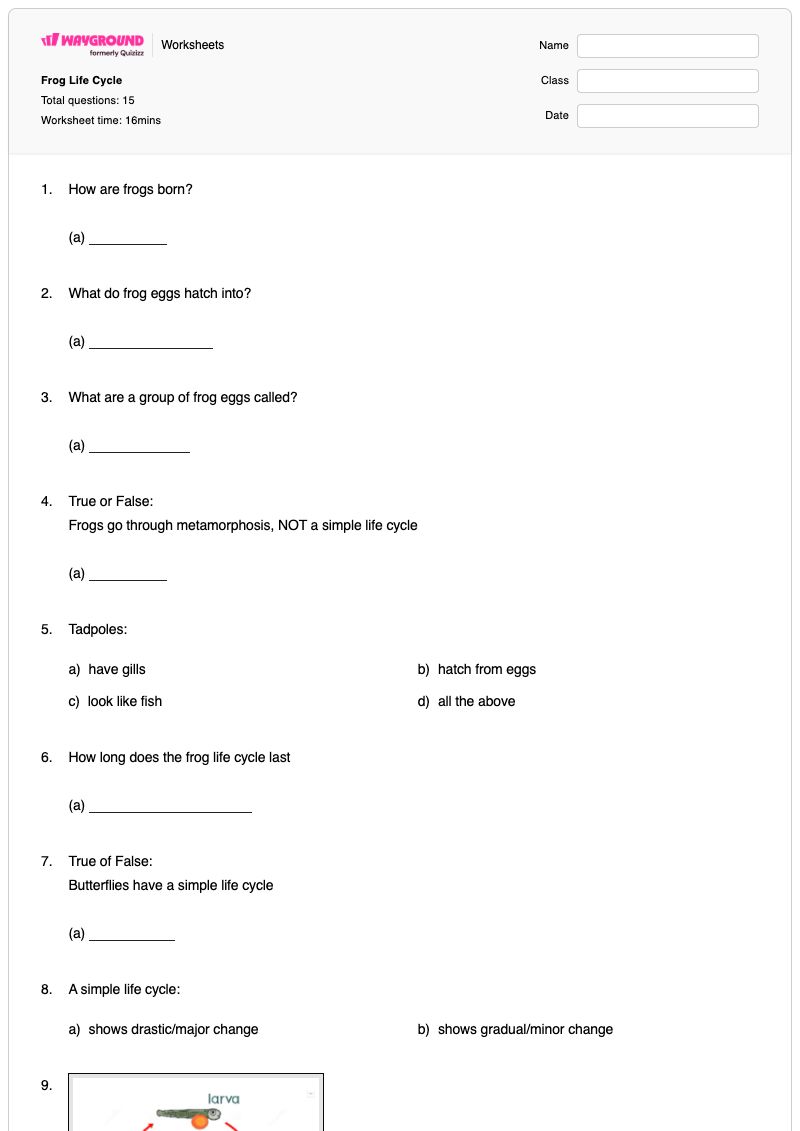
Frog Life Cycle is a Grade 4 science worksheet that helps students identify and explain the stages and patterns involved in frog development. Across 15 items, students complete seven fill-in-the-blank questions, answer six multiple-choice questions, and respond to two open-ended prompts. They identify eggs, egg masses, and tadpoles; recognize that tadpoles hatch from eggs, have gills, and look like fish; and connect frog development with metamorphosis.
The worksheet also compares metamorphosis with a simple life cycle. Students distinguish major changes from gradual changes, classify examples such as butterflies, humans, and dogs, and describe both life-cycle patterns in their own words. This free printable worksheet is designed for Grade 4 science instruction, review, or assessment and includes a complete answer key for checking student understanding.
Worksheet settings
Font size
S
M
L
XL
Worksheets
Frog Life Cycle
Total questions: 15
Name
Class
Date
1.
How are frogs born?
(a)
2.
What do frog eggs hatch into?
(a)
3.
What are a group of frog eggs called?
(a)
4.
True or False:
Frogs go through metamorphosis, NOT a simple life cycle
(a)
5.
Tadpoles:
a)
have gills
b)
hatch from eggs
c)
look like fish
d)
all the above
6.
How long does the frog life cycle last
(a)
7.
True of False:
Butterflies have a simple life cycle
(a)
8.
A simple life cycle:
a)
shows drastic/major change
b)
shows gradual/minor change
9.
a)
Complete metamorphosis
b)
Incomplete metamorphosis
c)
Not metamorphosis
10.
a)
Complete metamorphosis
b)
Incomplete metamorphosis
c)
Not metamorphosis
11.
a)
Complete metamorphosis
b)
Incomplete metamorphosis
c)
Not metamorphosis
12.
True or False:
Humans, dogs, and other mammals have a simple life cycle
(a)
13.
In the best way yo can, describe a simple life cycle
4 lines
14.
In the best way you can, describe metamorphosis
4 lines
15.
Metamorphosis means....
a)
Still
b)
Change
c)
Stagnant
d)
Butterfly
Answer Key
Frog Life Cycle
Total questions: 15
1.
eggs
2.
Tadpoles
3.
mass, masses
4.
True
5.
d)
all the above
6.
2 - 3 weeks, 2 to 3 weeks
7.
False
8.
b)
shows gradual/minor change
9.
c)
Not metamorphosis
10.
a)
Complete metamorphosis
11.
c)
Not metamorphosis
12.
True
13.
n/a
14.
n/a
15.
b)
Change
140 %
Browse by subjects
Browse by grades
Browse by format
FAQs
What does the Frog Life Cycle worksheet cover?
This Grade 4 science worksheet uses fill-in-the-blank, multiple-choice, and open-ended questions to teach how frogs develop from eggs into tadpoles and undergo metamorphosis. Students also compare metamorphosis, which involves major change, with a simple life cycle, which involves gradual change, and explain each pattern in their own words.
How can I use this worksheet to teach frog metamorphosis and simple life cycles?
Introduce the worksheet by having students sequence the vocabulary they will encounter: eggs, egg mass, tadpoles, and metamorphosis. Use the multiple-choice items to discuss why tadpoles are described as having gills and looking like fish, then use the two open-ended prompts to have students compare a frog’s metamorphosis with the gradual life cycles of humans, dogs, or other mammals.
What mistakes should I watch for when students complete this frog life cycle worksheet?
Watch for students confusing an egg mass with a single frog egg, or identifying tadpoles without recognizing that they hatch from eggs, have gills, and look like fish. Students may also reverse the worksheet’s distinction between metamorphosis and a simple life cycle, select “butterfly” instead of “change” for the meaning of metamorphosis, or give incomplete descriptions in the open-ended responses.
How do I assign and grade the Frog Life Cycle worksheet?
You can assign this Frog Life Cycle worksheet as a printable PDF or as a digital quiz on Wayground. It includes a complete answer key, and printable submissions can be graded by scanning student work with the Wayground for Teachers app. The printable format also gives schools an option for reducing screen time.
How can I differentiate this Frog Life Cycle worksheet for my students?
Use the worksheet’s Advanced Settings to adjust font spacing and font size so the fill-in-the-blank prompts and open-ended responses have more visual room. You can also enable a dyslexia-friendly font or translate the worksheet into another language, helping students access the frog life cycle vocabulary and comparison questions in a format that works for them.
Where can I find more worksheets like this on Wayground?
Wayground offers a comprehensive collection of free printable worksheets and practice problems across subjects, with downloadable PDFs and answer keys to help students master essential skills and concepts. Browse more resources at https://wayground.com/en-us/worksheets.

 Worksheets

