

Wayground
Geometry Vocabulary - Printable Mathematics Worksheets - Wayground

Geometry Vocabulary

17 questions

10th - 10th Grade

Mathematics

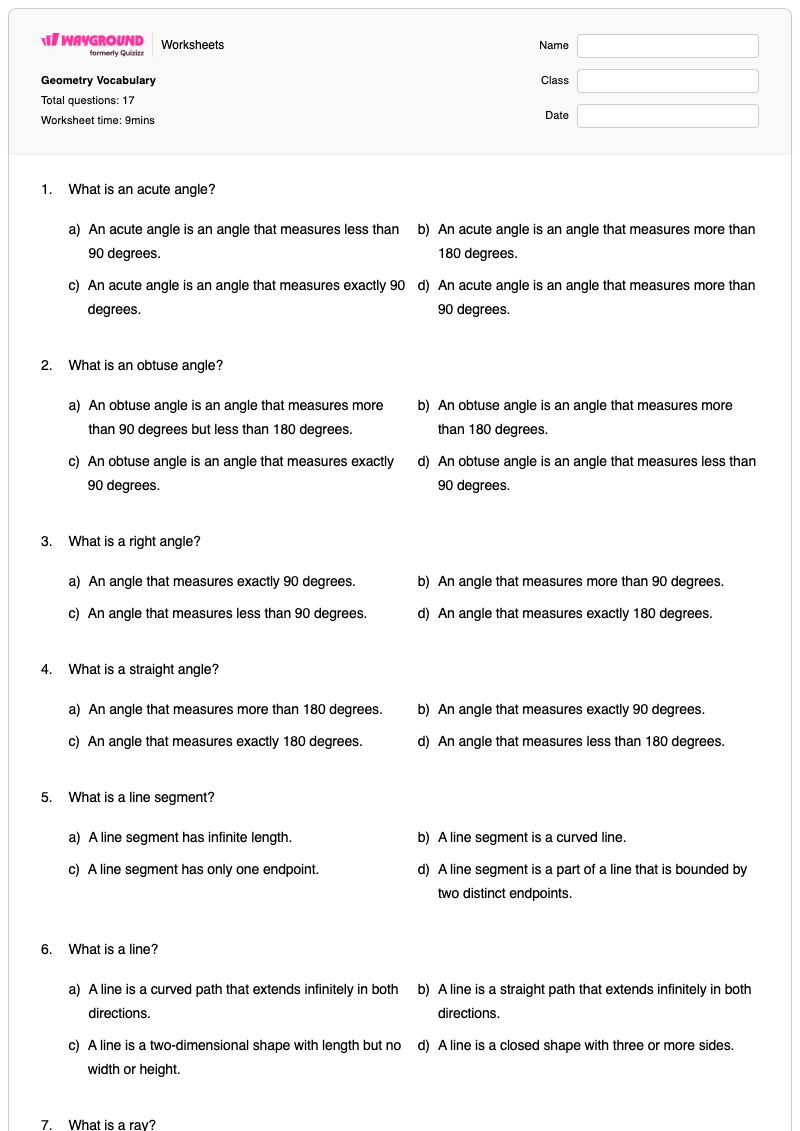
Geometry Vocabulary is a Grade 10 mathematics worksheet that builds precise understanding of foundational geometric terms. Its 17 multiple-choice questions ask students to identify definitions for angle classifications—including acute, obtuse, right, and straight angles—as well as point, line, ray, line segment, midpoint, and plane. Students also distinguish relationships and properties involving collinear and coplanar points, vertical and adjacent angles, and complementary angles. This free printable worksheet helps students connect geometric vocabulary to defining characteristics such as angle measure, endpoints, infinite extension, equal division, shared sides, and common planes. The multiple-choice format provides focused practice in recognizing accurate definitions and separating closely related terms, making it useful for vocabulary introduction, review, or a quick formative assessment in Grade 10 geometry. A complete answer key is included for efficient checking and feedback.

Worksheet settings

Font size

S
M
L
XL
Worksheets

Geometry Vocabulary

Total questions: 17

Name
Class
Date
1.

What is an acute angle?

a)

An acute angle is an angle that measures less than 90 degrees.

b)

An acute angle is an angle that measures more than 180 degrees.

c)

An acute angle is an angle that measures exactly 90 degrees.

d)

An acute angle is an angle that measures more than 90 degrees.

2.

What is an obtuse angle?

a)

An obtuse angle is an angle that measures more than 90 degrees but less than 180 degrees.

b)

An obtuse angle is an angle that measures more than 180 degrees.

c)

An obtuse angle is an angle that measures exactly 90 degrees.

d)

An obtuse angle is an angle that measures less than 90 degrees.

3.

What is a right angle?

a)

An angle that measures exactly 90 degrees.

b)

An angle that measures more than 90 degrees.

c)

An angle that measures less than 90 degrees.

d)

An angle that measures exactly 180 degrees.

4.

What is a straight angle?

a)

An angle that measures more than 180 degrees.

b)

An angle that measures exactly 90 degrees.

c)

An angle that measures exactly 180 degrees.

d)

An angle that measures less than 180 degrees.

5.

What is a line segment?

a)

A line segment has infinite length.

b)

A line segment is a curved line.

c)

A line segment has only one endpoint.

d)

A line segment is a part of a line that is bounded by two distinct endpoints.

6.

What is a line?

a)

A line is a curved path that extends infinitely in both directions.

b)

A line is a straight path that extends infinitely in both directions.

c)

A line is a two-dimensional shape with length but no width or height.

d)

A line is a closed shape with three or more sides.

7.

What is a ray?

a)

A ray is a line that starts at a point and extends infinitely in one direction.

b)

A ray is a line segment with a fixed length.

c)

A ray is a line that starts at a point and extends infinitely in both directions.

d)

A ray is a curved line that changes direction at every point.

8.

What is a point?

a)

A point is a small dot on a surface.

b)

A point is a precise location in space that has no size or dimension.

c)

A point is a unit of measurement in geometry.

d)

A point is a line segment with two endpoints.

9.

What is a midpoint?

a)

The point that divides a line segment into four equal parts.

b)

The point that divides a line segment into three equal parts.

c)

The point that divides a line segment into two equal parts.

d)

The point that divides a line segment into two unequal parts.

10.

What is a plane?

a)

A plane is a type of tool used for smoothing wood surfaces.

b)

A plane is a mathematical term used to describe a flat surface.

c)

A plane is a type of vehicle used for air travel.

d)

A plane is a flat, two-dimensional surface.

11.

What are collinear points?

a)

Points that form a triangle.

b)

Points that do not lie on the same straight line.

c)

Points that are equidistant from each other.

d)

Points that lie on the same straight line.

12.

What are coplanar points?

a)

Points that lie on the same plane.

b)

Points that are collinear.

c)

Points that are not on a plane.

d)

Points that lie on different planes.

13.

What are vertical angles?

a)

Congruent angles formed opposite each other by the intersection of two lines.

b)

Angles formed by the intersection of two intersecting lines at a right angle.

c)

Angles formed by the intersection of two perpendicular lines.

d)

Angles formed by the intersection of two parallel lines.

14.

What are adjacent angles?

a)

Two angles that share a common side but do not have a common vertex.

b)

Two angles that share a common vertex and a common side, but do not overlap.

c)

Two angles that do not share a common vertex.

d)

Two angles that share a common vertex and overlap.

15.

What are complimentary angles?

a)

Two angles that add up to 180 degrees.

b)

Two angles that add up to 45 degrees.

c)

Two angles that add up to 270 degrees.

d)

Two angles that add up to 90 degrees.

16.

What are supplementary angles?

a)

Two angles that add up to 180 degrees.

b)

Two angles that add up to 45 degrees.

c)

Two angles that add up to 270 degrees.

d)

Two angles that add up to 90 degrees.

17.

Two items are congruent if they...

a)

have the same size and shape.

b)

have a different size and shape.

c)

have the same size but a different shape.

d)

have a different size but are the same shape.

Answer Key

Geometry Vocabulary

Total questions: 17

1.
a)

An acute angle is an angle that measures less than 90 degrees.

2.
a)

An obtuse angle is an angle that measures more than 90 degrees but less than 180 degrees.

3.
a)

An angle that measures exactly 90 degrees.

4.
c)

An angle that measures exactly 180 degrees.

5.
d)

A line segment is a part of a line that is bounded by two distinct endpoints.

6.
b)

A line is a straight path that extends infinitely in both directions.

7.
a)

A ray is a line that starts at a point and extends infinitely in one direction.

8.
b)

A point is a precise location in space that has no size or dimension.

9.
c)

The point that divides a line segment into two equal parts.

10.
d)

A plane is a flat, two-dimensional surface.

11.
d)

Points that lie on the same straight line.

12.
a)

Points that lie on the same plane.

13.
a)

Congruent angles formed opposite each other by the intersection of two lines.

14.
b)

Two angles that share a common vertex and a common side, but do not overlap.

15.
d)

Two angles that add up to 90 degrees.

16.
a)

Two angles that add up to 180 degrees.

17.
a)

have the same size and shape.

FAQs

What does the Geometry Vocabulary worksheet cover?

This Grade 10 worksheet uses 17 multiple-choice questions to assess definitions of foundational geometry terms and angle relationships. Students distinguish acute, obtuse, right, and straight angles; identify points, lines, rays, segments, midpoints, and planes; and recognize collinear, coplanar, vertical, adjacent, and complementary relationships.

How can I use this worksheet to teach geometry vocabulary?

Introduce the terms in connected groups before assigning the questions: compare angle measures, contrast a line, ray, and line segment by their endpoints and extension, then discuss point, plane, midpoint, and point relationships. After students select answers, ask them to explain the defining feature they used—for example, why vertical angles are opposite and congruent or why complementary angles total 90 degrees.

What mistakes should I watch for when students complete this geometry vocabulary worksheet?

Students may confuse acute, right, and obtuse angles by mixing up the 90-degree boundary or overlook that a straight angle measures 180 degrees. They may also confuse a line, ray, and segment, or mistake collinear points for coplanar points. In the relationship questions, watch for confusion between vertical and adjacent angles and between complementary angles that total 90 degrees and distractors using other totals.

How do I assign and grade the Geometry Vocabulary worksheet?

You can assign this worksheet as a printable PDF or as a digital quiz on Wayground, and it includes a complete answer key for all 17 multiple-choice questions. Printable submissions can be graded by scanning student work with the Wayground for Teachers app, while the digital version supports straightforward online response review.

How can I differentiate this geometry vocabulary worksheet for my students?

In the worksheet’s Advanced Settings, adjust font spacing or font size to make the definition-based multiple-choice items easier to read. You can also apply a dyslexia-friendly font or translate the worksheet into another language, helping students access terms such as collinear, coplanar, vertical, and complementary.

Where can I find more worksheets like this on Wayground?

Wayground offers a comprehensive collection of free printable worksheets and practice problems across subjects, with downloadable PDFs and answer keys to support essential skills and concepts. Browse more resources at https://wayground.com/en-us/worksheets.