Honors Geometry: Inequalities in One Triangle is a free printable mathematics worksheet for students in Grades 9–12. Its 17 multiple-choice questions target the relationships between triangle side lengths and angle measures, including ordering angles by opposite side lengths, ordering sides by opposite angle measures, identifying the smallest or largest angle or side, and determining whether given lengths can form a triangle.
Students also apply the Triangle Inequality Theorem to find or evaluate possible third-side lengths, including questions that require recognizing strict ranges and identifying an impossible length. Numerical angle expressions and labeled triangles give students practice connecting geometric relationships to algebraic information. The worksheet includes a complete answer key and is suitable for guided practice, independent work, review, or assessment of triangle inequalities and angle-side relationships.
Worksheet settings
Font size
S
M
L
XL
Worksheets
Honors Geometry: Inequalities in One Triangle
Total questions: 17
Name
Class
Date
1.
List the angles of the triangle in order from smallest to largest:
ΔXYZ, where XY = 12, YZ = 24, ZX = 30
a)
∡Z, ∡X, ∡Y
b)
∡X, ∡Y, ∡Z
c)
∡Z, ∡Y, ∡X
d)
∡Y, ∡Z, ∡X
2.
List the sides of the triangle in order from shortest to longest:
ΔDEF, with m∡D = 20, m∡E = 120, and m∡F = 40
a)
EF, DE, DF
b)
DE, DF, EF
c)
DF, DE, EF
d)
DF, EF, DE
3.
Can a triangle have sides with the given lengths:
4 m, 5 m, 9 m
a)
Yes
b)
No
4.
Can a triangle have sides with the given lengths?
15 cm, 1 cm, 15 cm
a)
Yes
b)
No
5.
The lengths of two sides of a triangle are 5 in and 16 in. What is the range of possible lengths for the third side?
a)
11 in < x < 21 in
b)
x > 0
c)
11 or 21
d)
5 < x < 16
6.
Find the longest side of ΔABC, with m∡A = 50, m∡B = 2x - 10, m∡C = 5x.
a)
AB
b)
BC
c)
AC
d)
∡C
7.
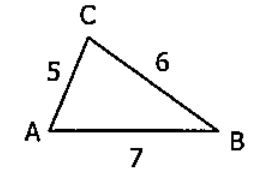
Name the smallest angle in this triangle.
a)
∠A
b)
∠B
c)
∠C
8.
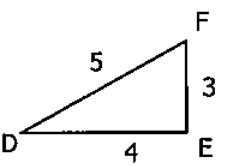
Name the largest angle in this triangle.
a)
∠D
b)
∠E
c)
∠F
9.
The smallest angle would be located where in a triangle?
a)
Across from the smallest side.
b)
Across from the largest side
c)
Cannot tell
10.
Order the sides from greatest to least
a)
a , b , c
b)
b , c , a
c)
c , b , a
d)
a , c , b
11.
Where would the largest angle of a triangle be located?
a)
Across from the longest side.
b)
Across from the shortest side
c)
I need more information to get an answer.
12.
List the SIDES from smallest to largest.
a)
PR,QP,RQ
b)
PR,RQ,QP
c)
QP,PR,RQ
d)
QP,RQ,PR
13.
Is it possible to construct a triangle with sides 15, 37, 53?
a)
Yes
b)
No
c)
Cannot be determined
14.
A triangle has two sides with lengths 5 and 13. Which choice describes the possible lengths of the third side?
a)
7<x<16
b)
5<x<13
c)
8<x<18
d)
9<x<19
15.
A triangle has side lengths 6 and 10.
Which choice CANNOT be the length of the third side?
a)
5
b)
11
c)
15
d)
17
16.
Use the figure to determine the relationship between the lengths of the given sides.
a)
DE<DG
b)
DE>DG
17.
Use the figure to determine the relationship between the lengths of the given sides.
a)
EG<FG
b)
EG>FG
Answer Key
Honors Geometry: Inequalities in One Triangle
Total questions: 17
1.
a)
∡Z, ∡X, ∡Y
2.
a)
EF, DE, DF
3.
b)
No
4.
a)
Yes
5.
a)
11 in < x < 21 in
6.
a)
AB
7.
b) ∠B
8.
b) ∠E
9.
a) Across from the smallest side.
10.
b)
b , c , a
11.
a) Across from the longest side.
12.
c)
QP,PR,RQ
13.
b)
No
14.
c)
8<x<18
15.
d)
17
16.
a)
DE<DG
17.
a)
EG<FG
140 %
Browse by subjects
Browse by grades
Browse by format
FAQs
What does this Honors Geometry worksheet cover?
This worksheet covers angle-side relationships in triangles and the Triangle Inequality Theorem through 17 multiple-choice questions. Students order angles or sides by comparing opposite measures, identify the smallest or largest part of a triangle, and determine whether side lengths or a proposed third side can form a valid triangle. These tasks build precision in connecting opposite angles and sides and applying strict inequalities.
How can I use this worksheet to teach triangle inequalities and angle-side relationships?
Introduce the two key relationships first: the largest angle is opposite the longest side, and the smallest angle is opposite the shortest side. Then model the strict Triangle Inequality range for a third side before assigning the multiple-choice items, using the answer choices to discuss why endpoint values are excluded. Have students explain the rule behind each selected answer rather than relying only on visual comparisons.
What mistakes should I watch for when students complete this triangle inequalities worksheet?
Watch for students matching an angle with an adjacent side instead of the side directly opposite it, especially when ordering labeled triangle parts. Students may also reverse the side order when ordering angles, or use a non-strict inequality for the third-side range. For items with two angle expressions, check that students evaluate or compare the angles before identifying the opposite longest or shortest side.
How do I assign and grade this worksheet?
This worksheet is available as a printable PDF and as a digital quiz on Wayground, with a complete answer key for its multiple-choice questions. Assign the digital version for online responses, or print the worksheet and grade student work by scanning it with the Wayground for Teachers app. The printable option can also support schools that are reducing screen time.
How can I differentiate this triangle inequalities worksheet for my students?
Use the worksheet’s Advanced Settings to adjust font spacing and font size so the labeled triangle information and multiple-choice options are easier to read. You can also enable a dyslexia-friendly font or translate the worksheet into another language. These file-level options can make the angle-side and third-side inequality questions more accessible without changing the targeted skills.
Where can I find more worksheets like this on Wayground?
Wayground offers a comprehensive collection of free printable worksheets and practice problems across subjects, with downloadable PDFs and answer keys to help students master essential skills and concepts. Browse more resources at https://wayground.com/en-us/worksheets.

 Worksheets