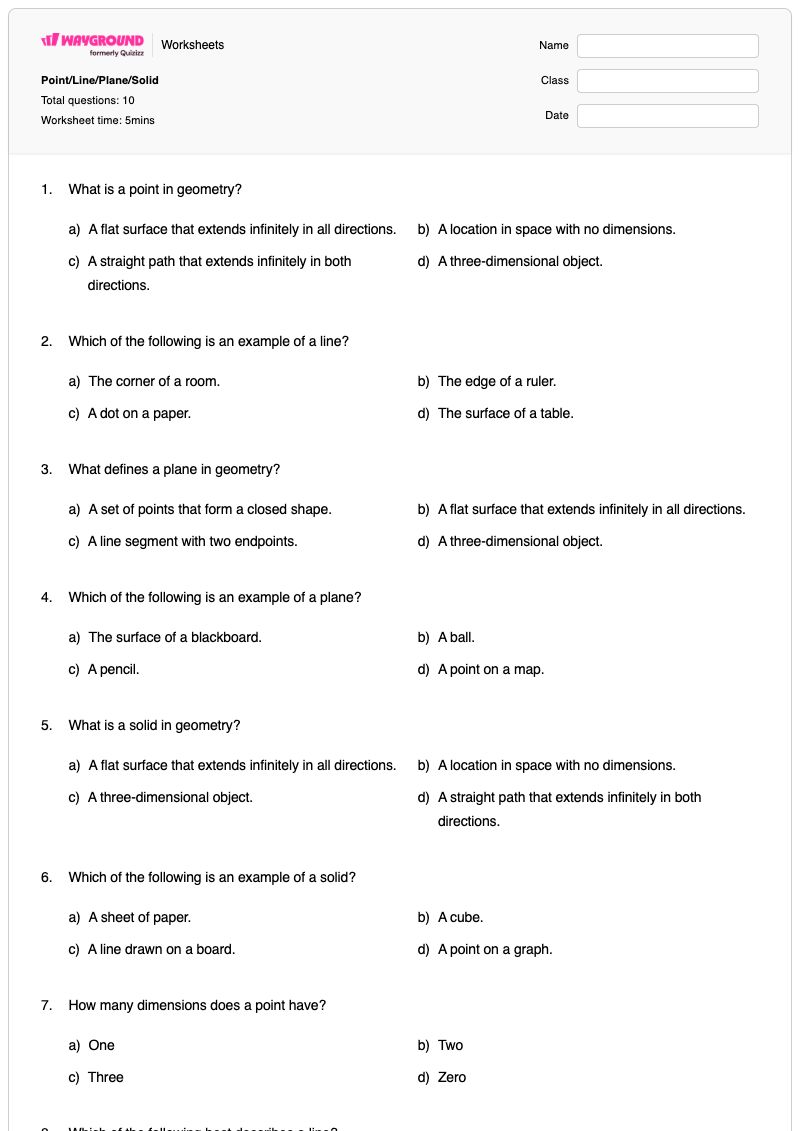
Point/Line/Plane/Solid is a free printable Grade 7 geometry worksheet that helps students distinguish four foundational geometric ideas: points, lines, planes, and solids. Through 10 multiple-choice questions, students identify formal definitions, recognize real-world examples such as a ruler edge, blackboard surface, and cube, and connect each concept to its number of dimensions. The worksheet also checks whether students can identify a characteristic that does not describe a solid.
This worksheet is useful for introducing or reviewing the basic language of geometry before students work with figures, measurements, or spatial relationships. Its carefully varied questions require students to compare zero-, one-, two-, and three-dimensional objects and interpret descriptions involving infinite extension and volume. It is a free printable worksheet with a complete answer key, making it suitable for independent practice, classroom review, homework, or a quick formative assessment for Grade 7 learners.
Worksheet settings
Font size
S
M
L
XL
Worksheets
Point/Line/Plane/Solid
Total questions: 10
Name
Class
Date
1.
What is a point in geometry?
a)
A flat surface that extends infinitely in all directions.
b)
A location in space with no dimensions.
c)
A straight path that extends infinitely in both directions.
d)
A three-dimensional object.
2.
Which of the following is an example of a line?
a)
The corner of a room.
b)
The edge of a ruler.
c)
A dot on a paper.
d)
The surface of a table.
3.
What defines a plane in geometry?
a)
A set of points that form a closed shape.
b)
A flat surface that extends infinitely in all directions.
c)
A line segment with two endpoints.
d)
A three-dimensional object.
4.
Which of the following is an example of a plane?
a)
The surface of a blackboard.
b)
A ball.
c)
A pencil.
d)
A point on a map.
5.
What is a solid in geometry?
a)
A flat surface that extends infinitely in all directions.
b)
A location in space with no dimensions.
c)
A three-dimensional object.
d)
A straight path that extends infinitely in both directions.
6.
Which of the following is an example of a solid?
a)
A sheet of paper.
b)
A cube.
c)
A line drawn on a board.
d)
A point on a graph.
7.
How many dimensions does a point have?
a)
One
b)
Two
c)
Three
d)
Zero
8.
Which of the following best describes a line?
a)
A set of points that form a closed shape.
b)
A straight path that extends infinitely in both directions.
c)
A flat surface with boundaries.
d)
A three-dimensional object.
9.
How many dimensions does a plane have?
a)
One
b)
Two
c)
Three
d)
Zero
10.
Which of the following is NOT a characteristic of a solid?
a)
It has volume.
b)
It has length, width, and height.
c)
It extends infinitely in all directions.
d)
It is a three-dimensional object.
Answer Key
Point/Line/Plane/Solid
Total questions: 10
1.
b)
A location in space with no dimensions.
2.
b)
The edge of a ruler.
3.
b)
A flat surface that extends infinitely in all directions.
4.
a)
The surface of a blackboard.
5.
c)
A three-dimensional object.
6.
b)
A cube.
7.
d)
Zero
8.
b)
A straight path that extends infinitely in both directions.
9.
b)
Two
10.
c)
It extends infinitely in all directions.
140 %
Browse by subjects
Browse by grades
Browse by format
FAQs
What does the Point/Line/Plane/Solid worksheet cover?
This Grade 7 worksheet uses 10 multiple-choice questions to help students distinguish a point, line, plane, and solid by their definitions, dimensions, and familiar examples. Students identify a point as zero-dimensional, a line as extending infinitely in two directions, a plane as a two-dimensional surface extending infinitely, and a solid as a three-dimensional object with volume.
How can I use this worksheet to teach points, lines, planes, and solids?
Introduce the four terms with physical or drawn examples, then ask students to explain why a ruler edge represents a line, a blackboard surface represents a plane, and a cube represents a solid. Have students complete the multiple-choice items individually or in pairs, followed by a discussion that compares the number of dimensions and the idea of infinite extension in each definition.
What mistakes should I watch for on this point, line, plane, and solid worksheet?
Students may confuse a point with a small object rather than a location with zero dimensions, or mistake a flat plane for a three-dimensional solid. Watch for students choosing a sheet of paper as a plane without considering the worksheet’s idealized definition, and for selecting infinite extension as a property of a solid even though solids have length, width, height, and volume.
How do I assign and grade the Point/Line/Plane/Solid worksheet?
You can assign this worksheet as a printable PDF or as a digital quiz on Wayground, and it includes a complete answer key for checking all 10 multiple-choice questions. For printable submissions, scan student work with the Wayground for Teachers app to streamline grading.
How can I differentiate this Point/Line/Plane/Solid worksheet for my students?
Use the worksheet’s Advanced Settings to adjust font spacing and font size so the definitions and answer choices are easier to follow. You can also apply a dyslexia-friendly font or translate the worksheet into another language while students work with the point, line, plane, and solid questions.
Where can I find more worksheets like this on Wayground?
Wayground offers a broad collection of free printable worksheets and practice problems across subjects, with downloadable PDFs and answer keys to support mastery of essential skills and concepts. Browse more resources at https://wayground.com/en-us/worksheets.

 Worksheets