

Wayground
Intro to Solving System of Inequalities - Printable Mathematics Worksheets class 8 - Wayground

Intro to Solving System of Inequalities

1 questions

8th - 8th Grade

Mathematics

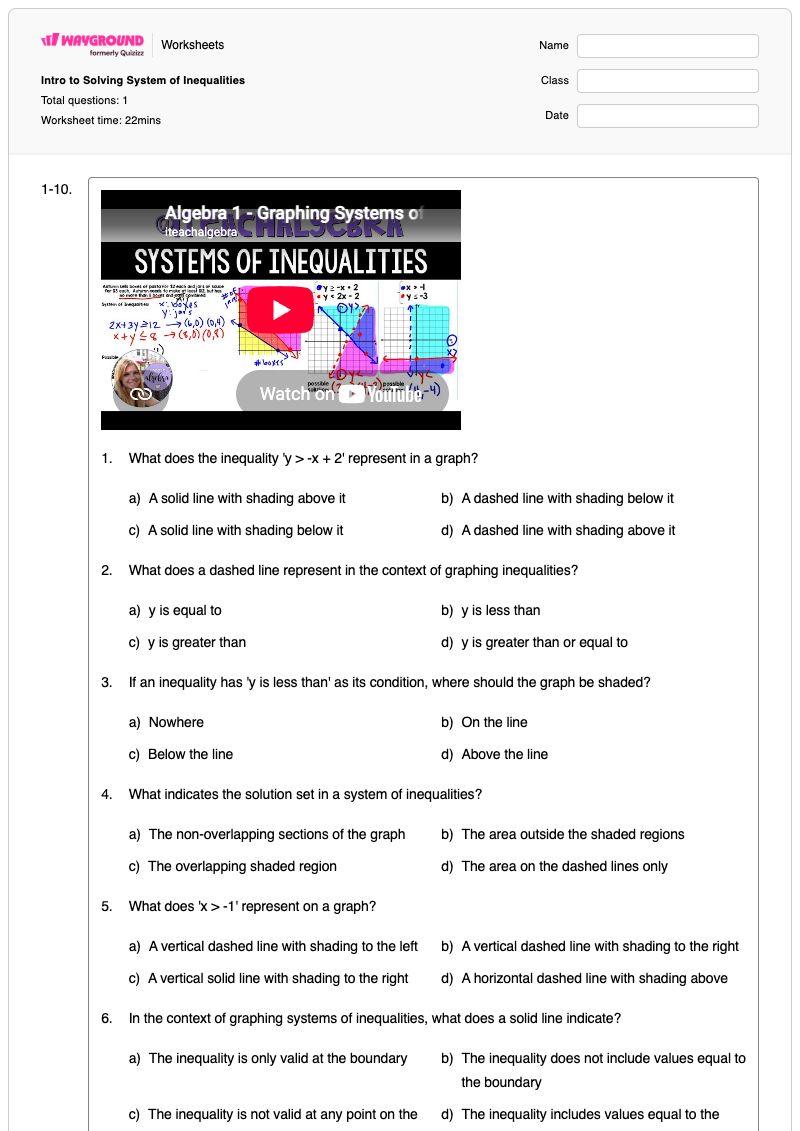
This Grade 8 mathematics worksheet introduces students to solving systems of inequalities by interpreting their graphs. It includes one comprehension item and ten multiple-choice questions covering boundary lines, shading directions, vertical and horizontal inequality graphs, overlapping shaded regions, and systems with no solution. Students also interpret inequalities in real-world contexts, including revenue and work-hour situations, to connect symbolic expressions with practical constraints. The worksheet is designed for introductory practice, review, or a quick formative check before students graph complete systems independently. Its questions help students distinguish how an inequality is represented, identify the solution set where shaded regions overlap, and reason about how parallel boundaries and shading affect possible solutions. This free printable worksheet includes a complete answer key for efficient teacher review and feedback. It is appropriate for Grade 8 math classrooms, intervention groups, homework, or independent practice.

Worksheet settings

Font size

S
M
L
XL
Worksheets

Intro to Solving System of Inequalities

Total questions: 1

Name
Class
Date
1-10.
1.

What does the inequality 'y > -x + 2' represent in a graph?

a)

A solid line with shading above it

b)

A dashed line with shading below it

c)

A solid line with shading below it

d)

A dashed line with shading above it

2.

What does a dashed line represent in the context of graphing inequalities?

a)

y is equal to

b)

y is less than

c)

y is greater than

d)

y is greater than or equal to

3.

If an inequality has 'y is less than' as its condition, where should the graph be shaded?

a)

Nowhere

b)

On the line

c)

Below the line

d)

Above the line

4.

What indicates the solution set in a system of inequalities?

a)

The non-overlapping sections of the graph

b)

The area outside the shaded regions

c)

The overlapping shaded region

d)

The area on the dashed lines only

5.

What does 'x > -1' represent on a graph?

a)

A vertical dashed line with shading to the left

b)

A vertical dashed line with shading to the right

c)

A vertical solid line with shading to the right

d)

A horizontal dashed line with shading above

6.

In the context of graphing systems of inequalities, what does a solid line indicate?

a)

The inequality is only valid at the boundary

b)

The inequality does not include values equal to the boundary

c)

The inequality is not valid at any point on the boundary

d)

The inequality includes values equal to the boundary

7.

What happens when two inequalities in a system are graphed and they have no overlapping shaded regions?

a)

There is no solution

b)

There is one unique solution

c)

There is an infinite number of solutions

d)

The solution is any point on the dashed line

8.

How can parallel lines in a system of inequalities affect the solution?

a)

They always result in an infinite number of solutions

b)

They can result in no solution, a unique solution, or many solutions depending on the shading

c)

They indicate that the inequalities are identical

d)

They always result in no solution

9.

In the word problem about Autumn selling pasta and sauce, what does the inequality '2x + 3y >= 12' represent?

a)

The types of products she sells

b)

The minimum amount of money she needs to make

c)

The total number of boxes and jars she can sell

d)

The maximum number of items she can sell

10.

What does the inequality 'x + y < 6' represent in Nathan's work hours problem?

a)

The maximum amount of money he wants to make

b)

The types of jobs he has

c)

The minimum hours he needs to work

d)

The maximum hours he can work

Answer Key

Intro to Solving System of Inequalities

Total questions: 1

1-10.
1.
a)

A solid line with shading above it

2.
b)

y is less than

3.
c)

Below the line

4.
c)

The overlapping shaded region

5.
b)

A vertical dashed line with shading to the right

6.
d)

The inequality includes values equal to the boundary

7.
a)

There is no solution

8.
b)

They can result in no solution, a unique solution, or many solutions depending on the shading

9.
b)

The minimum amount of money she needs to make

10.
d)

The maximum hours he can work

FAQs

What does this worksheet cover, and how does it help students learn systems of inequalities?

This Grade 8 worksheet uses one comprehension item and ten multiple-choice questions to build introductory skill with graphing systems of inequalities. Students identify boundary-line features, determine the correct shading direction, locate overlapping shaded regions as solution sets, and interpret whether systems have no solution. Context-based items also ask students to connect inequalities with real-world limits such as minimum earnings and maximum work hours.

How can I use this worksheet to teach graphing systems of inequalities?

Introduce the worksheet by modeling how to read one inequality as a boundary and shaded region, then use the early multiple-choice items to discuss line style and shading before moving to systems. Ask students to explain why the common shaded region represents values satisfying both inequalities, and use the parallel-line and no-overlap questions to compare possible solution outcomes. Finish by having students translate the word-problem inequalities into statements about minimum or maximum quantities.

What mistakes should I watch for when students complete this systems of inequalities worksheet?

Watch for students choosing the wrong side of a boundary, confusing solid and dashed lines, or treating the boundary itself as the entire solution set. Students may also select all shaded regions instead of the overlap required by a system, overlook that an x-inequality produces a vertical graph, or assume parallel boundaries always produce the same type of solution. In the word problems, check that they interpret the inequality as a minimum or maximum rather than simply describing the quantities involved.

How do I assign and grade this systems of inequalities worksheet?

You can assign this worksheet as a printable PDF or as a digital quiz on Wayground. It includes a complete answer key for checking the comprehension and multiple-choice responses, and printable submissions can be graded by scanning student work with the Wayground for Teachers app. The printable format also gives schools an option for reducing screen time.

How can I differentiate this systems of inequalities worksheet for my students?

Use the worksheet’s Advanced Settings to adjust font spacing or choose a larger font size so the graphing terms, answer choices, and real-world inequality prompts are easier to read. You can also select a dyslexia-friendly font or translate the worksheet into another language when that supports access to the multiple-choice and comprehension items.

Where can I find more free worksheets like this on Wayground?

Wayground offers a comprehensive collection of free printable worksheets and practice problems across all subjects, with downloadable PDFs and answer keys to support essential skills and concepts. Browse more resources at https://wayground.com/en-us/worksheets.