This free printable Characteristics of Polynomial Graphs worksheet is designed for Grade 9–12 mathematics students who are learning to interpret polynomial functions from their graphs. It includes 10 questions—7 multiple-choice and 3 multiple-select—that ask students to count extrema, distinguish maximums from minimums, classify points as relative or absolute extrema, and estimate a polynomial’s degree from its graph.
Students also identify intervals where the graph is increasing or decreasing, determine the function’s range, and interpret its end behavior using limit notation. These tasks require students to connect visible graph features with algebraic vocabulary and function behavior rather than simply read individual coordinates. The worksheet includes a complete answer key, making it useful for guided practice, independent work, review, or assessment. Teachers can use the printable format with Grade 9–12 learners developing fluency in polynomial function analysis.
Worksheet settings
Font size
S
M
L
XL
Worksheets
Characteristics of Polynomial Graphs
Total questions: 10
Name
Class
Date
1.
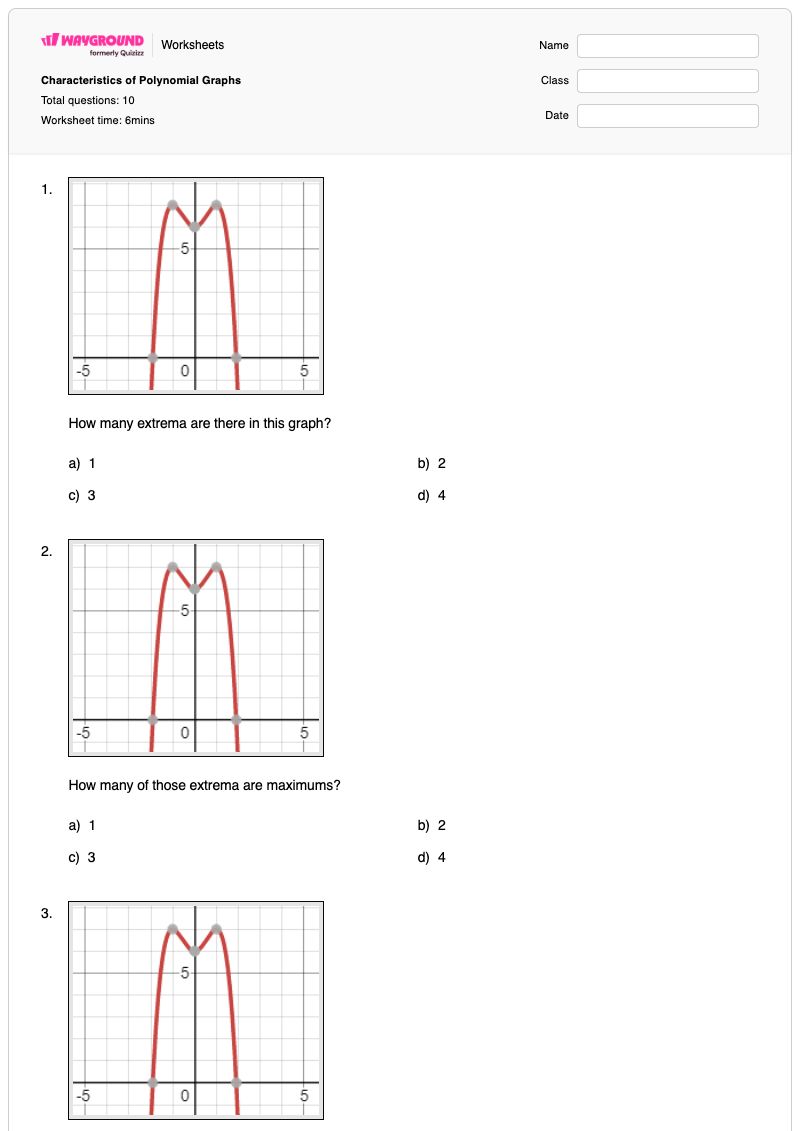
How many extrema are there in this graph?
a)
1
b)
2
c)
3
d)
4
2.
How many of those extrema are maximums?
a)
1
b)
2
c)
3
d)
4
3.
How many of the extrema are minimums?
a)
1
b)
2
c)
3
d)
4
4.
How would you describe the point at (1,7)?
a)
Relative Minimum
b)
Absolute Minimum
c)
Relative Maximum
d)
Absolute Maximum
5.
How would you describe the point at (0,6)?
a)
Relative Minimum
b)
Absolute Minimum
c)
Relative Maximum
d)
Absolute Maximum
6.
What is the likely degree of the polynomial that created this graph?
a)
1
b)
2
c)
3
d)
4
7.
Check all the intervals where this graph is decreasing.
a)
(-∞, -1)
b)
(-1, 0)
c)
(0, 1)
d)
(1, ∞)
8.
Check all the intervals where this graph is increasing.
a)
(-∞, -1)
b)
(-1, 0)
c)
(0, 1)
d)
(1, ∞)
9.
What is the Range of the function being graphed?
a)
(-∞, ∞)
b)
(7, ∞)
c)
(-∞, 7)
d)
(-1, 1)
10.
Which statements describe the End Behavior of the graph? (Check all that apply)
a)
x→ -∞, f(x)→ -∞
b)
x→ -∞, f(x)→∞
c)
x→ ∞, f(x)→∞
d)
x→ ∞, f(x)→ -∞
Answer Key
Characteristics of Polynomial Graphs
Total questions: 10
1.
c)
3
2.
b)
2
3.
a)
1
4.
d)
Absolute Maximum
5.
a)
Relative Minimum
6.
d)
4
7.
d)
(1, ∞)
, b)
(-1, 0)
8.
a)
(-∞, -1)
, c)
(0, 1)
9.
c)
(-∞, 7)
10.
d)
x→ ∞, f(x)→ -∞
, a)
x→ -∞, f(x)→ -∞
140 %
Browse by subjects
Browse by grades
Browse by format
FAQs
What does the Characteristics of Polynomial Graphs worksheet cover?
This worksheet builds graph-analysis skills for polynomial functions through 10 items: 7 multiple-choice questions and 3 multiple-select questions. Students count and classify extrema, estimate the polynomial’s degree, identify increasing and decreasing intervals, determine range, and interpret end behavior from a displayed graph.
How can I use this worksheet to teach students to analyze a polynomial graph?
Introduce the graph vocabulary first, then have students trace the curve from left to right and mark turning points before completing the questions. Ask students to explain why each turning point is a relative or absolute maximum or minimum, and have them connect each rising or falling section to the increasing/decreasing interval choices. Finish by using the degree, range, and end-behavior questions as a discussion about how one graph communicates several properties of a polynomial.
What mistakes should I watch for when students complete this polynomial graph worksheet?
Students may count every visible point instead of identifying only extrema, or confuse a relative extremum with the graph’s absolute maximum or minimum. In the multiple-select interval questions, they may select intervals based on endpoint labels without checking whether the curve rises or falls across the entire interval. They may also reverse the range notation or choose end behavior based on the graph’s middle rather than its far-left and far-right directions.
How do I assign and grade this Characteristics of Polynomial Graphs worksheet?
Wayground provides this worksheet as both a printable PDF and a digital quiz, and it includes a complete answer key for all 10 graph-analysis questions. For printable submissions, you can scan student work with the Wayground for Teachers app to help grade responses efficiently. The printable option also supports classrooms that are reducing screen time.
How can I differentiate this polynomial graph worksheet for my students?
Use the worksheet’s Advanced Settings to adjust font spacing or increase the font size so the graph-analysis prompts and interval choices are easier to read. You can also enable a dyslexia-friendly font or translate the worksheet into another language when those options better support students working with extrema, range, and end-behavior vocabulary.
Where can I find more worksheets like this on Wayground?
Wayground offers a broad collection of free printable worksheets and practice problems across subjects, with downloadable PDFs and answer keys to support essential skills and concepts. Browse more resources at https://wayground.com/en-us/worksheets.

 Worksheets


