

Wayground
Hair and Fiber Quiz Review - Printable Science Worksheets class 12 - Wayground

Hair and Fiber Quiz Review

Kelly Flaherty

Created by Kelly Flaherty

21 questions

12th Grade

Science

Updated Apr 2026

Hair and Fiber Quiz Review is a Grade 12 science worksheet that strengthens forensic analysis of hair and fiber evidence. Its 21 items include one multiple-select question, 17 multiple-choice questions, and three fill-in-the-blank prompts. Students review where natural fibers originate, why fibers are useful as trace evidence, the filament-to-fiber-to-fabric production sequence, and methods for distinguishing fiber types. The worksheet also asks students to identify the hair shaft’s cuticle, cortex, and medulla; connect the hair root with DNA analysis; recognize anagen as the active growth stage; distinguish mitochondrial DNA from other DNA types in a rootless hair shaft; and identify coronal, spinous, and imbricate cuticle scales from an image. Fill-in-the-blank items apply knowledge of cotton and spandex. This free printable worksheet includes a complete answer key for independent review, classroom assessment, or forensic science test preparation.

Worksheet settings

Font size

S
M
L
XL
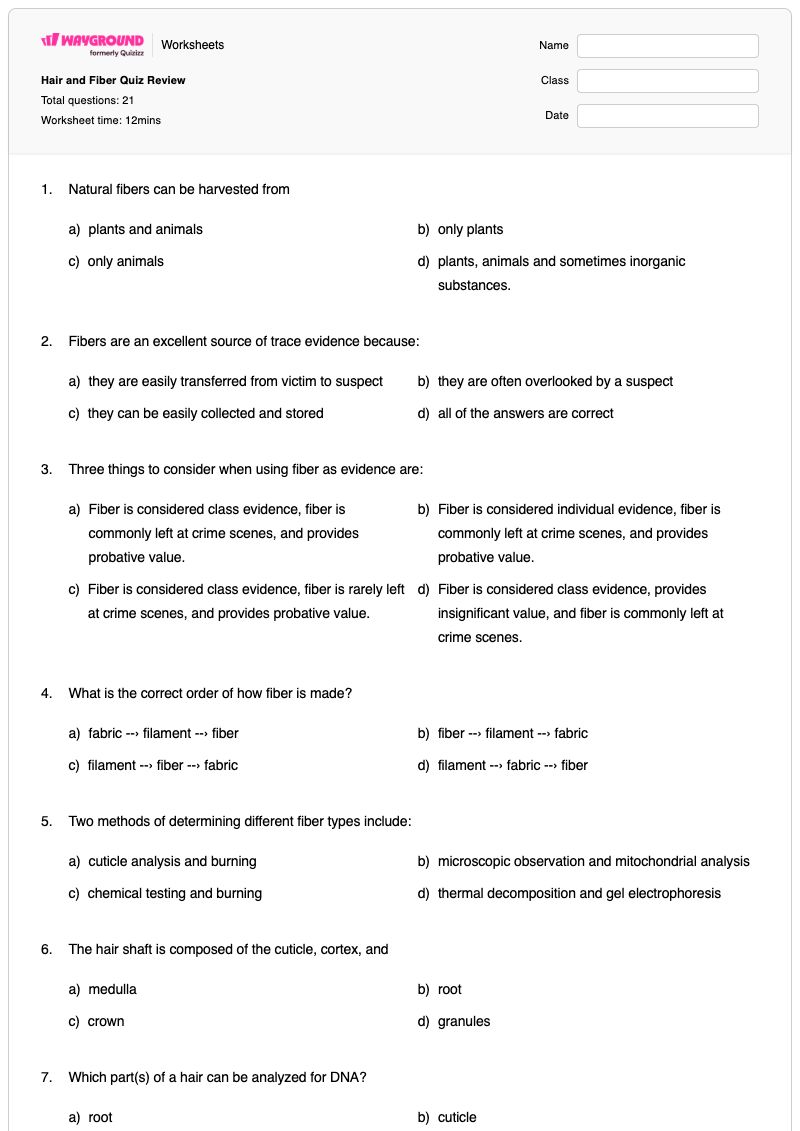
WaygroundWorksheets

Hair and Fiber Quiz Review

Total questions: 21

Name
Class
Date
1.

Natural fibers can be harvested from

a)

plants and animals

b)

only plants

c)

only animals

d)

plants, animals and sometimes inorganic substances.

2.

Fibers are an excellent source of trace evidence because:

a)

they are easily transferred from victim to suspect

b)

they are often overlooked by a suspect

c)

they can be easily collected and stored

d)

all of the answers are correct

3.

Three things to consider when using fiber as evidence are:

a)

Fiber is considered class evidence, fiber is commonly left at crime scenes, and provides probative value.

b)

Fiber is considered individual evidence, fiber is commonly left at crime scenes, and provides probative value.

c)

Fiber is considered class evidence, fiber is rarely left at crime scenes, and provides probative value.

d)

Fiber is considered class evidence, provides insignificant value, and fiber is commonly left at crime scenes.

4.

What is the correct order of how fiber is made?

a)

fabric --› filament --› fiber

b)

fiber --› filament --› fabric

c)

filament --› fiber --› fabric

d)

filament --› fabric --› fiber

5.

Two methods of determining different fiber types include:

a)

cuticle analysis and burning

b)

microscopic observation and mitochondrial analysis

c)

chemical testing and burning

d)

thermal decomposition and gel electrophoresis

6.

The hair shaft is composed of the cuticle, cortex, and

a)

medulla

b)

root

c)

crown

d)

granules

7.

Which part(s) of a hair can be analyzed for DNA?

a)

root

b)

cuticle

c)

medulla

d)

cortex

8.

The period of active hair growth is called the ___________ stage.

a)

catagen

b)

telogen

c)

anagen

d)

imagen

9.

What are all the reasons that hair is a valuable piece of evidence?

a)

It is considered trace evidence, it has a wide range of characteristics, and it is persistent.

b)

It contains genomic DNA in the hair shaft, it resists degradation, and it is commonly found at crime scenes.

c)

It has a wide range of characteristics, it contains genomic DNA in the hair shaft, it is persistent, and it is considered trace evidence.

d)

It has a wide range of characteristics, it is persistent, it resists degradation, and it is commonly found at crime scenes.

10.

A crime scene from 25 years ago was re-examined and one strand of hair (without the root) was found on the couch. What type of DNA can be obtained from this hair shaft?

a)

nuclear DNA

b)

cytoplasmic DNA

c)

chloroplast DNA

d)

mitochondrial DNA

11.
Look at the picture above Match the letter to the correct cuticle scale. What is A?

Look at the picture above Match the letter to the correct cuticle scale. What is A?

a)

Spinous

b)

Imbricate

c)

Coronal

12.
Look at the picture above Match the letter to the correct cuticle scale. What is B?

Look at the picture above Match the letter to the correct cuticle scale. What is B?

a)

Spinous

b)

Imbricate

c)

Coronal

13.
Look at the picture above Match the letter to the correct cuticle scale. What is C?

Look at the picture above Match the letter to the correct cuticle scale. What is C?

a)

Spinous

b)

Imbricate

c)

Coronal

14.

What type of fiber is: Most common type of fiber textile and is made out of cellulose.

(a)  

15.

What type of fiber is: Stretches 600% and can do back to its original shape.

(a)  

16.

What type of fiber is: Made from the cocoons of little caterpillars.

(a)  

17.

The shaft of the hair is considered class evidence in a trial.

a)

True

b)

False

18.

Pulled-out hairs have a bulb-shaped root.

a)

True

b)

False

19.

Chromatography is the absorption of light at one wavelength and its reemission as a longer wavelength.

a)

True

b)

False

20.

When examining a Becke line of fiber, if the edges of the fiber cannot be seen, the refractive index is the same as the fiber.

a)

True

b)

False

21.

The cortex may contain pigment granules.

a)

True

b)

False

WaygroundAnswer Key

Hair and Fiber Quiz Review

Total questions: 21

1.
a)

plants and animals

, d)

plants, animals and sometimes inorganic substances.

2.
d)

all of the answers are correct

3.
a)

Fiber is considered class evidence, fiber is commonly left at crime scenes, and provides probative value.

4.
c)

filament --› fiber --› fabric

5.
c)

chemical testing and burning

6.
a)

medulla

7.
a)

root

8.
c)

anagen

9.
d)

It has a wide range of characteristics, it is persistent, it resists degradation, and it is commonly found at crime scenes.

10.
d)

mitochondrial DNA

11.
c)

Coronal

12.
a)

Spinous

13.
b)

Imbricate

14.
cotton, Cotton
15.
spandex, Spandex
16.
silk, Silk
17.
a)

True

18.
b)

False

19.
b)

False

20.
a)

True

21.
a)

True

FAQs

What does the Hair and Fiber Quiz Review worksheet cover?

This Grade 12 science worksheet reviews how hair and fibers are analyzed as forensic evidence through multiple-select, multiple-choice, and fill-in-the-blank questions. Students apply concepts including the filament-to-fiber-to-fabric sequence, fiber testing, hair shaft structures, DNA sources, the anagen growth stage, cuticle scale identification, and the properties of cotton and spandex.

How can I use this worksheet to teach forensic hair and fiber analysis?

Introduce the review by having students organize the hair concepts into categories: structure, growth, DNA, and cuticle scales, then contrast those with fiber origin, manufacture, testing, and evidentiary value. Use the image-based cuticle questions to prompt students to justify each scale identification, and ask them to explain why a rootless hair shaft is associated with mitochondrial DNA before assigning the full quiz review.

What mistakes should I watch for when students complete this hair and fiber worksheet?

Watch for students reversing the production order as fiber, filament, fabric instead of filament, fiber, fabric, or treating fiber as individual rather than class evidence. Students may also confuse the medulla with another hair structure, select the hair shaft rather than the root for DNA analysis, identify telogen or catagen instead of anagen for active growth, or mix up the coronal, spinous, and imbricate cuticle scales in the image items.

How do I assign and grade the Hair and Fiber Quiz Review worksheet?

You can assign this hair and fiber review as a printable PDF or as a digital quiz on Wayground, and it includes a complete answer key for checking all 21 items. For printable submissions, scan student work with the Wayground for Teachers app to grade responses efficiently.

How can I differentiate this hair and fiber worksheet for my students?

In the worksheet’s Advanced Settings, adjust font spacing or font size to make the forensic terminology, answer choices, and cuticle-scale items easier to read. You can also enable a dyslexia-friendly font or translate the worksheet into another language when those options support access to the hair and fiber review.

Where can I find more worksheets like this on Wayground?

Wayground offers a comprehensive collection of free printable worksheets and practice problems across subjects, with downloadable PDFs and answer keys to help students master essential skills and concepts. Browse more resources at https://wayground.com/en-us/worksheets.