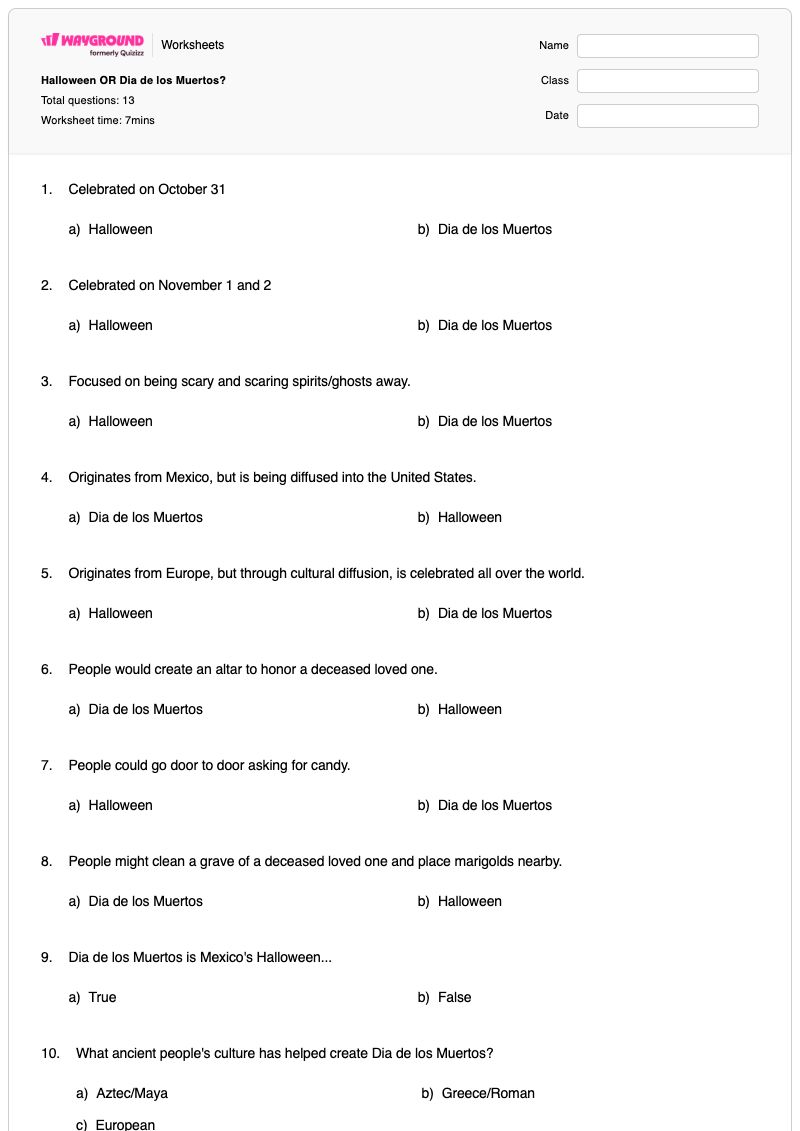
This Grade 6 social studies worksheet helps students compare Halloween and Día de los Muertos through 13 multiple-choice questions. Students identify each celebration’s dates, cultural origins, traditions, and purposes; distinguish honoring deceased loved ones from attempts to scare away spirits; and recognize examples of cultural diffusion. The questions also connect Día de los Muertos to Aztec/Maya cultural influences, Halloween to Celtic/Roman influences, and the film Coco to Día de los Muertos.
The worksheet builds comparison and cultural-literacy skills by asking students to classify statements, evaluate a true-or-false claim, identify cultural influences, and determine which example does not represent cultural diffusion. It is a free printable worksheet with a complete answer key, making it useful for guided instruction, independent practice, or a quick formative assessment after introducing both celebrations. The focused question format helps teachers see whether students can distinguish the celebrations without treating Día de los Muertos as simply Mexico’s version of Halloween.
Worksheet settings
Font size
S
M
L
XL
Worksheets
Halloween OR Dia de los Muertos?
Total questions: 13
Name
Class
Date
1.
Celebrated on October 31
a)
Halloween
b)
Dia de los Muertos
2.
Celebrated on November 1 and 2
a)
Halloween
b)
Dia de los Muertos
3.
Focused on being scary and scaring spirits/ghosts away.
a)
Halloween
b)
Dia de los Muertos
4.
Originates from Mexico, but is being diffused into the United States.
a)
Dia de los Muertos
b)
Halloween
5.
Originates from Europe, but through cultural diffusion, is celebrated all over the world.
a)
Halloween
b)
Dia de los Muertos
6.
People would create an altar to honor a deceased loved one.
a)
Dia de los Muertos
b)
Halloween
7.
People could go door to door asking for candy.
a)
Halloween
b)
Dia de los Muertos
8.
People might clean a grave of a deceased loved one and place marigolds nearby.
a)
Dia de los Muertos
b)
Halloween
9.
Dia de los Muertos is Mexico's Halloween...
a)
True
b)
False
10.
What ancient people's culture has helped create Dia de los Muertos?
a)
Aztec/Maya
b)
Greece/Roman
c)
European
11.
What ancient people's culture has helped shape Halloween?
a)
Celtic/Roman
b)
Aztec/Mayan
c)
Native Americans
12.
What movie portrays Dia de los Muertos?
a)
Coco
b)
Friday the 13th
c)
Saw
d)
Miracle on 34th Street
13.
Which is NOT an example of Cultural Diffusion?
a)
Halloween is celebrated in the U.S.
b)
Dia de los Muertos is celebrated in the U.S.
c)
Hanal Pixal is only celebrated in the Yucatan Peninsula
d)
Chicken is eaten all around the world today.
Answer Key
Halloween OR Dia de los Muertos?
Total questions: 13
1.
a)
Halloween
2.
b)
Dia de los Muertos
3.
a)
Halloween
4.
a)
Dia de los Muertos
5.
a)
Halloween
6.
a)
Dia de los Muertos
7.
a)
Halloween
8.
a)
Dia de los Muertos
9.
b)
False
10.
a)
Aztec/Maya
11.
a)
Celtic/Roman
12.
a)
Coco
13.
c)
Hanal Pixal is only celebrated in the Yucatan Peninsula
140 %
Browse by subjects
Browse by grades
Browse by format
FAQs
What does the Halloween OR Dia de los Muertos worksheet cover?
This Grade 6 social studies worksheet uses 13 multiple-choice questions to compare Halloween and Día de los Muertos. Students classify dates, traditions, purposes, and cultural origins; identify examples of cultural diffusion; and connect Día de los Muertos with Coco. These comparison questions help students distinguish the two celebrations using specific cultural traits rather than assuming they are the same holiday.
How can I use this worksheet to teach the differences between Halloween and Día de los Muertos?
Introduce the two celebrations with a side-by-side chart showing their dates, purposes, and practices, then have students complete the multiple-choice items independently or with a partner. Pause to discuss why creating an altar, cleaning a grave, and placing marigolds belong with Día de los Muertos, while asking for candy and focusing on scaring spirits belong with Halloween. Use the cultural-diffusion questions as a closing discussion about how celebrations can spread beyond their places of origin.
What mistakes should I watch for when students complete this Halloween and Día de los Muertos worksheet?
Watch for students who reverse the dates—October 31 for Halloween and November 1 and 2 for Día de los Muertos—or treat Día de los Muertos as simply Mexico’s Halloween. Students may also confuse honoring deceased loved ones with scaring spirits away, or select the wrong cultural influences by switching Celtic/Roman and Aztec/Maya. The cultural-diffusion item may reveal confusion between a tradition spreading to new places and one described as remaining only in the Yucatán Peninsula.
How do I assign and grade this Halloween and Día de los Muertos worksheet?
Wayground provides this worksheet as a printable PDF and as a digital quiz, with a complete answer key for all 13 multiple-choice questions. Assign the digital version for automatic results, or collect printable responses and grade them with the key; you can also scan student work using the Wayground for Teachers app. The printable option can support classrooms that are reducing screen time.
How can I differentiate this Halloween and Día de los Muertos worksheet for my students?
Use the worksheet’s Advanced Settings to increase font size or adjust font spacing so the multiple-choice questions and answer options are easier to follow. You can also select a dyslexia-friendly font or translate the worksheet into another language when that supports access to the comparison of Halloween and Día de los Muertos. These adjustments apply to the worksheet file itself.
Where can I find more worksheets like this on Wayground?
Wayground offers a broad collection of free printable worksheets and practice problems across subjects, with downloadable PDFs and answer keys to support essential skills and concepts. Browse more resources at https://wayground.com/en-us/worksheets.

 Worksheets