
 Worksheets
Author's Purpose
Total questions: 13
Name
Class
Date
1.
An author's purpose is...
a)
the reason an author writes
b)
the reason an author teaches
c)
author's sense of humor
d)
author's way of life.
2.
Dear Edith,
Pets should be allowed in restaurants. I brought my dog to dinner, and the waiter threw us out. He said that dogs were dirty, but my dog is cleaner than many people. I know! It's not fair - it's a ridiculous rule, and it should be changed.
Pets should be allowed in restaurants. I brought my dog to dinner, and the waiter threw us out. He said that dogs were dirty, but my dog is cleaner than many people. I know! It's not fair - it's a ridiculous rule, and it should be changed.
a)
to persuade
b)
to inform
c)
to entertain
3.
Once upon a time, there was a sad dragon. People were afraid of him because he breathed fire. So, one day, he bought a bid bag of marshmallows, got some sticks, and put up a sign: "Free Marshmallow Roast." No one was afraid if him anymore.
a)
to persuade
b)
to inform
c)
to entertain
4.
Welcome to National Park
Watch for signs along the trail. They will tell you about the trees, plants, and animals that live here. The trail is six miles long and takes the average person two hours to hike. There are two rest stops along the way.
Watch for signs along the trail. They will tell you about the trees, plants, and animals that live here. The trail is six miles long and takes the average person two hours to hike. There are two rest stops along the way.
a)
to persuade
b)
to inform
c)
to entertain
5.

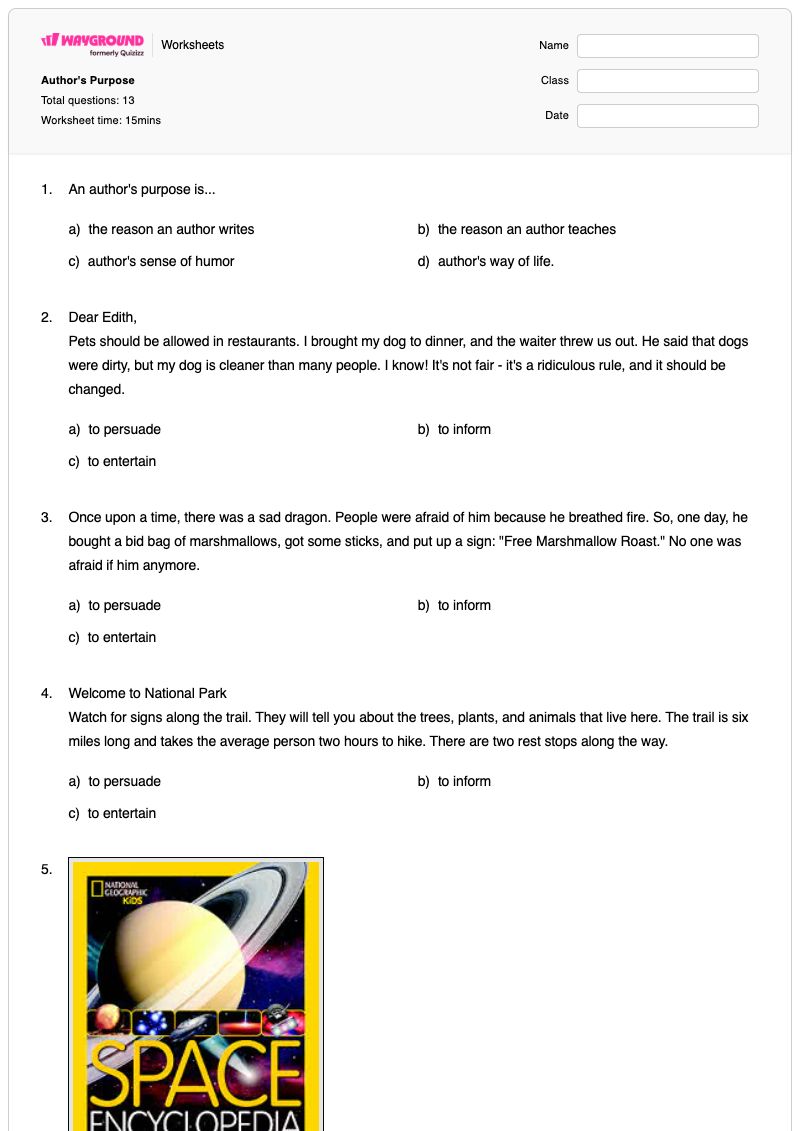
In a non-fiction book, the author's purpose is to:
a)
Persuade
b)
Inform
c)
Entertain
6.

Advertisements are created to:
a)
Persuade
b)
Inform
c)
Entertain
7.

The author wants to amuse you or for you to enjoy the writing.
a)
Persuade
b)
Inform
c)
Entertain
8.
Do you want to be an artist? Just enroll in "The Awesome Artists" program. Don't let this opportunity or your talent slip away. We guarantee you will be painting like the masters in two weeks for a low cost of $59.95.
What is the author's purpose?
What is the author's purpose?
a)
to entertain you with a story about artists
b)
to teach you how all artists become famous
c)
to persuade you to attend an art program
d)
to explain how to paint a sunset
9.
Ted was anxious to try out for the basketball team. He had practiced and knew he was ready. Tryouts made him a little nervous, but when he found out he made the team he knew that all the work had paid off.
What is the author's purpose?
What is the author's purpose?
a)
to entertain you witha story about a boy who worked hard
b)
to teach how to play basketball
c)
to persuade you to try out for the basketball team
d)
to explain the rules of basketball
10.
In a recent survey of parents of children in grades 1-8, more than half of the parents agreed that students are overburdened with homework. These parents favored mandating less homework in local schools.
a)
persuade
b)
describe
c)
explain
d)
inform
11.
My Dog Miles One day, my dog, Miles, decided he had enough of living with our cat, Theo. He packed his doggie biscuits, his favorite toys, and hit the road. Life on the road was not as easy as he had expected. No one fed him, and many people ignored him completely. He was not used to this kind of treatment. After a few hours of hunger and loneliness, Miles decided to come back home. As soon as he walked in the door, we all pounced on him, giving him hugs and his favorite foods. Miles smiled and howled, “There really is no place like home.”
What is the author’s purpose?
What is the author’s purpose?
a)
entertain
b)
persuasive
c)
inform
12.
For the three days in April, people from around the world come to villages in China to celebrate the New Year at the Water Splashing Festival. Women wear yellow and pink
dresses and participate in traditional dancing. Children carve water toys out of bamboo and play with hoses in the streets. Other people race dragon boats across the river and float
paper boats throughout the village. The festival is a tradition of the Dai community, who live in Southern China.
What's the Author’s Purpose?
a)
Persuade
b)
Inform
c)
Entertain
13.
The Slim-O-Matic will cause you to loose pounds and inches from your body in one month. This amazing machine helps you to exercise correctly and provides an easy video to show you the proper way to exercise. Send $75.99 and begin exercising today.
a)
to Inform
b)
to Entertain
c)
to Persuade
Answer KeyAuthor's Purpose
Total questions: 13
1.
a) the reason an author writes
2.
a) to persuade
3.
c) to entertain
4.
b) to inform
5.
b) Inform
6.
a) Persuade
7.
c) Entertain
8.
c) to persuade you to attend an art program
9.
a) to entertain you witha story about a boy who worked hard
10.
d) inform
11.
a) entertain
12.
b)
Inform
13.
c) to Persuade
140 %