

Wayground
Area of Polygons - Printable Mathematics Worksheets class 6 - Wayground

Area of Polygons

9 questions

6th - 6th Grade

Mathematics

Area of Polygons is a Grade 6 mathematics worksheet that builds students’ ability to select and apply area formulas for triangles, rectangles, parallelograms, trapezoids, and composite polygons. Students match formulas to shapes, calculate areas and missing dimensions, classify shape definitions, and draw decomposition lines to break octagons and hexagons into familiar figures. The worksheet also reinforces multiple approaches to finding the area of a trapezoid, including decomposition, composition, and formula use. Its mixed-format practice includes drag-and-drop, drawing, matching, classification, fill-in-the-blank, multiple-choice, dropdown, multiple-select, and open-ended questions. In the final application task, students use the A.I.D.E. strategy to identify relevant information, find the area of a pool formed from a rectangle and trapezoid, calculate cement cost, compare it with a budget, and explain their reasoning. This free printable worksheet includes a complete answer key for Grade 6 math instruction, guided practice, or assessment.

Worksheet settings

Font size

S
M
L
XL
Worksheets

Area of Polygons

Total questions: 9

Name
Class
Date
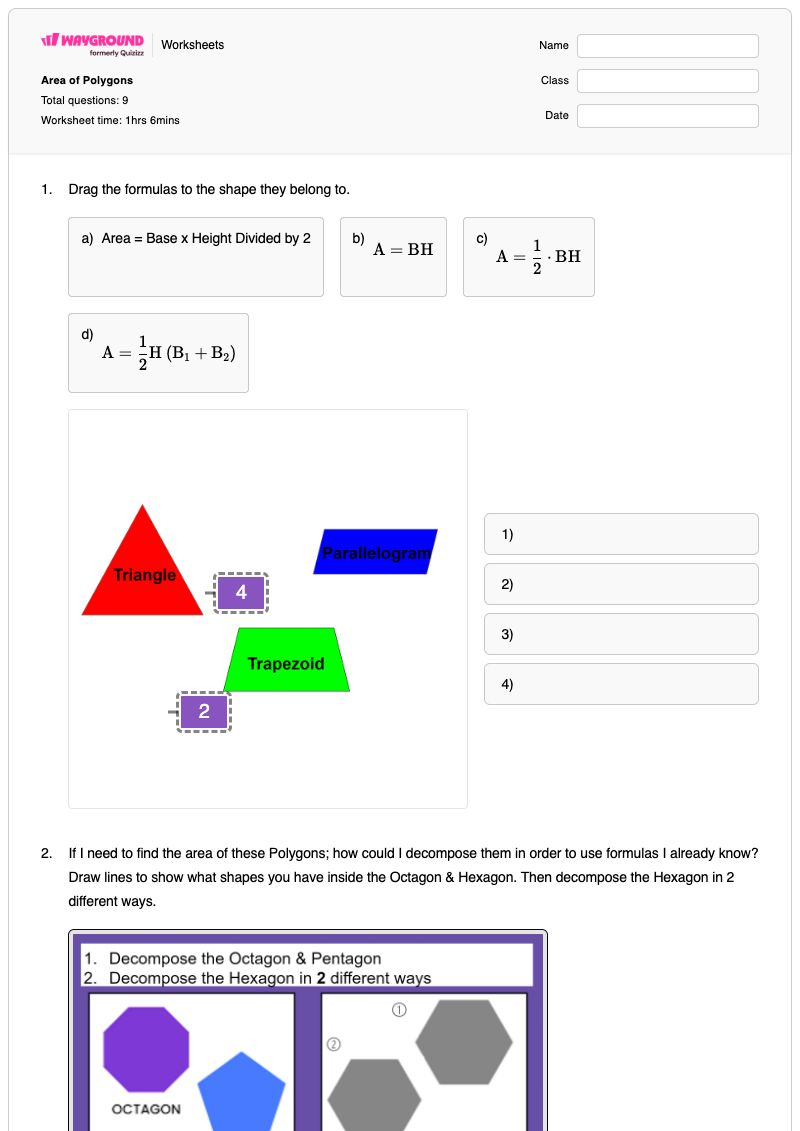
1.

Drag the formulas to the shape they belong to.

2.

If I need to find the area of these Polygons; how could I decompose them in order to use formulas I already know? Draw lines to show what shapes you have inside the Octagon & Hexagon. Then decompose the Hexagon in 2 different ways.

3.

This right triangle's area is (a)   in2

4.

Match the following shape to its correct area.

81 ft.2

18 in.2

15 ft.2

32 in.2

168 ft.2

5.

Organize the shapes/definitions into the correct categories.

Categorize the following

Isosceles Triangle

A 2D closed figure that consists of straight lines - that are NOT congruent on all sides.

A type of shape with four sides of EQUAL length and four angles of EQUAL measure.

A Parallelogram is NEVER this

A hexagon can sometimes be this...

A shape that has 4 sides of EQUAL length is always this...

Shapes with 3 Vertices
Irregular Polygons
Quadrilaterals
6.

Find h

a)

h = 6

b)

h = 491 in2

c)

h = 6 in2

d)

h = 8 in2

7.

We learned 3 different ways to find the area of a ​ (a)   .

When we ​find the area by (b)   ​ we break the trapezoid into 1 ​rectangle and ​ (c)   ​ triangles .

When we compose in order to find the area, we copy, flip, and put it side by side to make a ​ (d)   .

The last way we learned to find its area was using the formula: ​ ​ ​ ​ ​ (e)  

Choose from the below words
trapezoid
parallelogram
circle
decomposing
1 or 2
hexagon
multiply
A=BH
2

α=12h(b1+b2)\alpha=\frac{1}{2}h\left(b_1+b_2\right)  

8.

Find the missing dimension by dragging and dropping the correct answers.

(a)  

13 = 12B⋅4\frac{1}{2}B\cdot4

Turn the (b)   into 1 by multiplying it by 2, then multiply the (c)   by 2 as well.

(Anything multiplied by 1 = itself, so no need to write 1×B1\times B )

26=B4

Next, ​ (d)   the 4 by 4, then divide the area by 4 to find the answer B= (e)  

Choose from the below words

A=12BHA=\frac{1}{2}BH  

A=LW
4

12\frac{1}{2}  

area
height
divide
3.25 cm2
6R5
6.5 cm2
9-15.

9.

Read the passage and use the A.I.D.E strategy to help you solve the problem.

After reading it one time, determine what is the passage ASKING?

4 lines
10.

Read it again and look for what is IMPORTANT? Check all that apply.

a)

The dimensions of the pool (found in the picture)

b)

Artis is a community pool director

c)

The director budgeted $20,000 to spend on the cement

d)

The cement is made from a pebble based material.

e)

The cement cost $8.45 per square

11.

Read it a third time then figure out what you have to DO.

Fill in the blanks to complete the steps you will take to solve the problem

First I need to figure out the (a)   of the pool.

12.

In order to find the pool's area I have to figure out the area of the (a)   and trapezoid then add them together.

13.

After that I have to (a)   the total area of the pool by $8.45

14.

Finally once I know how much it will cost in total, I have to determine if Artis budgeted enough money, by seeing if the amount needed is greater than or less than $ (a)  

15.

Now that you completed the steps, EXPLAIN how you got your answer.

4 lines
Answer Key

Area of Polygons

Total questions: 9

1.
2.
n/a
3.
40
4.

 - 

81 ft.2

, 

 - 

18 in.2

, 

 - 

15 ft.2

, 

 - 

32 in.2

, 

 - 

168 ft.2

5.
Shapes with 3 Vertices

Isosceles Triangle

A Parallelogram is NEVER this

Irregular Polygons

A 2D closed figure that consists of straight lines - that are NOT congruent on all sides.

A hexagon can sometimes be this...

Quadrilaterals

A type of shape with four sides of EQUAL length and four angles of EQUAL measure.

A shape that has 4 sides of EQUAL length is always this...

6.
c)

h = 6 in2

7.
trapezoid, decomposing, 1 or 2, parallelogram,

α=12h(b1+b2)\alpha=\frac{1}{2}h\left(b_1+b_2\right)  

8.

A=12BHA=\frac{1}{2}BH  

,

12\frac{1}{2}  

, area, divide, 6.5 cm2
9-15.
9.
n/a
10.
a)

The dimensions of the pool (found in the picture)

, c)

The director budgeted $20,000 to spend on the cement

, e)

The cement cost $8.45 per square

11.
area
12.
rectangle
13.
multiply
14.
20,000
15.
n/a

FAQs

What does the Area of Polygons worksheet cover?

This Grade 6 worksheet focuses on finding polygon area by matching formulas to shapes, calculating missing dimensions, and decomposing composite figures such as octagons and hexagons into familiar shapes. Its mixed question formats require students to identify area relationships, use trapezoid strategies, and explain a multi-step pool-cost solution using the A.I.D.E. strategy.

How can I use this worksheet to teach area of polygons?

Begin by reviewing the area formulas represented in the formula-matching and missing-dimension items, then model how to draw decomposition lines through the octagon and hexagon. Have students compare the two possible decompositions of the hexagon and discuss why both can produce the same total area. Finish with the pool scenario so students apply area calculations, unit cost, and budget comparison in a meaningful sequence.

What mistakes should I watch for when students complete this worksheet?

Watch for students matching a formula to the wrong shape, treating a missing dimension as an area, or forgetting to include square units. In the decomposition task, students may omit one component or count an internal region twice. In the pool problem, they may select background details instead of the dimensions, budget, and cost, or compare the cost with the budget before calculating the pool’s total area.

How do I assign and grade the Area of Polygons worksheet?

The worksheet is available as a printable PDF and as a digital quiz on Wayground, and it includes a complete answer key for checking formula, calculation, and written-response items. Printable submissions can be graded by scanning student work with the Wayground for Teachers app. The PDF option can also support schools that are reducing screen time.

How can I differentiate this Area of Polygons worksheet for my students?

In the worksheet’s Advanced Settings, adjust font spacing and font size to make the formula prompts, decomposition directions, and pool passage easier to read. You can also enable a dyslexia-friendly font or translate the worksheet into another language, while keeping the diagrams and mixed-format area questions intact.

Where can I find more worksheets like this on Wayground?

Wayground offers a comprehensive collection of free printable worksheets and practice problems across subjects, with downloadable PDFs and answer keys to help students master essential skills and concepts. Browse more resources at https://wayground.com/en-us/worksheets.