

Wayground
Law of Detachment and Law of Syllogism Quick check - Printable Math Worksheets class 9 - Wayground

Law of Detachment and Law of Syllogism Quick check

Zohra Samji

Created by Zohra Samji

11 questions

9th - 10th Grade

Math

Updated Oct 2026

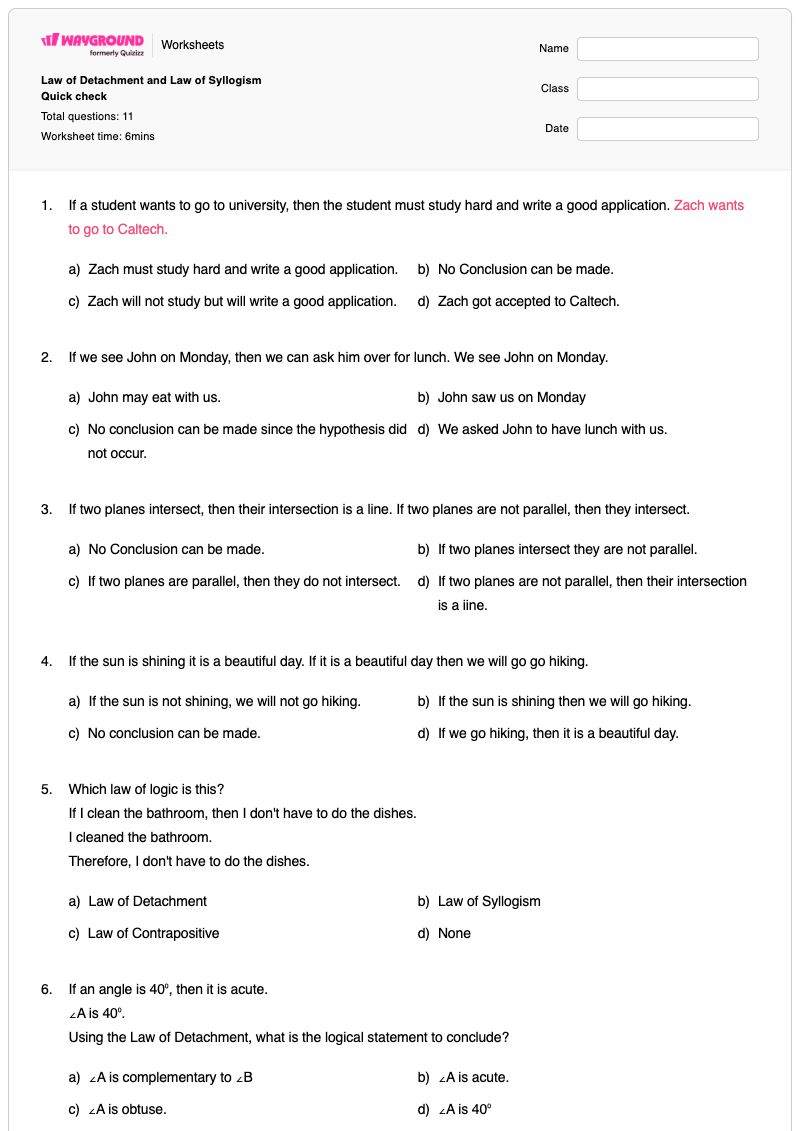
Law of Detachment and Law of Syllogism Quick check is a Grade 9–10 mathematics worksheet with 11 multiple-choice questions. Students use conditional statements to draw valid conclusions, identify whether a conclusion follows, and name the law of logic being applied. The items include everyday scenarios, plane intersections, angle classification, study habits, and chained statements about school cancellation and testing. This worksheet helps students distinguish the Law of Detachment—using a stated hypothesis to confirm a conclusion—from the Law of Syllogism, which links two conditional statements. Several questions also require students to recognize when a conclusion is not possible, such as reversing a conditional statement or treating its conclusion as proof of the hypothesis. Use the worksheet for independent practice, a quick check, or review before formal work with conditional logic. It is a free printable worksheet with a complete answer key for efficient checking.

Worksheet settings

Font size

S
M
L
XL
WaygroundWorksheets

Law of Detachment and Law of Syllogism Quick check

Total questions: 11

Name
Class
Date
1.

If a student wants to go to university, then the student must study hard and write a good application. Zach wants to go to Caltech.

a)

Zach must study hard and write a good application.

b)

No Conclusion can be made.

c)

Zach will not study but will write a good application.

d)

Zach got accepted to Caltech.

2.

If we see John on Monday, then we can ask him over for lunch. We see John on Monday.

a)

John may eat with us.

b)

John saw us on Monday

c)

No conclusion can be made since the hypothesis did not occur.

d)

We asked John to have lunch with us.

3.

If two planes intersect, then their intersection is a line. If two planes are not parallel, then they intersect.

a)

No Conclusion can be made.

b)

If two planes intersect they are not parallel.

c)

If two planes are parallel, then they do not intersect.

d)

If two planes are not parallel, then their intersection is a iine.

4.

If the sun is shining it is a beautiful day. If it is a beautiful day then we will go go hiking.

a)

If the sun is not shining, we will not go hiking.

b)

If the sun is shining then we will go hiking.

c)

No conclusion can be made.

d)

If we go hiking, then it is a beautiful day.

5.

Which law of logic is this?

If I clean the bathroom, then I don't have to do the dishes.

I cleaned the bathroom.

Therefore, I don't have to do the dishes.

a)

Law of Detachment

b)

Law of Syllogism

c)

Law of Contrapositive

d)

None

6.
If an angle is 40⁰, then it is acute.
∠A is 40⁰.
Using the Law of Detachment, what is the logical statement to conclude?
a)
∠A is complementary to ∠B
b)
∠A is acute.
c)
∠A is obtuse.
d)
∠A is 40⁰
7.

Use the Law of Detachment to draw a conclusion from the two given statements. If not possible, write not possible.

Statement 1: If I study for one hour each day, then I will score well on the exam

Statement 2: I will study from 6pm to 7pm tonite.

a)

I study for several hours each day.

b)

I will do well on the exam

c)

If I do well on the exam, I studied for hours.

d)

not possible

8.
If the binding of the book is broken, then the student will have to pay for a new one. Michael has to pay for a new book, so he concludes the binding on his book is broken. Is he correct?
a)
Yes
b)
No
9.
Draw a conclusion from the statement.
If Jack goes to school, then it is Monday.
Jack doesn't go to school.
a)
Jack skipped school.
b)
It isn't Monday.
c)
It's Saturday.
d)
Invalid
10.
Using the Law of Syllogism, which of the following completes the statement to form a valid conclusion?
If it is snowing heavily, then school will be canceled.
If school is canceled, the big test will not be given today.
It is snowing heavily, therefore
a)
look out for the snowplows while driving to school.
b)
the big test will not be given today.
c)
the roads will be hard to drive on.
d)
you should call the school to see if school is canceled.
11.
Use the Law of Detachment to draw a conclusion from the two given statements. If not possible, write not possible.
Statement 1: If I study for one hour each day, then I will score well on the exam
Statement 2: I will score well on the exam
a)
 I study for 1 hour each day.
b)
I do not study for 1 hour each day
c)
If I do well on the exam, I studied for 1 hour each day.
d)
not possible
WaygroundAnswer Key

Law of Detachment and Law of Syllogism Quick check

Total questions: 11

1.
a)

Zach must study hard and write a good application.

2.
d)

We asked John to have lunch with us.

3.
d)

If two planes are not parallel, then their intersection is a iine.

4.
b)

If the sun is shining then we will go hiking.

5.
a)

Law of Detachment

6.
b) ∠A is acute.
7.
b)

I will do well on the exam

8.
b) No
9.
d) Invalid
10.
b) the big test will not be given today.
11.
d) not possible

FAQs

What does the Law of Detachment and Law of Syllogism Quick check cover?

This Grade 9–10 mathematics worksheet uses 11 multiple-choice questions to assess applying the Law of Detachment and Law of Syllogism to conditional statements. Students draw conclusions from a stated hypothesis, connect two conditional statements, identify the law used, and recognize when a conclusion is invalid or not possible.

How can I use this worksheet to teach the Law of Detachment and Law of Syllogism?

First model the structure of a conditional statement, labeling its hypothesis and conclusion. Then work through one Law of Detachment item by confirming the hypothesis, followed by a Law of Syllogism example in which two conditionals are chained, such as heavy snow leading to school cancellation and then to a postponed test. Have students explain why each selected conclusion follows before completing the remaining multiple-choice questions independently.

What mistakes should I watch for on this logic worksheet?

Watch for students reversing a conditional, such as concluding that a book’s binding was broken merely because a replacement must be paid for. Students may also claim that Monday is ruled out when Jack does not go to school, or infer that studying occurred because a student scored well; the worksheet treats these as invalid reversals rather than valid conclusions. They should also avoid choosing a conclusion when the stated hypothesis does not match the conditional.

How do I assign and grade this Law of Detachment and Law of Syllogism worksheet?

Wayground provides this 11-question worksheet as both a printable PDF and a digital quiz, and it includes a complete answer key. Assign the PDF for paper practice or use the digital quiz for online responses; printable submissions can be graded by scanning student work with the Wayground for Teachers app.

How does this worksheet help students distinguish valid conclusions from invalid reversals?

The multiple-choice items deliberately contrast forward reasoning with unsupported reversals. Students apply a given hypothesis to reach a conclusion in Law of Detachment questions, connect conditionals in Law of Syllogism questions, and select “not possible” or “Invalid” when the information only states a conclusion or denies the hypothesis.

Where can I find more free worksheets like this from Wayground?

Wayground offers a broad collection of free printable worksheets and practice problems across subjects, with downloadable PDFs and answer keys to support essential skills and concepts. Browse more resources at https://wayground.com/en-us/worksheets.