
Wayground
Layers of Earth - Printable Science Worksheets 7th Grade - Wayground

Layers of Earth

C Cardwell

Created by C Cardwell

20 questions

7th Grade

Science

Updated Sept 2026

Layers of Earth is a Grade 7 science worksheet that uses 20 multiple-choice questions to build students’ understanding of Earth’s physical and compositional layers. Students identify the lithosphere, crust, mantle, asthenosphere, mesosphere, outer core, and inner core; compare layer temperatures, pressure, density, composition, and physical state; and connect the outer core to Earth’s magnetic field. Several items also ask students to interpret labeled or color-coded layer representations. This free printable worksheet helps students distinguish commonly confused Earth science terms, such as crust versus lithosphere and inner core versus outer core. It is suitable for introducing the structure of Earth, reinforcing a completed lesson, or checking whether students can apply layer characteristics to multiple-choice questions. A complete answer key is included for efficient review and grading.

Worksheet settings

Font size

S
M
L
XL
WaygroundWorksheets

Layers of Earth

Total questions: 20

Name
Class
Date
1.

What is the outermost physical layer of earth?

a)

crust

b)

outer core

c)

mantle

d)

lithosphere

2.
Which layer is made of solid iron & nickel?
a)
inner core
b)
outer core
c)
mantle
d)
crust
3.
Which layer has the coolest temperatures?
a)
outer core
b)
inner core
c)
mantle
d)
crust
4.
Which layer has the hottest temperatures?
a)
inner core
b)
outer core
c)
mantle
d)
crust
5.

Which compositional layer is the least dense?

a)

inner core

b)

lithosphere

c)

mantle

d)

crust

6.
Which layer causes the earth's magnetic field?
a)
inner core
b)
outer core
c)
mantle
d)
crust
7.
Out of all the layers, which one would be the easiest for us to drill through?
a)
inner core
b)
outer core
c)
mantle
d)
crust
8.
Which statement is correct?
a)
As you move up through the layers, the pressure increases.
b)
As you move down through the layers pressure increases.
c)
As you move down through the layers, pressure decreases.
d)
As you move up down through the layers, pressure remains the same.
9.
What happens to temperature as you move down through the layers?
a)
it remains the same
b)
it increases then decreases
c)
it increases
d)
it decreases
10.
Which physical layer is represented by the yellow layer?

Which physical layer is represented by the yellow layer?

a)

lithosphere

b)

mesosphere

c)

core

d)

inner core

11.
The core is mostly made up mostly of which elements?
a)
Oxygen and Silicon
b)
Silicon and Magnesium
c)
Nickel and Iron
d)
Iron and Magnesium
12.
This is the plastic layer of the mantle on which pieces of the lithosphere move.
a)
Lithosphere
b)
Asthenosphere
c)
Mesosphere
d)
Crust
13.
A layer made of rock that is softer and can flow
a)
crust
b)
lithosphere
c)
asthenosphere
d)
mesosphere
14.
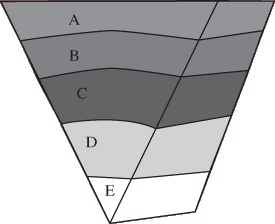
What does layer D show?

What does layer D show?

a)

upper mantle

b)

lower mantle

c)

outer core

d)

inner core

15.
Which of the following is a major difference between Earth's inner core and outer core?
a)
The inner core is liquid, and the outer core is solid
b)
The inner core is solid, and the outer core is liquid
c)
The inner core is gas, and the outer core is solid
d)
The inner core is solid, and the outer core is gas
16.
Earth can be divided into 5 layers: the lithosphere, the asthenosphere, the mesosphere, the outer core, and the inner core. Which properties are used to make these divisions?
a)
Compositional properties
b)
Physical properties
c)
Chemical properties
d)
Elemental properties
17.
This is the plastic layer of the mantle on which pieces of the lithosphere move.
a)
Lithosphere
b)
Asthenosphere
c)
Mesosphere
d)
Crust
18.

Which element make up the largest amount of the Earth's crust

a)

nitrogen

b)

carbon

c)

silicon

d)

plutonium

19.

List the layers from innermost to outermost.

a)

crust, inner core, lower mantle, upper mantle

b)

crust, mantle, outer core, inner core

c)

inner core, outer core lower mantle, upper mantle

d)

inner core, upper mantle, lower mantle, crust

20.

What are Earth's Chemical Compositional Layers?

a)

Lithosphere, Astenosphere, Mantle, Crust

b)

Lithosphere, Asthenosphere, Mesosphere, Inner Core, Outer Core

c)

Crust, Mantle, Core

d)

Crust, Lithosphere, Astenosphere, Mantle

WaygroundAnswer Key

Layers of Earth

Total questions: 20

1.
d)

lithosphere

2.
a) inner core
3.
d) crust
4.
a) inner core
5.
d)

crust

6.
b) outer core
7.
d) crust
8.
b) As you move down through the layers pressure increases.
9.
c) it increases
10.
d)

inner core

11.
c) Nickel and Iron
12.
b) Asthenosphere
13.
c) asthenosphere
14.
c)

outer core

15.
b) The inner core is solid, and the outer core is liquid
16.
b) Physical properties
17.
b) Asthenosphere
18.
c)

silicon

19.
c)

inner core, outer core lower mantle, upper mantle

20.
c)

Crust, Mantle, Core

FAQs

What does the Layers of Earth worksheet cover?

This Grade 7 science worksheet uses 20 multiple-choice questions to assess how students identify Earth’s physical and compositional layers. Students compare the lithosphere, crust, mantle, asthenosphere, mesosphere, outer core, and inner core by temperature, pressure, density, composition, physical state, and role in producing Earth’s magnetic field.

How can I use this worksheet to teach Earth’s layers?

Introduce a labeled Earth cross-section and have students distinguish physical layers, such as the lithosphere and asthenosphere, from compositional layers, such as the crust, mantle, and core. Then use the multiple-choice items to prompt explanations: ask students why pressure and temperature increase with depth, why the inner core is solid while the outer core is liquid, and how the asthenosphere allows lithospheric pieces to move.

What mistakes should I watch for when students complete this worksheet?

Students may confuse the crust with the lithosphere, even though this worksheet treats them as different layer classifications. They may also reverse the inner core and outer core’s physical states, identify the asthenosphere as a rigid layer instead of a softer, flowing mantle layer, or select the crust when an item asks for the least dense compositional layer. Review the temperature and pressure trend questions carefully, since both increase as students move deeper into Earth.

How do I assign and grade this Layers of Earth worksheet?

You can assign the worksheet as a printable PDF or use it as a digital quiz on Wayground. It includes a complete answer key, and printable student work can be graded by scanning it with the Wayground for Teachers app. The PDF option also supports classrooms that are reducing screen time while practicing Earth’s layer properties.

How can I differentiate this Earth layers worksheet for my students?

Use the worksheet’s Advanced Settings to adjust font spacing or increase the font size, making the layer-identification and property-comparison questions easier to read. You can also enable a dyslexia-friendly font or translate the worksheet into another language when that better supports students working with Earth science vocabulary.

Where can I find more worksheets like this on Wayground?

Wayground offers a comprehensive collection of free printable worksheets and practice problems across subjects, with downloadable PDFs and answer keys to help students master essential skills and concepts. Browse more resources at https://wayground.com/en-us/worksheets.