

Wayground
I Wanna New Room - Argumentative Text - Printable English Worksheets class 3 - Wayground

I Wanna New Room - Argumentative Text

14 questions

3rd - 3rd Grade

English

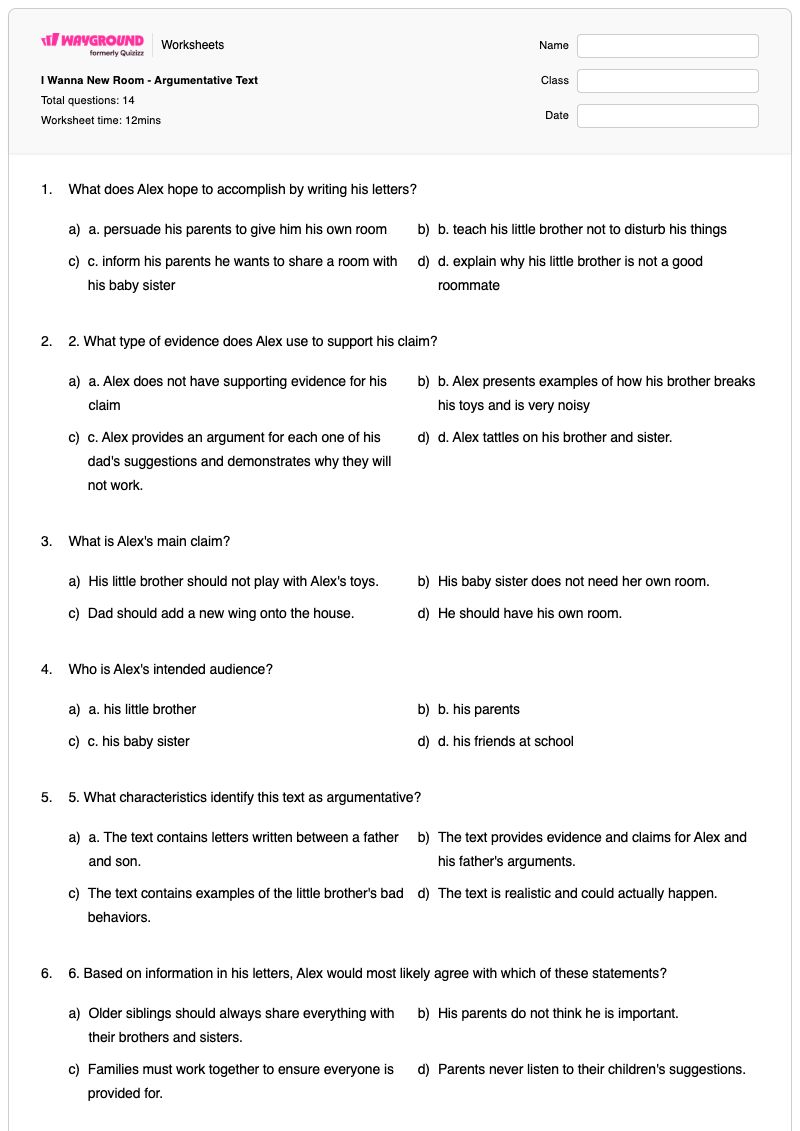
I Wanna New Room - Argumentative Text is a Grade 3 English worksheet that helps students analyze how an argument is built through a character’s letters. The 14 questions include 12 multiple-choice items and 2 open-ended R.A.C.E. prompts focused on identifying the main claim, intended audience, supporting evidence, and characteristics of argumentative text. Students also distinguish fact from opinion, explain how evidence supports an argument, and examine how the father responds to the character’s reasoning. The written-response items ask students to use details from the text to explain the sibling relationship and evaluate whether the character’s argument is valid. This free printable worksheet includes a complete answer key for checking comprehension and written responses.

Worksheet settings

Font size

S
M
L
XL
Worksheets

I Wanna New Room - Argumentative Text

Total questions: 14

Name
Class
Date
1.

What does Alex hope to accomplish by writing his letters?

a)

a. persuade his parents to give him his own room

b)

b. teach his little brother not to disturb his things

c)

c. inform his parents he wants to share a room with his baby sister

d)

d. explain why his little brother is not a good roommate

2.

2. What type of evidence does Alex use to support his claim?

a)

a. Alex does not have supporting evidence for his claim

b)

b. Alex presents examples of how his brother breaks his toys and is very noisy

c)

c. Alex provides an argument for each one of his dad's suggestions and demonstrates why they will not work.

d)

d. Alex tattles on his brother and sister.

3.

What is Alex's main claim?

a)

His little brother should not play with Alex's toys.

b)

His baby sister does not need her own room.

c)

Dad should add a new wing onto the house.

d)

He should have his own room.

4.

Who is Alex's intended audience?

a)

a. his little brother

b)

b. his parents

c)

c. his baby sister

d)

d. his friends at school

5.

5. What characteristics identify this text as argumentative?

a)

a. The text contains letters written between a father and son.

b)

The text provides evidence and claims for Alex and his father's arguments.

c)

The text contains examples of the little brother's bad behaviors.

d)

The text is realistic and could actually happen.

6.

6. Based on information in his letters, Alex would most likely agree with which of these statements?

a)

Older siblings should always share everything with their brothers and sisters.

b)

His parents do not think he is important.

c)

Families must work together to ensure everyone is provided for.

d)

Parents never listen to their children's suggestions.

7.

7. Based on the text, which of the following is a fact rather than an opinion?

a)

a. Alex's little brother is out of control.

b)

b. The iguana's cage has an unusual smell.

c)

c. Stinky the dog is treated like a king.

d)

d. Alex's little brother broke his toys.

8.

8. What piece of evidence most strongly supports Dad's claim that Alex is important to the family too?

a)

a. He demands Alex to let his brother out of the bedroom.

b)

b. He helps Alex build a treehouse so he can have his own space.

c)

c. He reminds Alex that he used to be careless when he was little.

d)

d. He explains why his baby sister needs her own room.

9.

9. What evidence from the text shows Dad is paying attention to Alex's arguments for his own room?

a)

a. He has evidence for the reasons Alex cannot have his own room.

b)

b. He signs each letter with the words "Love, Dad".

c)

c. He tells Alex he will have to talk to his mother about a new room.

d)

d. He responds to each of Alex's letters with suggestions and advice.

10.

10. Dad uses his letters to demonstrate that -

a)

a. He understands Alex's situation and wants to help.

b)

b. Alex is being selfish and should stop asking for a room.

c)

c. Alex will have to learn to tolerate his brother and sister's behavior.

d)

d. He does not want to discuss a new room for Alex.

11.

11. Alex's main argument is -

a)

a. he should be treated like a king

b)

b. he needs his own space away from his siblings.

c)

c. his little brother is loud and destructive.

d)

d. his parents do not care how he feels

12.

12. How does the evidence Alex shares support his argument?

a)

a. The evidence demonstrates Alex is happy sharing his room with his brother.

b)

b. The evidence shares that Alex's dad is not willing to listen to his arguments.

c)

c. The evidence shows Alex is unhappy with the way his little brother treats his things and that he has earned the privilege of having his own room.

d)

d. Alex does not provide good evidence for his claims.

13.

13. What can the reader tell about the relationship between Ethan and his little brother? Support your answer with evidence from the text. (R.A.C.E.)

4 lines
14.

14. Which details from the story support the idea Ethan has a valid argument? (R.A.C.E.)

4 lines
Answer Key

I Wanna New Room - Argumentative Text

Total questions: 14

1.
a)

a. persuade his parents to give him his own room

2.
c)

c. Alex provides an argument for each one of his dad's suggestions and demonstrates why they will not work.

3.
d)

He should have his own room.

4.
b)

b. his parents

5.
b)

The text provides evidence and claims for Alex and his father's arguments.

6.
c)

Families must work together to ensure everyone is provided for.

7.
d)

d. Alex's little brother broke his toys.

8.
b)

b. He helps Alex build a treehouse so he can have his own space.

9.
d)

d. He responds to each of Alex's letters with suggestions and advice.

10.
a)

a. He understands Alex's situation and wants to help.

11.
b)

b. he needs his own space away from his siblings.

12.
c)

c. The evidence shows Alex is unhappy with the way his little brother treats his things and that he has earned the privilege of having his own room.

13.
n/a
14.
n/a

FAQs

What does the I Wanna New Room - Argumentative Text worksheet cover?

This Grade 3 worksheet asks students to analyze an argumentative text presented through letters about a character’s request for his own room. Its 12 multiple-choice questions and 2 R.A.C.E. open-ended prompts practice identifying the claim, intended audience, supporting evidence, fact versus opinion, and whether the argument is valid.

How can I use this worksheet to teach claims and evidence in argumentative writing?

Introduce the character’s request by having students state his claim in their own words, then ask them to identify the details he uses to support it. As students complete the multiple-choice items, discuss how the father responds to each argument and how his actions provide evidence of his position. Finish with the R.A.C.E. prompts so students cite text details when explaining the sibling relationship and evaluating the argument.

What mistakes should I watch for when students complete this argumentative text worksheet?

Students may select a supporting detail, such as the sibling’s noisy or destructive behavior, as the main claim instead of recognizing that the claim is that the character should have his own room. They may also confuse an opinion with a fact or overlook that the father’s responses address the character’s arguments. In the R.A.C.E. responses, check that students explain their idea and support it with specific evidence from the text rather than offering an unsupported judgment.

How do I assign and grade this worksheet?

This worksheet is available as a printable PDF and as a digital quiz on Wayground, and it includes a complete answer key for the 12 multiple-choice questions and guidance for reviewing the R.A.C.E. responses. For printable submissions, you can scan student work with the Wayground for Teachers app to help grade the worksheet efficiently. The printable format can also support classrooms working to reduce screen time.

How can I differentiate this worksheet for my students?

Use the worksheet’s Advanced Settings to adjust font spacing and font size so the letter-based questions and R.A.C.E. prompts are easier to navigate. You can also apply a dyslexia-friendly font or translate the worksheet into another language, depending on student needs. These options modify the worksheet file while preserving its argumentative-text questions and response format.

Where can I find more worksheets like this on Wayground?

Wayground offers a comprehensive collection of free printable worksheets and practice problems across subjects, with downloadable PDFs and answer keys to help students master essential skills and concepts. Browse more resources at https://wayground.com/en-us/worksheets.