

Wayground
3 as a factor - Printable Mathematics Worksheets 3rd Grade - Wayground

3 as a factor

Myra Cortez

Created by Myra Cortez

10 questions

3rd Grade

Mathematics

Updated May 2025

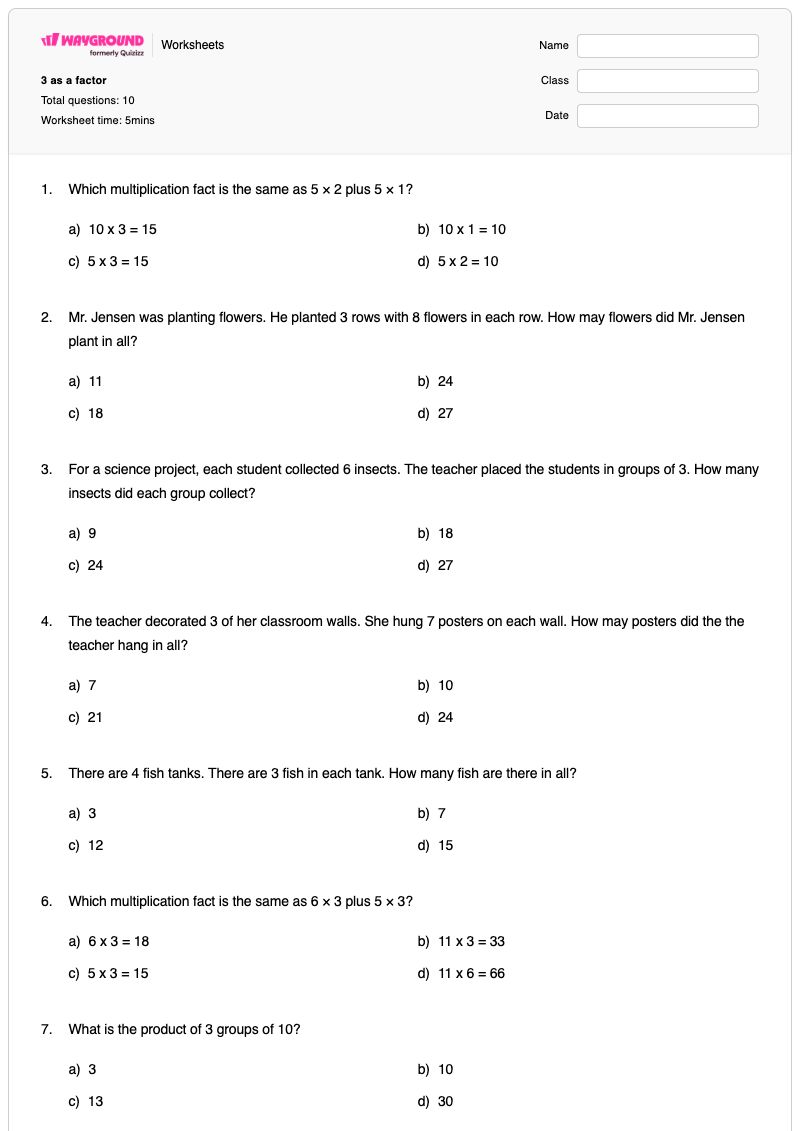
This Grade 3 mathematics worksheet helps students use 3 as a factor in multiplication. It includes 10 multiple-choice questions that ask learners to identify equivalent multiplication expressions, find products such as 3 × 3 and 3 × 10, and solve equal-groups word problems involving flowers, insects, posters, fish, crayons, and teams. Several items connect repeated groups to multiplication, while others require students to combine partial products, such as 5 × 2 plus 5 × 1 or 6 × 3 plus 5 × 3. Use this free printable worksheet for independent practice, classwork, homework, or a quick check of Grade 3 multiplication understanding. The multiple-choice format lets students demonstrate whether they can recognize the factor 3, interpret group-based situations, and distinguish a product from an individual factor. A complete answer key is included so teachers can review student thinking and address errors efficiently.

Worksheet settings

Font size

S
M
L
XL
WaygroundWorksheets

3 as a factor

Total questions: 10

Name
Class
Date
1.

Which multiplication fact is the same as 5 × 2 plus 5 × 1?

a)

10 x 3 = 15

b)

10 x 1 = 10

c)

5 x 3 = 15

d)

5 x 2 = 10

2.

Mr. Jensen was planting flowers. He planted 3 rows with 8 flowers in each row. How may flowers did Mr. Jensen plant in all?

a)

11

b)

24

c)

18

d)

27

3.

For a science project, each student collected 6 insects. The teacher placed the students in groups of 3. How many insects did each group collect?

a)

9

b)

18

c)

24

d)

27

4.

The teacher decorated 3 of her classroom walls. She hung 7 posters on each wall. How may posters did the the teacher hang in all?

a)

7

b)

10

c)

21

d)

24

5.

There are 4 fish tanks. There are 3 fish in each tank. How many fish are there in all?

a)

3

b)

7

c)

12

d)

15

6.

Which multiplication fact is the same as 6 × 3 plus 5 × 3?

a)

6 x 3 = 18

b)

11 x 3 = 33

c)

5 x 3 = 15

d)

11 x 6 = 66

7.

What is the product of 3 groups of 10?

a)

3

b)

10

c)

13

d)

30

8.

The art teacher had 3 boxes of crayons. Each box had 12 crayons. How many crayons did the art teacher have?

a)

12

b)

15

c)

24

d)

36

9.

What is the product of 3 x 3?

a)

0

b)

6

c)

9

d)

12

10.

There are 3 teams playing in a basketball tournament. Each team has 9 players. How many players are at the tournament?

a)

9

b)

18

c)

27

d)

36

WaygroundAnswer Key

3 as a factor

Total questions: 10

1.
c)

5 x 3 = 15

2.
b)

24

3.
b)

18

4.
c)

21

5.
c)

12

6.
b)

11 x 3 = 33

7.
d)

30

8.
d)

36

9.
c)

9

10.
c)

27

FAQs

What does this worksheet cover?

This worksheet covers using 3 as a factor in multiplication through 10 multiple-choice questions. Students identify equivalent expressions, calculate products such as 3 × 3 and 3 × 10, and apply multiplication to equal-groups situations such as rows of flowers, fish tanks, boxes of crayons, and teams of players.

How can I use this worksheet to teach using 3 as a factor?

Introduce the worksheet by modeling an equal-groups situation, such as 3 rows with 8 flowers, and represent it as 3 × 8. Then have students explain why expressions such as 5 × 2 plus 5 × 1 are equivalent to 5 × 3 before completing the multiple-choice items. Ask students to justify the factor and product they selected rather than choosing an answer from computation alone.

What mistakes should I watch for when students complete this worksheet?

Students may confuse the number of groups with the number in each group, especially in the flower, fish-tank, crayon-box, and basketball-team problems. They may also choose a partial product instead of the total product in the equivalent-expression questions, or add the factors rather than multiply them. Check that students can identify 3 as a factor and interpret the answer choice as the total number of objects or people.

How do I assign and grade this worksheet?

This worksheet is available as a printable PDF and as a digital quiz on Wayground, and it includes a complete answer key for all 10 multiple-choice questions. You can grade printable submissions by scanning student work with the Wayground for Teachers app, or review responses from the digital quiz.

How can I differentiate this worksheet for my students?

Use the worksheet’s Advanced Settings to adjust font spacing or increase the font size when students need more room to read the multiplication expressions and word problems. You can also enable a dyslexia-friendly font or translate the worksheet into another language to make the equal-groups questions more accessible.

Where can I find more worksheets like this on Wayground?

Wayground offers a comprehensive collection of free printable worksheets and practice problems across all subjects, with downloadable PDFs and answer keys to support essential skills and concepts. Browse more resources at https://wayground.com/en-us/worksheets.