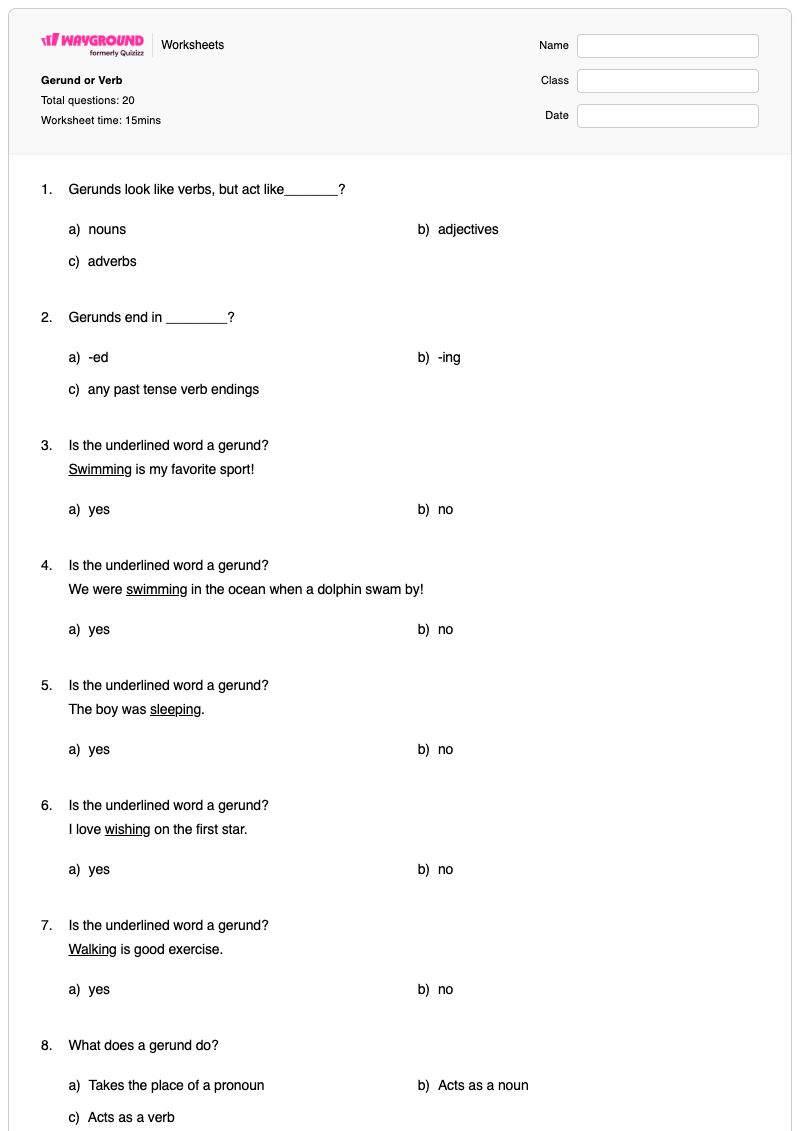
Gerund or Verb is a Grade 6 English grammar worksheet that helps students distinguish gerunds from verbs in context. Across 20 multiple-choice questions, students identify that gerunds end in -ing but function as nouns, decide whether an underlined -ing word is a gerund, and locate gerunds in sentences such as “Climbing is not as easy as it looks” and “Jessica really enjoys bothering the neighbors.”
The worksheet gives students repeated practice separating gerunds from -ing verbs used in progressive verb phrases, including examples such as “were swimming” and “was sleeping.” It is useful for grammar instruction, guided practice, independent review, or a quick assessment of students’ ability to recognize the grammatical role of an -ing word. This free printable worksheet includes a complete answer key for efficient checking and feedback.
Worksheet settings
Font size
S
M
L
XL
Worksheets
Gerund or Verb
Total questions: 20
Name
Class
Date
1.
Gerunds look like verbs, but act like_______?
a)
nouns
b)
adjectives
c)
adverbs
2.
Gerunds end in ________?
a)
-ed
b)
-ing
c)
any past tense verb endings
3.
Is the underlined word a gerund?
Swimming is my favorite sport!
a)
yes
b)
no
4.
Is the underlined word a gerund?
We were swimming in the ocean when a dolphin swam by!
a)
yes
b)
no
5.
Is the underlined word a gerund?
The boy was sleeping.
a)
yes
b)
no
6.
Is the underlined word a gerund?
I love wishing on the first star.
a)
yes
b)
no
7.
Is the underlined word a gerund?
Walking is good exercise.
a)
yes
b)
no
8.
What does a gerund do?
a)
Takes the place of a pronoun
b)
Acts as a noun
c)
Acts as a verb
9.
Find the gerund: Climbing is not as easy as it looks.
a)
is
b)
Climbing
c)
looks
10.
Find the gerund: Mason’s studying habits have improved over time.
a)
Habits
b)
over
c)
Studying
11.
IDENTIFY THE GERUND(S)
Eating ice cream on a hot day can be a good way to cool off.
a)
cool
b)
hot
c)
eating
12.
IDENTIFY THE GERUND(S)
Piling too much laundry into the washer will cause it to malfunction.
a)
washer
b)
piling
c)
cause
13.
IDENTIFY THE GERUND(S)
Ethan narrowly avoided driving off the cliff.
a)
narrowly
b)
driving
c)
Ethan
14.
IDENTIFY THE GERUND(S)
Blowing bubbles on a windy day is a fun activity for children.
a)
bubbles
b)
activity
c)
blowing
d)
children
15.
IDENTIFY THE GERUND(S)
Jessica really enjoys bothering the neighbors with loud music.
a)
Jessica
b)
bothering
c)
loud
16.
IDENTIFY THE GERUND(S)
You can tell a lot about a fellow's character by his way of eating jellybeans.
a)
jellybeans
b)
tell
c)
eating
17.
IDENTIFY THE GERUND(S)
We're going to see the changing of the guard at Buckingham Palace.
a)
going
b)
guard
c)
changing
18.
What is the underlined word?
Swimming is my favorite sport!
a)
verb
b)
gerund
19.
Is the underlined word a verb?
The questioning student raised her hand.
a)
yes
b)
no
20.
Is the underlined word a gerund?
I love wishing on the first star.
a)
yes
b)
no
Answer Key
Gerund or Verb
Total questions: 20
1.
a)
nouns
2.
b)
-ing
3.
a)
yes
4.
b)
no
5.
b)
no
6.
a)
yes
7.
a)
yes
8.
b)
Acts as a noun
9.
b)
Climbing
10.
c)
Studying
11.
c)
eating
12.
b)
piling
13.
b)
driving
14.
c)
blowing
15.
b)
bothering
16.
c)
eating
17.
c)
changing
18.
a)
verb
19.
a)
yes
20.
b)
no
140 %
Browse by subjects
Browse by grades
Browse by format
FAQs
What does the Gerund or Verb worksheet cover?
This Grade 6 English worksheet uses 20 multiple-choice questions to teach students that gerunds end in -ing but act as nouns. Students classify underlined -ing words, find gerunds within sentences, and distinguish noun-function gerunds such as “Swimming” in “Swimming is my favorite sport” from progressive verbs such as “were swimming.”
How can I use this worksheet to teach gerunds and verbs?
Introduce the worksheet by modeling the difference between an -ing word functioning as a noun and one completing a verb phrase, using examples such as “Walking is good exercise” and “The boy was sleeping.” Then have students explain what role each selected word plays before completing the multiple-choice items independently, and use the answer key to discuss why the surrounding sentence—not the -ing ending alone—determines whether the word is a gerund.
What mistakes should I watch for on the Gerund or Verb worksheet?
Students may choose every word ending in -ing as a gerund, overlooking that “were swimming” and “was sleeping” use -ing verbs in progressive verb phrases. They may also identify nearby words instead of the gerund in sentence-level items, so ask them to check whether the -ing word is functioning as a noun, as in “Piling too much laundry” or “Blowing bubbles.”
How do I assign and grade this Gerund or Verb worksheet?
The worksheet is available as a printable PDF and as a digital quiz on Wayground, so you can assign the 20 multiple-choice questions in the format that fits your lesson. It includes a complete answer key, and printable submissions can be graded by scanning student work with the Wayground for Teachers app. The printable option can also support schools that are reducing screen time.
How can I differentiate this gerund identification worksheet for my students?
Use the worksheet’s Advanced Settings to adjust font spacing or choose a larger font size so the sentence-based multiple-choice items are easier to read. You can also apply a dyslexia-friendly font or translate the worksheet into another language when those file-level changes support access to the gerund-versus-verb practice.
Where can I find more worksheets like this on Wayground?
Wayground offers a comprehensive collection of free printable worksheets and practice problems across all subjects, with downloadable PDFs and answer keys to help students master essential skills and concepts. Browse more resources at https://wayground.com/en-us/worksheets.


 Worksheets