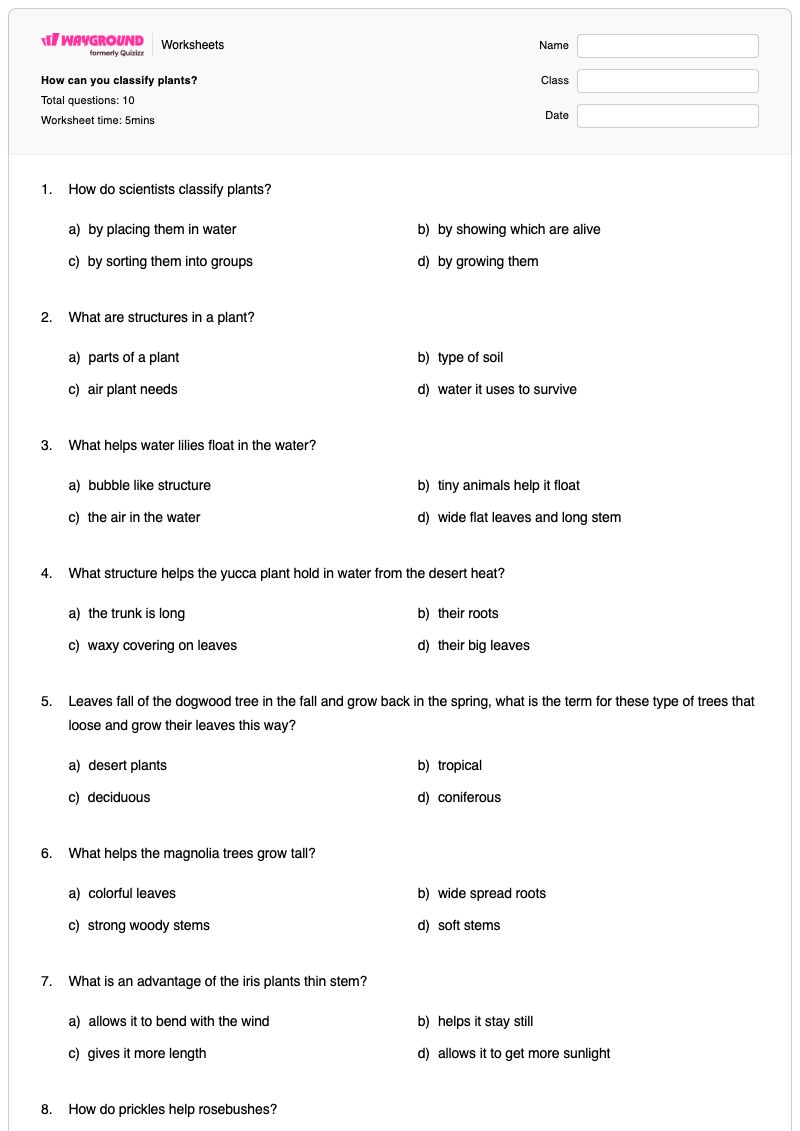
How can you classify plants? is a Grade 3 science worksheet with 10 multiple-choice questions that builds students’ understanding of how scientists group plants and identify the structures that help them survive. Students classify plants as deciduous or coniferous, recognize that ferns and mosses reproduce with spores, and connect structures such as wide leaves, waxy leaf coverings, woody stems, thin stems, roots, and prickles to their functions.
This free printable worksheet helps students apply plant classification vocabulary and explain how physical features support plant survival in different environments. The questions use familiar examples—including water lilies, yucca plants, dogwood trees, magnolias, irises, rosebushes, and longleaf pines—so students practice distinguishing plant groups while interpreting structure-and-function relationships. An answer key is included for efficient review, independent work, or assessment.
Worksheet settings
Font size
S
M
L
XL
Worksheets
How can you classify plants?
Total questions: 10
Name
Class
Date
1.
How do scientists classify plants?
a)
by placing them in water
b)
by showing which are alive
c)
by sorting them into groups
d)
by growing them
2.
What are structures in a plant?
a)
parts of a plant
b)
type of soil
c)
air plant needs
d)
water it uses to survive
3.
What helps water lilies float in the water?
a)
bubble like structure
b)
tiny animals help it float
c)
the air in the water
d)
wide flat leaves and long stem
4.
What structure helps the yucca plant hold in water from the desert heat?
a)
the trunk is long
b)
their roots
c)
waxy covering on leaves
d)
their big leaves
5.
Leaves fall of the dogwood tree in the fall and grow back in the spring, what is the term for these type of trees that loose and grow their leaves this way?
a)
desert plants
b)
tropical
c)
deciduous
d)
coniferous
6.
What helps the magnolia trees grow tall?
a)
colorful leaves
b)
wide spread roots
c)
strong woody stems
d)
soft stems
7.
What is an advantage of the iris plants thin stem?
a)
allows it to bend with the wind
b)
helps it stay still
c)
gives it more length
d)
allows it to get more sunlight
8.
How do prickles help rosebushes?
a)
protects them from being eaten
b)
get water
c)
attract more sunlight
d)
keeps the insects away
9.
the long leaf pine trees found in east Texas grow pines instead of flowers, what type of trees are these?
a)
desert
b)
tropical
c)
deciduous
d)
coniferous
10.
Which two types of plants do not produce seeds and instead make spores to reproduce?
a)
magnolia and cones
b)
deciduous and coniferous
c)
ferns and mosses
d)
palms and mangoes
Answer Key
How can you classify plants?
Total questions: 10
1.
c)
by sorting them into groups
2.
a)
parts of a plant
3.
d)
wide flat leaves and long stem
4.
c)
waxy covering on leaves
5.
c)
deciduous
6.
c)
strong woody stems
7.
a)
allows it to bend with the wind
8.
a)
protects them from being eaten
9.
d)
coniferous
10.
c)
ferns and mosses
140 %
Browse by subjects
Browse by grades
Browse by format
FAQs
What does this plant classification worksheet cover?
This Grade 3 worksheet uses 10 multiple-choice questions to assess how students classify plants into groups and identify plant structures and their functions. Students apply the ideas to examples such as water lilies, yucca, dogwood, magnolia, iris, rosebush, longleaf pine, ferns, and mosses, including deciduous and coniferous classifications and spore-based reproduction.
How can I use this worksheet to teach plant classification and structure-function relationships?
Introduce classification as sorting living things into groups, then review plant structures and ask students what each structure helps a plant do. Before students complete the multiple-choice questions, discuss examples such as how wide leaves and a long stem help a water lily float, how a waxy leaf covering helps yucca retain water, and how prickles protect rosebushes. Use students’ selected answers to prompt explanations rather than relying only on recall.
What mistakes should I watch for on this plant worksheet?
Students may confuse a plant structure with what it needs, such as choosing water or soil instead of identifying a structure as a plant part. They may also mix up deciduous and coniferous trees, overlook that ferns and mosses reproduce with spores rather than seeds, or choose a general feature instead of the structure’s stated function—for example, missing that an iris’s thin stem helps it bend in the wind.
How do I assign and grade this plant classification worksheet?
You can download this worksheet as a printable PDF or assign it as a digital quiz on Wayground. The complete answer key supports quick grading of all 10 multiple-choice questions, and printable student work can be graded by scanning it with the Wayground for Teachers app.
How can I differentiate this plant classification worksheet for my students?
Use the worksheet’s Advanced Settings to adjust font spacing and font size so the 10 multiple-choice questions and plant examples are easier to read. You can also enable a dyslexia-friendly font or translate the worksheet into another language when that better supports access to the classification and structure-function vocabulary.
Where can I find more worksheets like this on Wayground?
Wayground offers a comprehensive collection of free printable worksheets and practice problems across subjects, with downloadable PDFs and answer keys to help students master essential skills and concepts. Browse more resources at https://wayground.com/en-us/worksheets.


 Worksheets