

Wayground
Kumon Early Learner Staff Training - Printable Math Worksheets 9th - 12th Grade - Wayground

Kumon Early Learner Staff Training

Thomas Schnoor

Created by Thomas Schnoor

24 questions

9th - 12th Grade

Math

Kumon Early Learner Staff Training is a free printable worksheet for Grade 9–12 professional development learners preparing to support Kumon early learners. It uses 24 assessment items—14 multiple-select and 10 multiple-choice questions—to check understanding of Word-Building and Sentence-Building skill blocks, their associated grade levels, and core staff procedures. The worksheet provides focused practice with interpreting Standard Completion Time (SCT), distinguishing side a from side b, deciding when to begin pen pacing, and applying pacing expectations to work below, at, or above a student’s grade level. It also addresses appropriate table grading practices, the meaning of the tilde symbol, pen-pacing actions, and the instructional service parents expect. A complete answer key supports review, correction, and staff-training discussions.

Worksheet settings

Font size

S
M
L
XL
WaygroundWorksheets

Kumon Early Learner Staff Training

Total questions: 24

Name
Class
Date
1.
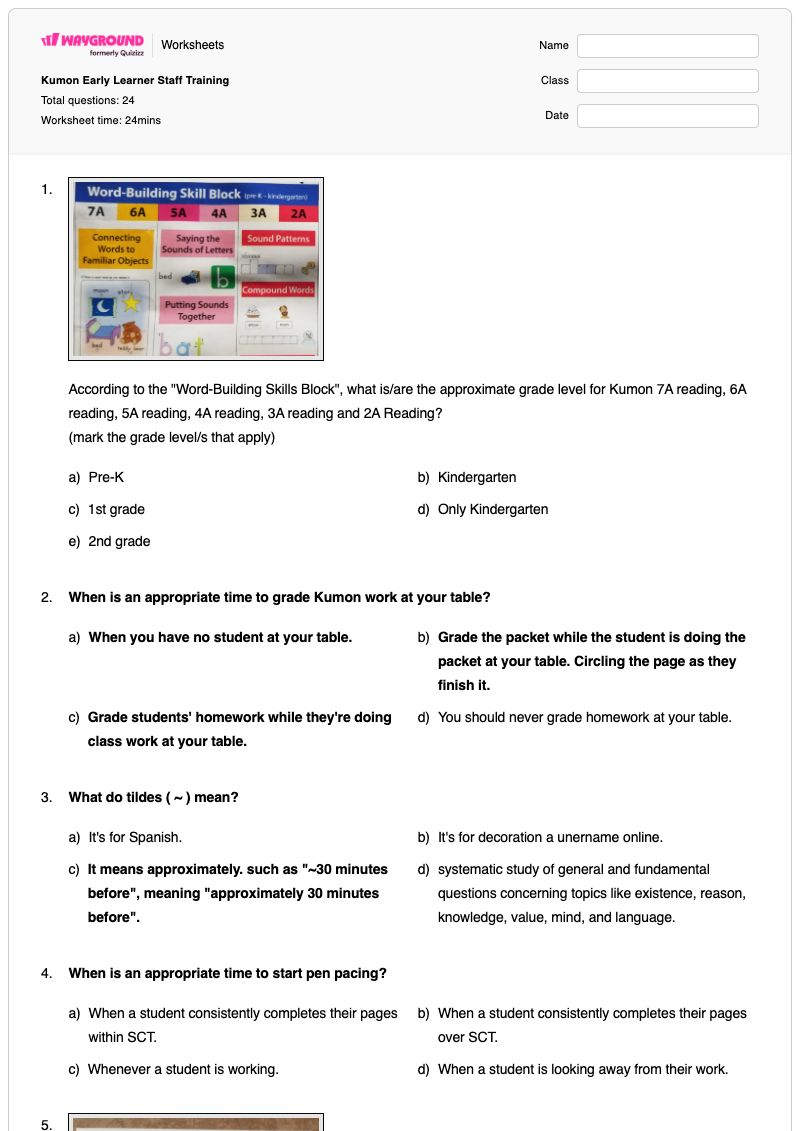
According to the "Word-Building Skills Block", what is/are the approximate grade level for Kumon 7A reading, 6A reading, 5A…

According to the "Word-Building Skills Block", what is/are the approximate grade level for Kumon 7A reading, 6A reading, 5A reading, 4A reading, 3A reading and 2A Reading?

(mark the grade level/s that apply)

a)

Pre-K

b)

Kindergarten

c)

1st grade

d)

Only Kindergarten

e)

2nd grade

2.

When is an appropriate time to grade Kumon work at your table?

a)

When you have no student at your table.

b)

Grade the packet while the student is doing the packet at your table. Circling the page as they finish it.

c)

Grade students' homework while they're doing class work at your table.

d)

You should never grade homework at your table.

3.
  • What do tildes ( ~ ) mean?

a)

It's for Spanish.

b)

It's for decoration a unername online.

c)
  • It means approximately. such as "~30 minutes before", meaning "approximately 30 minutes before".

d)

systematic study of general and fundamental questions concerning topics like existence, reason, knowledge, value, mind, and language.

4.

When is an appropriate time to start pen pacing?

a)

When a student consistently completes their pages within SCT.

b)

When a student consistently completes their pages over SCT.

c)

Whenever a student is working.

d)

When a student is looking away from their work.

5.
If SCT (Standard Completion Time) for Reading 5A is .5 ~2 min. per page. What is the longest a student should take to…

If SCT (Standard Completion Time) for Reading 5A is .5 ~2 min. per page. What is the longest a student should take to complete a page front and back?

a)

.5 min (30 seconds)

b)

2 min.

c)

1 min.

d)

5 min.

6.
If SCT (Standard Completion Time) for 3A reading is .5~2 per page, when do we start pen pacing?

If SCT (Standard Completion Time) for 3A reading is .5~2 per page, when do we start pen pacing?

a)

When a students reaches 2 minutes.

b)

When a student reaches .5 (30 seconds).

c)

When it seems like the student is not going to finish the page front and back in under 2 min.

d)

When it seems like the student is going to finish the page front and back in under 2 min

7.
SCT for Reading 5A is .5 ~2 per page. In general, if a student is in 1st grade and they are doing 5A reading work, should…

SCT for Reading 5A is .5 ~2 per page.

In general, if a student is in 1st grade and they are doing 5A reading work, should you expect they complete each pager, front and back, closer to 2 minutes or .5 min (30 sec)?

a)

Closer to 2 minutes

b)

Closer to .5 min (30 sec)

c)

As long as they need.

8.
According to the Sentence-Building Skill Block, what grade levels are included in Kumon AI, AII, BI, BII, CI, and CII? (Mark…

According to the Sentence-Building Skill Block, what grade levels are included in Kumon AI, AII, BI, BII, CI, and CII?

(Mark the level/s that can apply)

a)

1st grade

b)

2nd grade

c)

3rd grade

d)

4th grade

e)

Kindergarten

9.
SCT for Reading 5A is .5 ~2 min. per page. What does this mean?

SCT for Reading 5A is .5 ~2 min. per page.

What does this mean?

a)

Students should spend exactly .5 min (30 sec) for the front page.

b)

Approximately between 30 seconds and 2 min. on the front and back pages combined (side a and side b)

c)

Students should be about 2 min. on one side of the page, side a or side b.

10.

Select the pages that are side b. (the back side)

a)
Select the pages that are side b. (the back side)

b)
Select the pages that are side b. (the back side)

c)
Select the pages that are side b. (the back side)

d)
Select the pages that are side b. (the back side)

11.

Selcect the pages that are side a.

a)
Selcect the pages that are side a.

b)
Selcect the pages that are side a.

c)
Selcect the pages that are side a.

d)
Selcect the pages that are side a.

12.

When is it appropriate to expect the students to reach the fastest SCT?

a)

When the student is working on Kumon work that matches their actual grade level.

b)

When the student is working on Kumon work that is below their actual grade level.

c)

When the student is working on Kumon work that is above their grade level.

d)

Whenever the student is doing Kumon, they should be reaching the fastest SCT.

13.

When is it appropriate to expect the students to reach the longest SCT?

a)

When the student is working on Kumon work that matches their actual grade level.

b)

When the student is working on Kumon work that is below their actual grade level.

c)

When the student is working on Kumon work that is above their grade level.

d)

Whenever the student is doing Kumon, they should be taking the longest SCT.

14.

Which are appropriate definitions of "Pen pacing"?

a)

Poking students with pens.

b)

Pointing to the problems on the page and giving students answers if they do not know them within 3 seconds.

c)

Letting students use the red pen to circle their page.

d)

Using you pen to guide the student to keep their eyes on their page.

15.

What are parents paying every month for their students to come to Kumon?

a)

To receive quality tutoring from their instructor so their students can get to grade level or above grade level.

b)

To have their child scolded during their session by the instructor.

c)

To have their child hang out and chat the whole session with the instructor.

d)

To have their child complete about a page or two of their work, use the bathroom, get a drink and blow their nose.

16.

How long do you spend doing math charts with students per day?

a)

1 minute

b)

5 minutes

c)

How ever long the student needs

d)

7 minutes

17.

How long do you spend doing reading charts with students per day?

a)

1 minute

b)

5 minutes

c)

How ever long the student needs

d)

7 minutes

18.

What are appropriate sets for the student to work on if they do NOT have their ABC chart at 100% mastery?

(select any that apply)

a)
What are appropriate sets for the student to work on if they do NOT have their ABC chart at 100% mastery? (select any that…

b)
What are appropriate sets for the student to work on if they do NOT have their ABC chart at 100% mastery? (select any that…

c)
What are appropriate sets for the student to work on if they do NOT have their ABC chart at 100% mastery? (select any that…

d)
What are appropriate sets for the student to work on if they do NOT have their ABC chart at 100% mastery? (select any that…

19.

When is an appropriate time to do a student's charts?

a)

Start with charts.

b)

When there is time.

c)

Don't do them if you run out of time.

d)

Last 5 minutes of a student's session,

20.

If a student is not focusing and getting their work done within SCT, what should we do?

a)

Getting mad at students for not focusing.

b)

Evaluate if we are creating a quiet learning environment for them.

c)

Start pen-pacing.

d)

Ignore the student.

21.

Where should your cell phone be?

a)

In my pocket.

b)

In the breakroom.

22.

What should be on an organized table when students are working?
(Everything else should be on the ground resting on the table legs.)

a)

One neat pile of your students work they need to get done in class.

b)

the pencil bin within reach of students

c)

student's folders

d)

your drinks

e)

Work your students are working on in class.

23.
  • What are appropriate things to bring up when talking with parents, grandparents or the guardians?

a)
  • Keep talks with parents short and sweet and positive.

b)
  • Let them know if the student met their goals, if they ask.

c)

Give parent's lot of feedback about how their child was not working and unfocused.

d)

Let the parent know Shari or Tom can meet with them if they would like to talk about their students goals.

e)

If the parent specifically asks if here was a problem, always incorporate the sandwich approach IF you have anything negative to say about a student:

Say a positive, say the negative, end with a positive.

24.
  • Mark examples of professional touch and interactions instructors should have with students.

a)
  • pick up students. 

b)
  • give EXTRA attention to student's we like.

c)
  • smile and make all feel welcome t our table

d)

Give our favorite students big hugs in front of all students.

e)

Give students a high-five and tell them they are smart

WaygroundAnswer Key

Kumon Early Learner Staff Training

Total questions: 24

1.
a)

Pre-K

, b)

Kindergarten

2.
a)

When you have no student at your table.

, b)

Grade the packet while the student is doing the packet at your table. Circling the page as they finish it.

3.
c)
  • It means approximately. such as "~30 minutes before", meaning "approximately 30 minutes before".

4.
b)

When a student consistently completes their pages over SCT.

, d)

When a student is looking away from their work.

5.
b)

2 min.

6.
c)

When it seems like the student is not going to finish the page front and back in under 2 min.

7.
b)

Closer to .5 min (30 sec)

8.
a)

1st grade

, b)

2nd grade

, c)

3rd grade

9.
b)

Approximately between 30 seconds and 2 min. on the front and back pages combined (side a and side b)

10.
a)

, c)

, d)

11.
a)

, b)

, c)

, d)

12.
b)

When the student is working on Kumon work that is below their actual grade level.

13.
a)

When the student is working on Kumon work that matches their actual grade level.

, c)

When the student is working on Kumon work that is above their grade level.

14.
b)

Pointing to the problems on the page and giving students answers if they do not know them within 3 seconds.

, d)

Using you pen to guide the student to keep their eyes on their page.

15.
a)

To receive quality tutoring from their instructor so their students can get to grade level or above grade level.

16.
b)

5 minutes

17.
b)

5 minutes

18.
b)

19.
a)

Start with charts.

, b)

When there is time.

, d)

Last 5 minutes of a student's session,

20.
b)

Evaluate if we are creating a quiet learning environment for them.

, c)

Start pen-pacing.

21.
b)

In the breakroom.

22.
a)

One neat pile of your students work they need to get done in class.

, b)

the pencil bin within reach of students

, e)

Work your students are working on in class.

23.
a)
  • Keep talks with parents short and sweet and positive.

, b)
  • Let them know if the student met their goals, if they ask.

, d)

Let the parent know Shari or Tom can meet with them if they would like to talk about their students goals.

, e)

If the parent specifically asks if here was a problem, always incorporate the sandwich approach IF you have anything negative to say about a student:

Say a positive, say the negative, end with a positive.

24.
c)
  • smile and make all feel welcome t our table

, e)

Give students a high-five and tell them they are smart

FAQs

What does the Kumon Early Learner Staff Training worksheet cover?

This worksheet uses 14 multiple-select and 10 multiple-choice questions to assess Kumon staff knowledge of Word-Building and Sentence-Building skill-block grade levels, Standard Completion Time (SCT), side-a and side-b pages, pen pacing, and table-grading procedures. Students apply timing ranges such as 0.5–2 minutes to front-and-back pages and determine when pacing or the fastest or longest SCT is appropriate. These scenarios build practical decision-making for supporting early learners during Kumon sessions.

How can I use this worksheet to teach Kumon SCT and pen pacing?

Introduce the worksheet by modeling how to read an SCT range and clarify that the stated time applies to the front and back of the page together. Then have learners explain the worksheet’s scenarios for starting pen pacing, guiding a student’s eyes, and adjusting expectations when work is below, at, or above grade level. Use the multiple-select items to discuss why more than one staff action or condition may be appropriate.

What mistakes should I watch for when students complete this Kumon training worksheet?

Watch for students treating an SCT range as an exact time, applying it to only one side of a page, or confusing side a with side b. They may also select only one answer on a multiple-select item, start pen pacing whenever a student is working, or reverse when the fastest and longest SCT should be expected. Another common error is confusing pen pacing with supplying answers rather than using the pen to guide attention and provide an answer when the worksheet’s stated condition is met.

How do I assign and grade this Kumon staff training worksheet?

On Wayground, assign the worksheet as a digital quiz or download it as a printable PDF for staff training. The worksheet includes a complete answer key for checking the 24 multiple-choice and multiple-select responses, and printable submissions can be graded by scanning student work with the Wayground for Teachers app. The printable format can also support schools that are reducing screen time.

How can I differentiate this worksheet for my students?

For this text-heavy training worksheet, use the worksheet’s Advanced Settings to adjust font spacing and font size so SCT scenarios, terminology, and answer choices are easier to read. You can also enable a dyslexia-friendly font or translate the worksheet into another language when appropriate for the learner. These changes preserve the multiple-choice and multiple-select format while improving access to the same Kumon staff-training content.

Where can I find more worksheets like this on Wayground?

Wayground offers a comprehensive collection of free printable worksheets and practice problems across all subjects, with downloadable PDFs and answer keys to help students master essential skills and concepts. Browse more resources at https://wayground.com/en-us/worksheets.