

Wayground
LESSON 6:  "The Boy Who Saved Baseball" - Printable Math Worksheets 6th Grade - Wayground

LESSON 6: "The Boy Who Saved Baseball"

Michelle Pheasant

Created by Michelle Pheasant

15 questions

6th Grade

Math

Updated May 2025

This Grade 6 English reading worksheet uses 15 comprehension questions—14 multiple choice and one multiple-select—to examine The Boy Who Saved Baseball. Students identify the passage’s theme and genre, recognize Tom’s point of view, interpret metaphors such as the team’s transformation into a butterfly, and explain how figurative comparisons reveal Tom’s thoughts and the team’s experience. The questions also ask students to track Tom’s changing feelings, identify his central conflict, infer character traits from dialogue and actions, and determine what influences his final decision. This combination of literary analysis and evidence-based inference helps students move beyond recalling plot details to explain how fear, courage, relationships, and challenges shape the passage. Use this free printable worksheet with an answer key for independent practice, guided reading, discussion, or a post-lesson check of understanding.

Worksheet settings

Font size

S
M
L
XL
WaygroundWorksheets

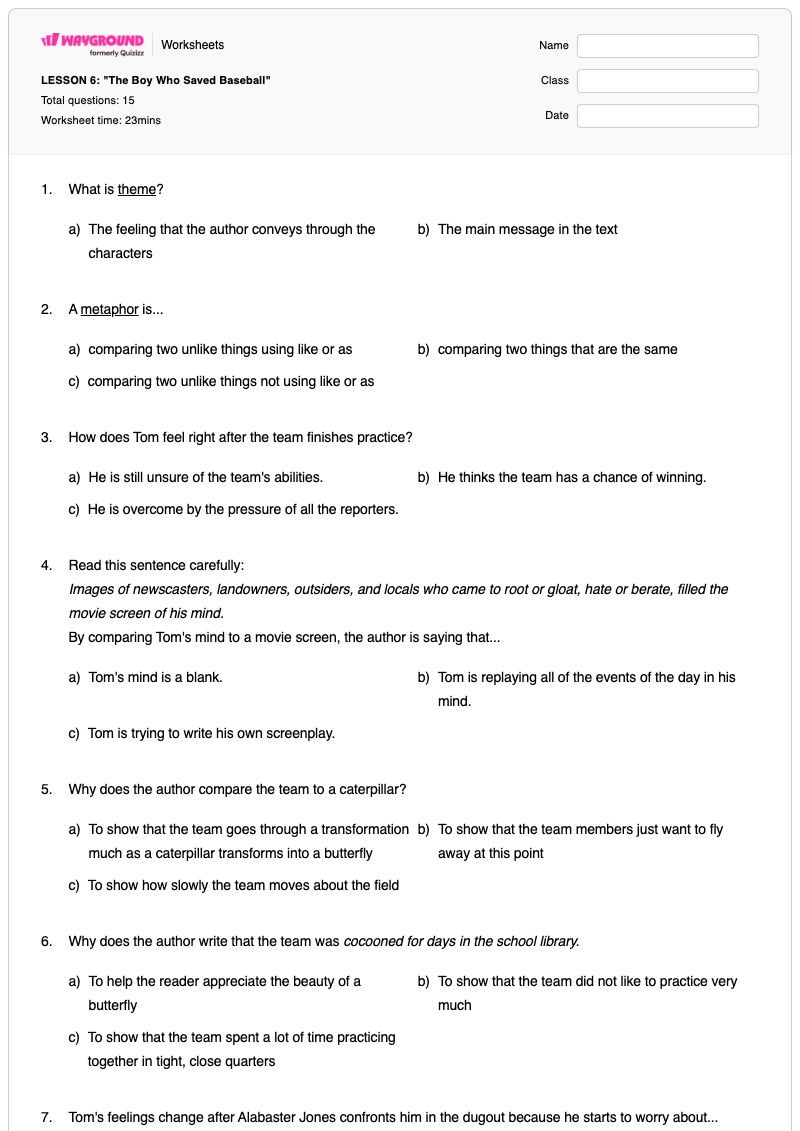
LESSON 6: "The Boy Who Saved Baseball"

Total questions: 15

Name
Class
Date
1.

What is theme?

a)

The feeling that the author conveys through the characters

b)

The main message in the text

2.

A metaphor is...

a)

comparing two unlike things using like or as

b)

comparing two things that are the same

c)

comparing two unlike things not using like or as

3.

How does Tom feel right after the team finishes practice?

a)

He is still unsure of the team's abilities.

b)

He thinks the team has a chance of winning.

c)

He is overcome by the pressure of all the reporters.

4.

Read this sentence carefully:

Images of newscasters, landowners, outsiders, and locals who came to root or gloat, hate or berate, filled the movie screen of his mind.

By comparing Tom's mind to a movie screen, the author is saying that...

a)

Tom's mind is a blank.

b)

Tom is replaying all of the events of the day in his mind.

c)

Tom is trying to write his own screenplay.

5.

Why does the author compare the team to a caterpillar?

a)

To show that the team goes through a transformation much as a caterpillar transforms into a butterfly

b)

To show that the team members just want to fly away at this point

c)

To show how slowly the team moves about the field

6.

Why does the author write that the team was cocooned for days in the school library.

a)

To help the reader appreciate the beauty of a butterfly

b)

To show that the team did not like to practice very much

c)

To show that the team spent a lot of time practicing together in tight, close quarters

7.

Tom's feelings change after Alabaster Jones confronts him in the dugout because he starts to worry about...

a)

the effects his actions will have on his family.

b)

what will occur if he happens to play in the game.

8.

"A lot of people are afraid of what might happen tomorrow. But we can't be. Then, whatever happens will turn out okay."


How does this speech by Rachel change the way Tom feels?

a)

It helps him see that fear makes him a better player.

b)

It makes him feel empowered and that he can't let his fears affect how he plays.

9.

The conflict that Tom faces in this passage is that if his team wins the game tomorrow,

a)

his dream of becoming a famous writer will be finished.

b)

his friends on the opposing team will never speak to him again.

c)

his parents might lose their jobs and his family could lose their home.

10.

Which of the following is the most likely reason readers might relate to Tom?

a)

Many people have coaches who are also Major League baseball players.

b)

Many people are afraid of major challenges in their lives.

c)

Everyone likes the game of baseball.

11.

What is the theme of the passage?

a)

What happens to us when we are young is not important.

b)

Overcoming fear is the most important step in facing a challenge.

c)

Sometimes we are doomed to failure no matter what we do.

12.

Which had the biggest influence on Tom's decision at the end fo the passage?

a)

The discussion the players have about facing fear.

b)

The way Cruz de la Cruz plays.

c)

The fact that the team has never beaten the Lake View Mesa team.

13.

What type of fiction is "The Boy Who Saved Baseball"?

a)

historical fiction

b)

realistic fiction

c)

fantasy

14.

Whose point of view is the story told from?

a)

Dante Del Gato

b)

Tom

c)

Cruz de la Cruz

15.

When Alabaster Jones threatens Tom, Tom stands up to him, saying, "We're not trying to hurt you, we don't have anything against you at all. Why are you trying to hurt us?"


What does the tell us about Tom? Choose all answers that apply.

a)

Tom is brave.

b)

Tom is still scared of Alabaster Jones.

c)

Tom believes in doing the right thing.

d)

Tom is a spiteful person.

WaygroundAnswer Key

LESSON 6: "The Boy Who Saved Baseball"

Total questions: 15

1.
b)

The main message in the text

2.
c)

comparing two unlike things not using like or as

3.
b)

He thinks the team has a chance of winning.

4.
b)

Tom is replaying all of the events of the day in his mind.

5.
a)

To show that the team goes through a transformation much as a caterpillar transforms into a butterfly

6.
c)

To show that the team spent a lot of time practicing together in tight, close quarters

7.
a)

the effects his actions will have on his family.

8.
b)

It makes him feel empowered and that he can't let his fears affect how he plays.

9.
c)

his parents might lose their jobs and his family could lose their home.

10.
b)

Many people are afraid of major challenges in their lives.

11.
b)

Overcoming fear is the most important step in facing a challenge.

12.
a)

The discussion the players have about facing fear.

13.
b)

realistic fiction

14.
b)

Tom

15.
a)

Tom is brave.

, c)

Tom believes in doing the right thing.

FAQs

What does this worksheet cover, and how does it build Grade 6 reading comprehension?

This worksheet covers The Boy Who Saved Baseball through 15 reading-comprehension questions: 14 multiple choice and one multiple select. Students identify theme, genre, and point of view; interpret metaphors; and analyze Tom’s feelings, conflict, character traits, and decision-making. These items build the ability to infer meaning and connect character actions and figurative language to the passage’s central message about facing fear.

How can I use this worksheet to teach theme and character development in The Boy Who Saved Baseball?

Before students begin, review the difference between a theme—the text’s main message—and a topic or feeling, then model how Tom’s actions and changing feelings reveal that message. Have students cite the team’s transformation metaphor, Tom’s conflict, Rachel’s speech, and Tom’s response to Alabaster Jones as they work through the questions. Finish by asking students to explain how the discussion about fear influences Tom’s decision.

What mistakes should I watch for when students complete this reading worksheet?

Watch for students choosing a character’s feeling instead of the passage’s theme, or identifying a metaphor as a comparison that uses “like” or “as.” Students may also overlook how the movie-screen and caterpillar comparisons convey meaning, confuse Tom’s conflict with a different consequence, or select only one correct trait in the multiple-select question about Tom confronting Alabaster Jones. Check that their answers reflect Tom’s changing feelings and the story’s point of view.

How do I assign and grade this worksheet?

You can assign The Boy Who Saved Baseball as a printable PDF or as a digital quiz on Wayground. It includes a complete answer key for the 14 multiple-choice items and the multiple-select item, and printable student work can be graded by scanning it with the Wayground for Teachers app. The PDF option can also support classrooms that are reducing screen time.

How can I differentiate this worksheet for my students?

Use the worksheet’s Advanced Settings to adjust font spacing or increase the font size so students can navigate the reading-comprehension questions more easily. You can also apply a dyslexia-friendly font or translate the worksheet into another language while preserving its focus on theme, metaphors, Tom’s character development, and point of view.

Where can I find more worksheets like this on Wayground?

Wayground offers a broad collection of free printable worksheets and practice problems across subjects, with downloadable PDFs and answer keys to help students master essential skills and concepts. Browse more resources at https://wayground.com/en-us/worksheets.