
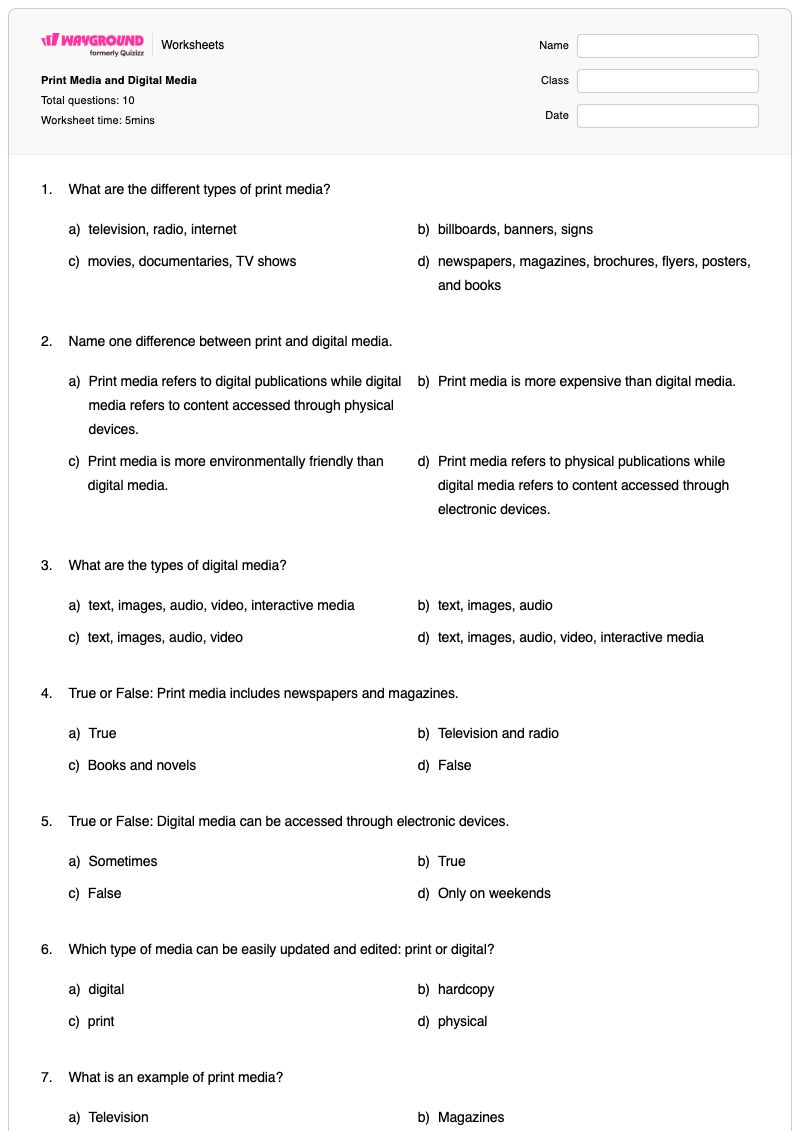

Print Media and Digital Media is a free printable Grade 3 worksheet that introduces students to the differences between physical and electronic forms of media. Through 10 multiple-choice questions, students identify print media such as newspapers, magazines, brochures, flyers, posters, and books; recognize digital media such as websites; and distinguish physical publications from content accessed through electronic devices.
The worksheet also checks students’ understanding of digital media formats, including text, images, audio, video, and interactive media. True-or-false and choice-based items ask students to apply these ideas by identifying which type of media can be updated and edited more easily and which supports interactive content. It includes a complete answer key, making it useful for Grade 3 media literacy lessons, independent practice, review, or a quick formative assessment.
Worksheet settings
Font size
S
M
L
XL
Worksheets
Print Media and Digital Media
Total questions: 10
Name
Class
Date
1.
What are the different types of print media?
a)
television, radio, internet
b)
billboards, banners, signs
c)
movies, documentaries, TV shows
d)
newspapers, magazines, brochures, flyers, posters, and books
2.
Name one difference between print and digital media.
a)
Print media refers to digital publications while digital media refers to content accessed through physical devices.
b)
Print media is more expensive than digital media.
c)
Print media is more environmentally friendly than digital media.
d)
Print media refers to physical publications while digital media refers to content accessed through electronic devices.
3.
What are the types of digital media?
a)
text, images, audio, video, interactive media
b)
text, images, audio
c)
text, images, audio, video
d)
text, images, audio, video, interactive media
4.
True or False: Print media includes newspapers and magazines.
a)
True
b)
Television and radio
c)
Books and novels
d)
False
5.
True or False: Digital media can be accessed through electronic devices.
a)
Sometimes
b)
True
c)
False
d)
Only on weekends
6.
Which type of media can be easily updated and edited: print or digital?
a)
digital
b)
hardcopy
c)
print
d)
physical
7.
What is an example of print media?
a)
Television
b)
Magazines
c)
Newspapers
d)
Billboards
8.
What is an example of digital media?
a)
Websites
b)
Books
c)
Newspapers
d)
Paintings
9.
True or False: Print media is more expensive than digital media.
a)
False
b)
Not enough information
c)
Partially true
d)
True
10.
True or False: Digital media allows for interactive content.
a)
False
b)
True
c)
Not sure
d)
Sometimes
Answer Key
Print Media and Digital Media
Total questions: 10
1.
d)
newspapers, magazines, brochures, flyers, posters, and books
2.
d)
Print media refers to physical publications while digital media refers to content accessed through electronic devices.
3.
a)
text, images, audio, video, interactive media
4.
a)
True
5.
b)
True
6.
a)
digital
7.
c)
Newspapers
8.
a)
Websites
9.
a)
False
10.
b)
True
140 %
Browse by subjects
Browse by grades
Browse by format
FAQs
What does the Print Media and Digital Media worksheet cover?
This Grade 3 worksheet uses 10 multiple-choice questions to help students identify print media and digital media and compare their defining features. Students classify examples such as newspapers and websites, identify digital formats including text, images, audio, video, and interactive media, and recognize that digital content can be updated and support interaction.
How can I use this worksheet to teach the difference between print and digital media?
Begin by showing students a physical publication, such as a newspaper or book, and an electronic example, such as a website. Use the worksheet’s classification and comparison questions to have students explain whether each example is a physical publication or content accessed through an electronic device. Afterward, discuss why digital media is easier to update and can include interactive content.
What mistakes should I watch for when students complete this media worksheet?
Students may confuse a type of media with an example, such as choosing newspapers when asked for the full types of print media or overlooking interactive media in the list of digital formats. They may also misclassify websites as print media or select an incorrect true-or-false response about electronic access, digital updates, or interactive content. Review the difference between a medium’s format and a specific example before grading.
How do I assign and grade this Print Media and Digital Media worksheet?
You can assign it as a printable PDF or as a digital quiz on Wayground. The worksheet includes a complete answer key, and printable submissions can be graded by scanning student work with the Wayground for Teachers app. The PDF option also supports lessons in settings that are reducing screen time.
How can I differentiate this print and digital media worksheet for my students?
Use the worksheet’s Advanced Settings to adjust font spacing or choose a larger font size so the 10 multiple-choice items are easier to read. You can also apply a dyslexia-friendly font or translate the worksheet into another language when that better supports students working with the media vocabulary.
Where can I find more free worksheets like this on Wayground?
Wayground offers a comprehensive collection of free printable worksheets and practice problems across all subjects, with downloadable PDFs and answer keys to support essential skills and concepts. Browse more resources at https://wayground.com/en-us/worksheets.