
Volume and Surface Area: Prisms, Cones, and Cylinders
Created by Laura Perry
14 questions
8th Grade
Math
Updated Aug 2026
Volume and Surface Area: Prisms, Cones, and Cylinders is a Grade 8 mathematics worksheet with 14 multiple-choice questions. It builds understanding of surface area as the total area covering a solid and distinguishes surface-area situations, such as finding the material for a label or wrapping a present, from volume situations involving how much a container can hold. Students identify three-dimensional figures and their bases, then use dimensions to calculate the surface area or volume of prisms, cones, and cylinders.
The questions also reinforce selecting an appropriate formula, converting diameter to radius when needed, using 3.14 or the π button, rounding cone and cylinder volumes to the nearest tenth, and reporting answers with appropriate square or cubic units. Use this free printable worksheet for Grade 8 practice, independent work, review, or assessment. It includes a complete answer key for efficient checking and feedback.
Worksheet settings
Font size
S
M
L
XL
Worksheets
Volume and Surface Area: Prisms, Cones, and Cylinders
Total questions: 14
Name
Class
Date
1.
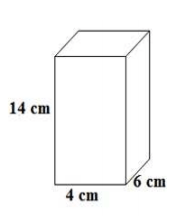
What is the surface area of this figure?
a)
3000 cm 2
b)
164 cm 2
c)
236 cm 2
d)
328 cm 2
2.
What is the total surface area of the triangular prism shown?
a)
468 in2
b)
540 in2
c)
576 in2
d)
700 in2
3.
What is surface area?
a)
Inside of the object
b)
the sum of all the areas of all the shapes that cover the surface of the object.
c)
Some random math concept that Mr. Simpson talks about
d)
Surface area is what you get when you boil unicorn tears.
4.
Which example requires you to find the surface area?
a)
Finding out how much water will fill a cylinder
b)
Finding out how much wrapping paper is needed to cover a present
c)
Finding the amount a container can hold
d)
Finding out how much wood is needed to build a fence in your back yard.
5.
What is the volume of the cone to the nearest tenth (use the π button)?
a)
157.1 m3
b)
31.4 m3
c)
471.2 m3
d)
208.6 m3
6.
What is the volume of the cone to the nearest tenth (use theπbutton)?
a)
29.3 m3
b)
88 m3
c)
14.7 m3
d)
44 m3
7.
Find the volume of the cylinder. Round your answers to the nearest tenth if necessary. Use 3.14 for π.
a)
124.6 in3
b)
87.9 in3
c)
97.5 in3
d)
78.9 in3
8.
Find the volume of the cylinder. Use 3.14 for π.
a)
282.6
b)
516.2
c)
133
d)
214
9.
Find the lateral surface area of the prism.
Don't forget to divide the diameter by 2 to get the radius.
a)
100.53 square inches
b)
351.86 square inches
c)
251.33 square inches
d)
50.27 square inches
10.
Campbell Soup is creating a new soup label. If a can has a height of 6 in and a diameter of 4 in, how much material does Campbell need for each soup label? Use 3.14 for π. Which formula can be used to find the surface area of the label?
a)
SA=2πrh+2r2
b)
SA=2πrh
c)
SA=Ph+2B
d)
V=Bh
11.
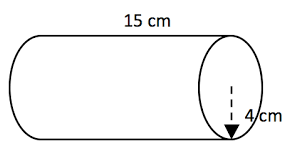
Find the Total Surface area of the cylinder.
a)
62.8m
b)
477.28 cm2
c)
235.5 cm3
d)
942 cm2
12.
Identify this shape.
a)
Triangular Prism
b)
Rectangular Prism
c)
Cube
d)
Triangular Pyramid
13.
What shape is the base? What is the area of the base (B)?
a)
Rectangle; 60in2
b)
Triangle; 12 in2
c)
Rectangle; 32 in2
d)
Triangle; 6 in2
14.
Calculate the volume:
a)
1120 ft 3
b)
600 ft 3
c)
560 ft 3
d)
64 ft 3
Answer Key
Volume and Surface Area: Prisms, Cones, and Cylinders
Total questions: 14
1.
d) 328 cm 2
2.
a) 468 in2
3.
b)
the sum of all the areas of all the shapes that cover the surface of the object.
4.
b)
Finding out how much wrapping paper is needed to cover a present
5.
a)
157.1 m3
6.
a)
29.3 m3
7.
b) 87.9 in3
8.
a)
282.6
9.
c)
251.33 square inches
10.
b) SA=2πrh
11.
b) 477.28 cm2
12.
a) Triangular Prism
13.
d) Triangle; 6 in2
14.
c) 560 ft 3
140 %
Browse by subjects
Browse by grades
Browse by format
FAQs
What does this worksheet cover, and how does it help students learn surface area and volume?
This Grade 8 worksheet uses 14 multiple-choice questions to practice calculating surface area and volume for triangular prisms, cones, and cylinders. Students also identify solids and their bases, distinguish covering-area problems from capacity problems, choose formulas, use diameter and radius correctly, apply π or 3.14, round answers, and use square or cubic units.
How can I use this worksheet to teach surface area and volume of prisms, cones, and cylinders?
Begin by contrasting the worksheet’s wrapping-paper and soup-label examples, which involve surface area, with container-capacity examples, which involve volume. Model how to identify the solid and base before selecting a formula, then have students explain why a choice is correct for the prism, cone, or cylinder items and how π, radius, rounding, and units affect the result.
What mistakes should I watch for when students complete this worksheet?
Watch for students confusing surface area with volume, choosing a volume formula for a covering problem, or reporting square units for a volume answer. In the cylinder and cone questions, students may use the diameter as the radius, omit a factor in the formula, use π inconsistently, or round before completing the calculation; in the prism items, they may misidentify the triangular base or calculate only part of the surface area.
How do I assign and grade this worksheet?
On Wayground, assign it as a digital quiz or download the printable PDF for paper-based practice. The worksheet includes a complete answer key, and printable submissions can be graded by scanning student work with the Wayground for Teachers app.
How can I differentiate this surface area and volume worksheet for my students?
Use the worksheet’s Advanced Settings to adjust font spacing and font size so the multiple-choice formulas, dimensions, and answer choices are easier to read. You can also apply a dyslexia-friendly font or translate the prism, cone, and cylinder questions into another language.
Where can I find more worksheets like this on Wayground?
Wayground offers a comprehensive collection of free printable worksheets and practice problems across all subjects, with downloadable PDFs and answer keys to support essential skills and concepts. Browse more resources at https://wayground.com/en-us/worksheets.