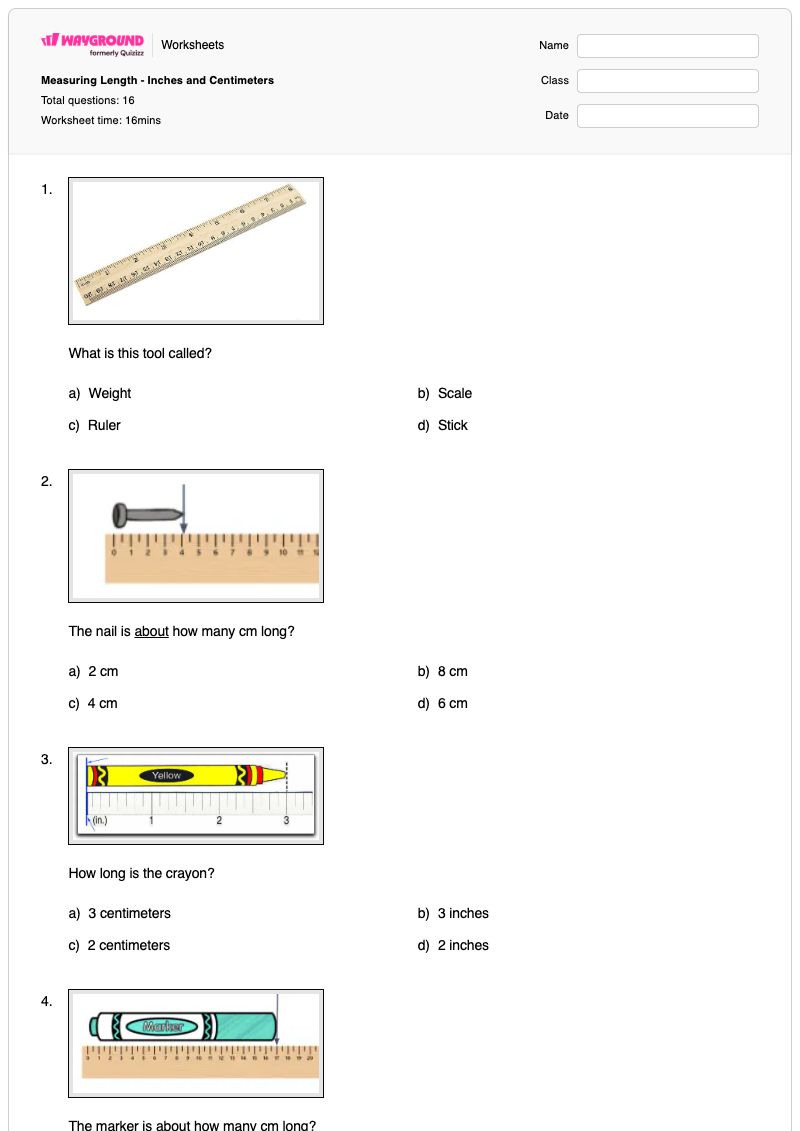
Measuring Length - Inches and Centimeters is a free printable Grade 3 math worksheet with an answer key for practicing measurement and unit selection. Its 16 multiple-choice questions ask students to identify a ruler, determine the length of pictured objects in centimeters or inches, measure to the nearest half inch, and estimate reasonable lengths for familiar objects.
The worksheet also builds judgment about which customary unit—inch, foot, or yard—best fits a real-world object. Students apply measurement skills to examples such as a nail, crayon, marker, ribbon, paintbrush, key, glue stick, child, and table, choosing among plausible answer options. This format gives teachers a focused way to check whether students can distinguish centimeters from inches, interpret half-inch measurements, and connect unit size to object size. It works well for independent practice, review, or a quick assessment of Grade 3 measurement understanding.
Worksheet settings
Font size
S
M
L
XL
Worksheets
Measuring Length - Inches and Centimeters
Total questions: 16
Name
Class
Date
1.
What is this tool called?
a)
Weight
b)
Scale
c)
Ruler
d)
Stick
2.
The nail is about how many cm long?
a)
2 cm
b)
8 cm
c)
4 cm
d)
6 cm
3.
How long is the crayon?
a)
3 centimeters
b)
3 inches
c)
2 centimeters
d)
2 inches
4.
The marker is about how many cm long?
a)
11 cm
b)
17 cm
c)
13 cm
d)
20 cm
5.
Measure to the nearest half inch. The scissors are about ____ inches long.
a)
3
b)
3 and 1/2
c)
4
d)
4 and 1/2
6.
What is the length of the pencil to the nearest HALF inch?
a)
4 inches
b)
4 1/2 inches
c)
5 inches
d)
3 1/2 inches
7.
What is the length of the eraser to the nearest half inch?
a)
2 inches
b)
1 inch
c)
1 1/2 inches
8.
Would you use inches, feet, or yards to measure this REAL WORLD object?
a)
inches
b)
feet
c)
yards
9.
How long is the green ribbon
a)
6 1/2 centimeters
b)
4 centimeters
c)
5 1/2 centimeters
d)
6 centimeters
10.
How long is the paintbrush?
a)
4 inches
b)
5 inches
c)
6 inches
d)
3 inches
11.
Estimate the length of a key.
a)
4 feet
b)
4 inches
12.
Which of these would best be measured using a ruler?
a)
The distance between your school and house
b)
The length of a glue stick
c)
The height of a tree
d)
The length of a football field
13.
The height of a child is about....
a)
4 inches
b)
4 feet
c)
4 centimeters
14.
Which object is about 3 feet tall?
a)
a house
b)
an ant
c)
a table
d)
a crayon
15.
About how many centimeters is the blue crayon?
a)
2 centimeters
b)
5 centimeters
c)
8 centimeters
d)
13 centimeters
16.
About how long is the pencil?
a)
10 centimeters
b)
3 inches
c)
6 inches
d)
8 centimeters
Answer Key
Measuring Length - Inches and Centimeters
Total questions: 16
1.
c)
Ruler
2.
c)
4 cm
3.
b)
3 inches
4.
b)
17 cm
5.
b) 3 and 1/2
6.
b) 4 1/2 inches
7.
a)
2 inches
8.
a) inches
9.
a)
6 1/2 centimeters
10.
a)
4 inches
11.
b)
4 inches
12.
b)
The length of a glue stick
13.
b) 4 feet
14.
c)
a table
15.
b)
5 centimeters
16.
c)
6 inches
140 %
Browse by subjects
Browse by grades
Browse by format
FAQs
What does the Measuring Length - Inches and Centimeters worksheet cover?
This Grade 3 worksheet uses 16 multiple-choice questions to assess identifying a ruler, measuring objects in centimeters and inches, recording lengths to the nearest half inch, and selecting inches, feet, or yards for familiar objects. Students build measurement judgment by comparing answer choices for items such as a nail, crayon, ribbon, key, glue stick, child, and table.
How can I use this worksheet to teach measuring length in inches and centimeters?
Begin by reviewing what a ruler measures and how inches and centimeters differ, then model reading whole-inch, centimeter, and half-inch lengths. Have students explain why a particular unit fits each real-world object before completing the multiple-choice items, especially when choosing between inches, feet, and yards. Use the pictured-object questions to discuss how benchmark lengths support reasonable estimates.
What mistakes should I watch for when students complete this measurement worksheet?
Watch for students choosing the wrong unit, such as centimeters instead of inches for an object measured in inches, or selecting feet or yards for a short object. Students may also ignore the half-inch requirement and choose a whole-number answer, or confuse a reasonable estimate with an obviously oversized measurement. Review whether they are matching the unit named in the question and judging the object’s approximate size before selecting an answer.
How do I assign and grade this measuring length worksheet?
The worksheet is available as a printable PDF and as a digital quiz on Wayground, and it includes a complete answer key for the 16 multiple-choice questions. You can assign the PDF for paper practice or use the digital version for online responses; printable submissions can also be graded by scanning student work with the Wayground for Teachers app.
How can I differentiate this inches-and-centimeters worksheet for my students?
Use the worksheet’s Advanced Settings to adjust font spacing and font size so the multiple-choice measurement items are easier to read. You can also apply a dyslexia-friendly font or translate the worksheet into another language when those options support access to the measurement vocabulary and answer choices.
Where can I find more worksheets like this on Wayground?
Wayground offers a comprehensive collection of free printable worksheets and practice problems across all subjects, with downloadable PDFs and answer keys to help students master essential skills and concepts. Browse more resources at https://wayground.com/en-us/worksheets.


 Worksheets


