

Wayground
Medieval Europe Pop Quiz - Printable Social studies Worksheets class 7 - Wayground

Medieval Europe Pop Quiz

Jennifer Carpenter

Created by Jennifer Carpenter

15 questions

7th Grade

Social studies

Medieval Europe Pop Quiz is a Grade 7 social studies worksheet that reviews how geography, religion, leadership, and economic systems shaped medieval Europe. Students answer 15 questions—13 multiple choice and 2 multiple select—using maps, passages, images, and diagrams to identify the effects of the North Atlantic Drift, locate the Alps, Ural Mountains, and English Channel, and explain how monasteries spread Christianity and preserved classical knowledge. The quiz also assesses students’ understanding of Charlemagne, manorialism, feudalism, and William the Conqueror, including key relationships among land, loyalty, protection, agriculture, and political change after the fall of the Roman Empire. It is a free printable worksheet with a complete answer key, suitable for review, independent practice, or a knowledge check after instruction on medieval Europe.

Worksheet settings

Font size

S
M
L
XL
WaygroundWorksheets

Medieval Europe Pop Quiz

Total questions: 15

Name
Class
Date
1.
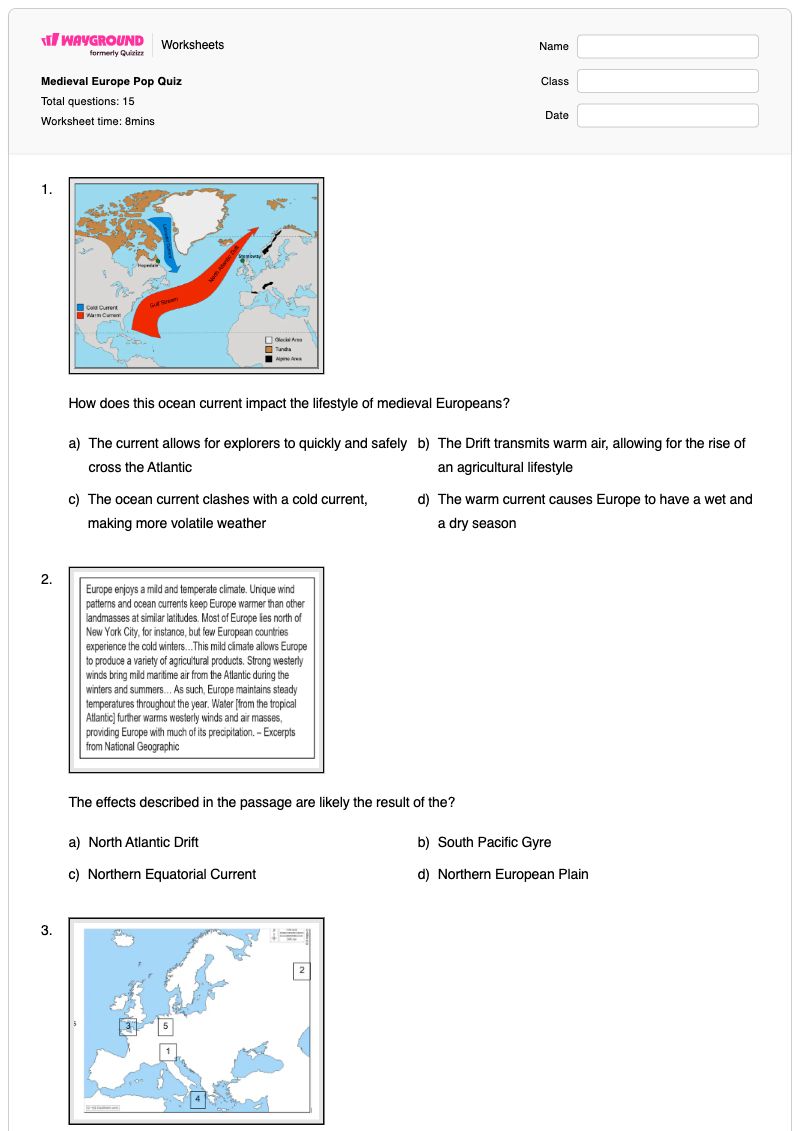
How does this ocean current impact the lifestyle of medieval Europeans?

How does this ocean current impact the lifestyle of medieval Europeans?

a)

The current allows for explorers to quickly and safely cross the Atlantic

b)

The Drift transmits warm air, allowing for the rise of an agricultural lifestyle

c)

The ocean current clashes with a cold current, making more volatile weather

d)

The warm current causes Europe to have a wet and a dry season

2.
The effects described in the passage are likely the result of the?

The effects described in the passage are likely the result of the?

a)

North Atlantic Drift

b)

South Pacific Gyre

c)

Northern Equatorial Current

d)

Northern European Plain

3.
Which of the following accurately identifies the location of the Alps Mountains?

Which of the following accurately identifies the location of the Alps Mountains?

a)

1

b)

2

c)

3

d)

4

4.
Which of the following accurately describes the location of the Ural Mountains?

Which of the following accurately describes the location of the Ural Mountains?

a)

1

b)

2

c)

3

d)

5

5.
Based on the map, answer the following: What likely caused the increase in the diffusion of the Christian faith between…

Based on the map, answer the following: What likely caused the increase in the diffusion of the Christian faith between 300-600 C.E.?

a)

Constantine’s Edict of Milan forced all persons in the Byzantine Empire to convert

b)

Monasteries served as Christian centers, leading to an increase in faith

c)

Christian invasions from Egypt led to the conversion of Europe

d)

Christianity passively diffused slowly over time with little interference

6.

What essential role did monasteries play throughout northern Europe?

a)

Monasteries became centers of wealth through trade

b)

Monasteries helped spread Christianity throughout Northern Europe

c)

Monasteries prevented invasions from northern invaders

d)

Monasteries created inventions to further oversea exploration

7.
How did monks in medieval Europe help preserve classical knowledge?

How did monks in medieval Europe help preserve classical knowledge?

a)

Monks would copy manuscripts that contained Greek and Roman ideas

b)

Monks would serve as historians, researching classical cultures

c)

Early monasteries served as libraries, which the monks would maintain

d)

Monks engaged in trade with Islamic cultures to obtain ancient documents

8.
The image shown depicts which historical event?

The image shown depicts which historical event?

a)

The conversion of Constantine to Christianity

b)

Saint Patrick’s baptism of the first Irish Christian

c)

The coronation of Pope Gregory I

d)

The crowning of Charlemagne as Holy Roman Emperor

9.

Which of the following two items did Charlemagne want for his kingdom?

a)

religious diversity

b)

increased education

c)

spreading of Christianity

d)

democracy in government

e)

less trade and contact with outsiders

10.
The diagram depicts a medieval manor. Which of the following describes the economic role of manorialism in medieval Europe?

The diagram depicts a medieval manor. Which of the following describes the economic role of manorialism in medieval Europe?

a)

Manors were set up on the outskirts of towns to provide food for growing medieval populations

b)

Manors served as the foundations for Christian monasteries, which were centers for trade

c)

Medieval manors created bonds of loyalty between kings and feudal lords

d)

Self-sufficient manors served as the centers of agricultural production during the medieval period

11.

Which of the following accurately describes feudalism in medieval Europe?

a)

An economic system that provided the papacy with funds from taxation

b)

An agricultural practice that resulted in increases in population

c)

A social and political system where land was exchanged for loyalty and protection

d)

A religious philosophy that resulted in forced conversion to Christianity

12.

Feudalism developed in Europe as a result of what?

a)

the spread of deadly diseases

b)

the fall of the Roman Empire

c)

the decline of the Catholic Church

d)

the increase in trade

13.
Which of the following completes the diagram?

 Which of the following completes the diagram?

a)

clergy

b)

vassals

c)

merchants/craftsment

d)

lords/nobles

14.
Which of the following accurately describes the location of the English Channel?

Which of the following accurately describes the location of the English Channel?

a)

4

b)

3

c)

5

d)

1

15.

The following 4 descriptions are of William the Conqueror: ​ (pick 4) ​ ​ ​ ​

​

a)
brought feudalism to England
b)
Duke of Normandy
c)
won the Battle of Hastings
d)
wrote the Domesday book
e)
pope of the Catholic Church
WaygroundAnswer Key

Medieval Europe Pop Quiz

Total questions: 15

1.
b)

The Drift transmits warm air, allowing for the rise of an agricultural lifestyle

2.
a)

North Atlantic Drift

3.
a)

1

4.
b)

2

5.
b)

Monasteries served as Christian centers, leading to an increase in faith

6.
b)

Monasteries helped spread Christianity throughout Northern Europe

7.
a)

Monks would copy manuscripts that contained Greek and Roman ideas

8.
d)

The crowning of Charlemagne as Holy Roman Emperor

9.
b)

increased education

, c)

spreading of Christianity

10.
d)

Self-sufficient manors served as the centers of agricultural production during the medieval period

11.
c)

A social and political system where land was exchanged for loyalty and protection

12.
b)

the fall of the Roman Empire

13.
d)

lords/nobles

14.
b)

3

15.
a) brought feudalism to England, b) Duke of Normandy, c) won the Battle of Hastings, d) wrote the Domesday book

FAQs

What does the Medieval Europe Pop Quiz worksheet cover?

This Grade 7 worksheet uses 13 multiple-choice and 2 multiple-select questions to assess medieval Europe’s geography, Christianity, political systems, and historical leaders. Students interpret maps of the Alps, Ural Mountains, and English Channel; connect the North Atlantic Drift to European agriculture; distinguish manorialism from feudalism; and identify the roles of monasteries, Charlemagne, and William the Conqueror.

How can I use this worksheet to teach medieval Europe?

Introduce the quiz after students have studied medieval Europe’s physical geography and major institutions. Have students explain the map, passage, image, and manor-diagram evidence before choosing an answer, then discuss why monasteries supported the spread of Christianity, how monks preserved classical knowledge, and how manorialism differed from feudalism. Review the two multiple-select items separately so students justify every selected choice.

What mistakes should I watch for when students complete this medieval Europe quiz?

Students may confuse the North Atlantic Drift with another current, misread numbered map locations, or treat the Alps, Ural Mountains, and English Channel as interchangeable geography items. They may also mix up monasteries’ religious and educational roles, manorialism’s agricultural function, and feudalism’s land-for-loyalty relationship. Remind students that the multiple-select questions require all correct choices, including the four descriptions requested for William the Conqueror.

How do I assign and grade the Medieval Europe Pop Quiz?

The worksheet is available as a printable PDF and as a digital quiz on Wayground, and it includes a complete answer key for all 15 items. You can grade printable student work by scanning it with the Wayground for Teachers app, while the digital version supports online assignment and scoring.

How can I differentiate this medieval Europe worksheet for my students?

Use the worksheet’s Advanced Settings to adjust font spacing or font size when students need more room to read the map labels, passages, image prompts, and answer choices. You can also enable a dyslexia-friendly font or translate the quiz into another language, depending on student needs.

Where can I find more worksheets like this on Wayground?

Wayground offers a comprehensive collection of free printable worksheets and practice problems across subjects, with downloadable PDFs and answer keys to support mastery of essential skills and concepts. Browse more resources at https://wayground.com/en-us/worksheets.