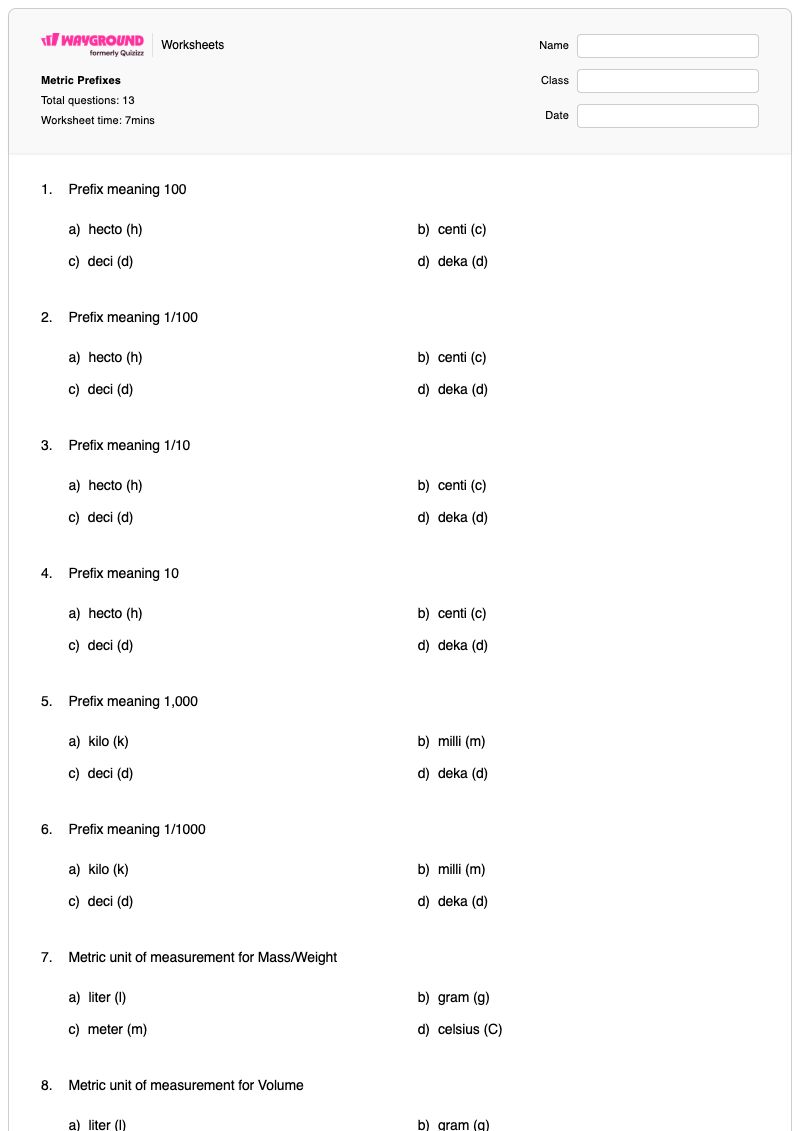
Metric Prefixes is a free printable science worksheet for students in Grades 5–7. It uses 13 multiple-choice questions to build recognition of common metric prefixes and their values, including hecto (100), deka (10), deci (1/10), centi (1/100), kilo (1,000), and milli (1/1,000). Students select the prefix that matches each numerical meaning, strengthening their ability to interpret metric measurements.
The worksheet also reviews the metric units used for mass or weight, volume, length, and temperature. In three additional multiple-choice items, students choose the most appropriate unit—liter, gram, or meter—for a measurement context. This combination helps learners connect metric prefixes with the measurement categories and base units they encounter in science. The worksheet is useful for introducing metric terminology, reviewing before an assessment, or checking individual understanding. It includes a complete answer key for quick, consistent grading.
Worksheet settings
Font size
S
M
L
XL
Worksheets
Metric Prefixes
Total questions: 13
Name
Class
Date
1.
Prefix meaning 100
a)
hecto (h)
b)
centi (c)
c)
deci (d)
d)
deka (d)
2.
Prefix meaning 1/100
a)
hecto (h)
b)
centi (c)
c)
deci (d)
d)
deka (d)
3.
Prefix meaning 1/10
a)
hecto (h)
b)
centi (c)
c)
deci (d)
d)
deka (d)
4.
Prefix meaning 10
a)
hecto (h)
b)
centi (c)
c)
deci (d)
d)
deka (d)
5.
Prefix meaning 1,000
a)
kilo (k)
b)
milli (m)
c)
deci (d)
d)
deka (d)
6.
Prefix meaning 1/1000
a)
kilo (k)
b)
milli (m)
c)
deci (d)
d)
deka (d)
7.
Metric unit of measurement for Mass/Weight
a)
liter (l)
b)
gram (g)
c)
meter (m)
d)
celsius (C)
8.
Metric unit of measurement for Volume
a)
liter (l)
b)
gram (g)
c)
meter (m)
d)
celsius (C)
9.
Metric unit of measurement for Length
a)
liter (l)
b)
gram (g)
c)
meter (m)
d)
celsius (C)
10.
Metric unit of measurement for Temperature
a)
liter (l)
b)
gram (g)
c)
meter (m)
d)
celsius (C)
11.
What unit would best measure this?
a)
liter (l)
b)
gram (g)
c)
meter (m)
d)
celsius (C)
12.
What unit would best measure this?
a)
liter (l)
b)
gram (g)
c)
meter (m)
d)
celsius (C)
13.
What unit would best measure this?
a)
liter (l)
b)
gram (g)
c)
meter (m)
d)
celsius (C)
Answer Key
Metric Prefixes
Total questions: 13
1.
a)
hecto (h)
2.
b)
centi (c)
3.
c)
deci (d)
4.
d)
deka (d)
5.
a)
kilo (k)
6.
b)
milli (m)
7.
b)
gram (g)
8.
a)
liter (l)
9.
c)
meter (m)
10.
d)
celsius (C)
11.
a)
liter (l)
12.
b)
gram (g)
13.
c)
meter (m)
140 %
Browse by subjects
Browse by grades
Browse by format
FAQs
What does the Metric Prefixes worksheet cover?
This Grade 5–7 science worksheet uses 13 multiple-choice questions to assess two connected skills: identifying the values of prefixes such as kilo, hecto, deka, deci, centi, and milli, and selecting metric units for mass, volume, length, and temperature. The final items ask students to choose an appropriate unit in a measurement context, helping them apply terminology rather than only memorize prefix definitions.
How can I use this worksheet to teach metric prefixes and units?
Introduce a metric scale showing how kilo, hecto, deka, the base unit, deci, centi, and milli relate to powers of ten, then have students explain why each prefix matches its numerical value. Before assigning the multiple-choice questions, review the roles of gram, liter, meter, and Celsius and ask students to justify the unit they would use for each of the worksheet’s measurement situations.
What mistakes should I watch for on this metric prefixes worksheet?
Students may reverse a prefix’s meaning, especially confusing centi (1/100) with hecto (100), or deci (1/10) with deka (10). They may also select a unit based on a familiar word instead of the measurement type, such as choosing meter for volume or gram for length, so ask them to identify whether each item concerns mass, volume, length, or temperature before choosing.
How do I assign and grade the Metric Prefixes worksheet?
You can assign this worksheet as a printable PDF or as a digital quiz on Wayground. It includes a complete answer key, and printable submissions can be graded by scanning student work with the Wayground for Teachers app. The printable format also supports classrooms that are reducing screen time.
How can I differentiate this metric prefixes worksheet for my students?
Use the worksheet’s Advanced Settings to adjust font spacing or choose a larger font size so the multiple-choice prefix and metric-unit options are easier to scan. You can also enable a dyslexia-friendly font or translate the worksheet into another language when that better supports students’ access to the terminology.
Where can I find more worksheets like this on Wayground?
Wayground offers a broad collection of free printable worksheets and practice problems across subjects, with downloadable PDFs and answer keys to help students master essential skills and concepts. Browse more resources at https://wayground.com/en-us/worksheets.

 Worksheets

